Virginia SOL LS.11.b
The Standard
- LS.11
- The student will investigate and understand that populations of organisms can change over time. Key ideas include
the fossil record, genetic information, and anatomical comparisons provide evidence for evolution
Virginia Standards of Learning for Science · The student will investigate and understand that populations of organisms can change over time. Key ideas include
Teacher's field guide
What This Standard Means
What Students Need to Do
- Students compare patterns in fossils, DNA or protein sequences, and body structures. They use similarities, differences, and changes over time to support claims about common ancestry and population change.
What Mastery Looks Like
- A student can place fossils in time order and identify how traits changed. The student can use genetic matches and shared body structures to explain which organisms are more closely related.
Common Misconceptions
- Students may think individual organisms evolve during their lifetimes. They may treat the fossil record as complete or view evolution as a straight line. They may assume any similar-looking structure proves close ancestry.
How to Assess It
- Show students a fossil sequence, a short DNA comparison table, and two forelimb diagrams. Ask, “Which organisms are most closely related, and what two pieces of evidence support your claim?”
Lesson moves
Ways to Teach It
Have groups arrange fossil cards by rock layer, then mark which traits appear, persist, or disappear over time.
Ask students to write: Which evidence best supports common ancestry, and how could two sources strengthen the same claim?
Play an evidence-sort relay where teams classify cards as fossil, genetic, shared anatomy, or misleading surface similarity.
Compare flu virus sequence snapshots from several years and explain why vaccines are updated as populations change.
Free download
Printable LS.11.b Worksheet
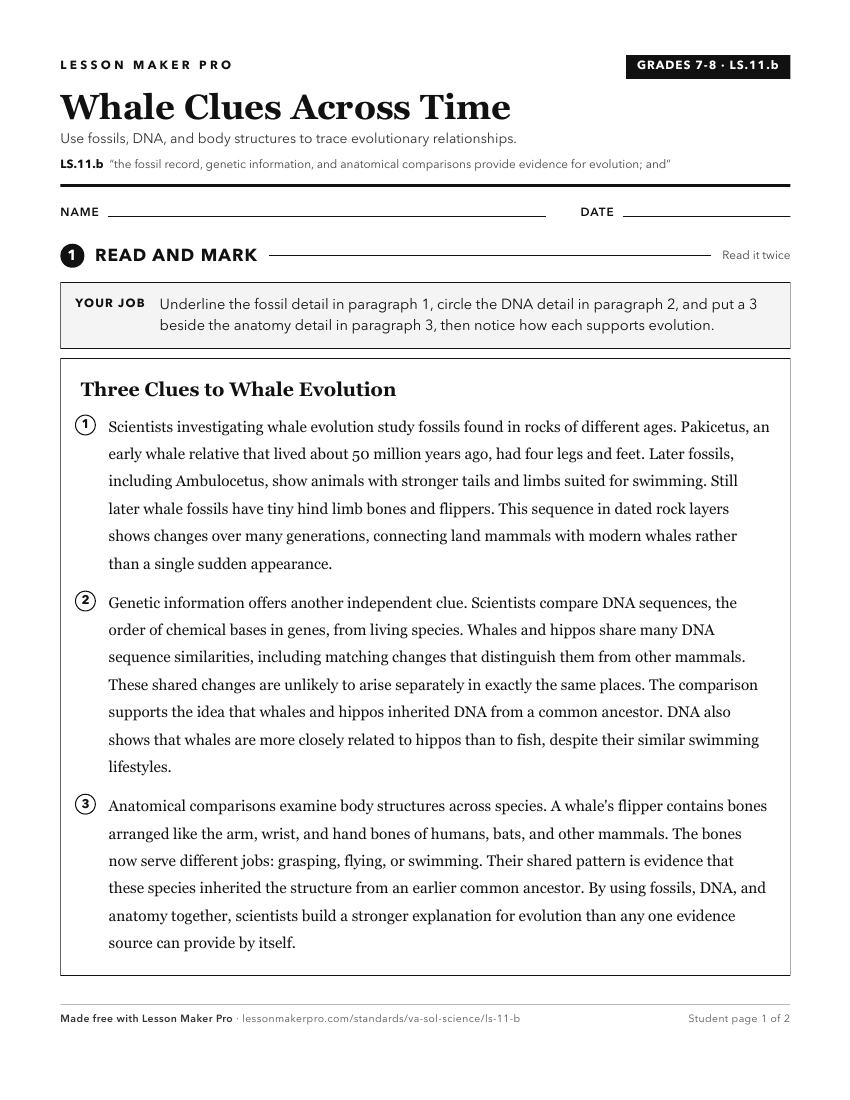
A ready-to-print activity worksheet aligned to LS.11.b, with an answer key for the teacher on its own page. No account needed.
PDF, US Letter, prints cleanly in black and white.
Download the worksheetKeep exploring
Related Standards
- LS.3.c
similar characteristics determine the classification of organisms.
- 5.8.e
fossils and geologic patterns provide evidence of Earth's change.
- 3.4.c
fossils provide evidence about the types of organisms that lived long ago as well as the nature of their environments.
- LS.3.b
unicellular and multicellular organisms have comparative structures
Turn this exact standard into a lesson
Grade, subject, topic, and the complete standard are prefilled. Create one free, no account needed.
Also for this standard:Make a WorksheetMake a QuizMake a Sub Lesson