Virginia SOL K.5.a
The Standard
- K.5
- The students will investigate and understand that senses allow humans to seek, find, take in, and react or respond to different information. Key ideas include
the five basic senses correspond to specific human body structures
Virginia Standards of Learning for Science
Teacher's field guide
What This Standard Means
What Students Need to Do
- Students match sight, hearing, smell, taste, and touch to the body parts used for each sense. They name eyes, ears, nose, tongue, and skin.
What Mastery Looks Like
- A student correctly pairs each sense with its body part. The student can explain the match using a simple example, such as using ears to hear a bell.
Common Misconceptions
- Students may say hands are the only body parts used for touch instead of recognizing skin. They may also mix up taste and smell because both help identify food.
How to Assess It
- Give students pictures of eyes, ears, a nose, a tongue, and skin. Ask them to draw a line from each picture to its sense.
Lesson moves
Ways to Teach It
Set up stations with a bell, textured cloth, scent jar, picture card, and approved cracker for students to identify the sense used.
Ask, “Which body part helps you know popcorn is nearby before you see it?” and have students explain their answer.
Play a matching game with cards showing body parts, senses, and objects such as drums, flowers, lemons, and feathers.
Take a short school walk and have students name what they see, hear, smell, and feel using each body part.
Free download
Printable K.5.a Worksheet
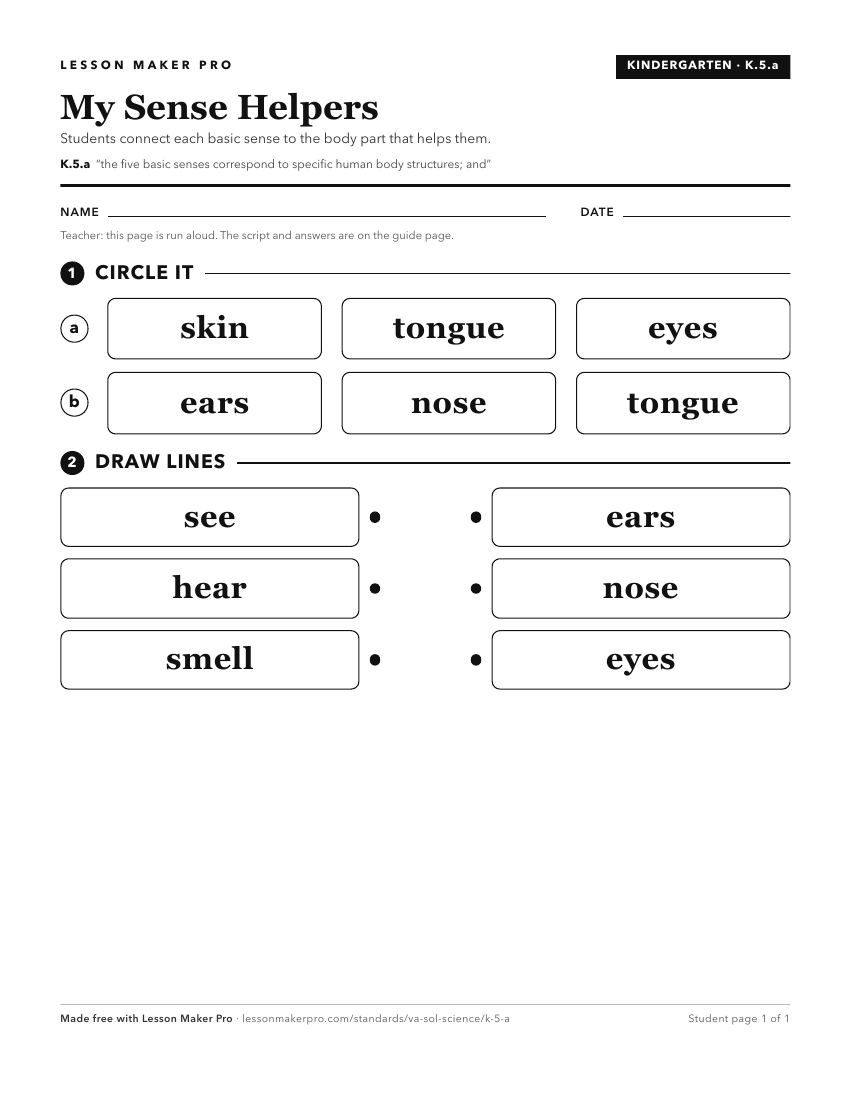
A ready-to-print activity worksheet aligned to K.5.a, with an answer key for the teacher on its own page. No account needed.
PDF, US Letter, prints cleanly in black and white.
Download the worksheetKeep exploring
Related Standards
- K.5
The students will investigate and understand that senses allow humans to seek, find, take in, and react or respond to different information. Key ideas include
- LS.3.a
patterns of cellular organization support life processes
- K.5.b
senses are used in our daily lives.
- 1.5.b
animals have different physical characteristics that perform specific functions
Turn this exact standard into a lesson
Grade, subject, topic, and the complete standard are prefilled. Create one free, no account needed.
Also for this standard:Make a WorksheetMake a QuizMake a Sub Lesson