Virginia SOL 1.5.b
The Standard
- 1.5
- The student will investigate and understand that animals, including humans, have basic life needs that allow them to survive. Key ideas include
animals have different physical characteristics that perform specific functions
Virginia Standards of Learning for Science
Teacher's field guide
What This Standard Means
What Students Need to Do
- Students observe an animal’s body parts, coverings, and shapes. They explain how a feature helps the animal move, eat, stay safe, or live in its habitat.
What Mastery Looks Like
- Given an animal picture, students can name a visible feature and tell its job. They can support the explanation with a clear example, such as webbed feet helping a duck swim.
Common Misconceptions
- Students may name a habitat or behavior instead of a physical feature. They may describe what a feature looks like without explaining its job, or assume similar features always have the same use.
How to Assess It
- Show a picture of a turtle. Ask students to point to one physical feature and complete: “The turtle’s ___ helps it ___.”
Lesson moves
Ways to Teach It
Let students handle feathers, faux fur, and plastic shell models, then match each covering to protection, warmth, or movement.
Show a woodpecker and duck, then ask: “How does each bird’s beak help it get food?”
Play a card match game pairing animal features, such as claws or fins, with the jobs they perform.
Observe birds outside and record one visible body part that helps each bird move, eat, or stay safe.
Free download
Printable 1.5.b Worksheet
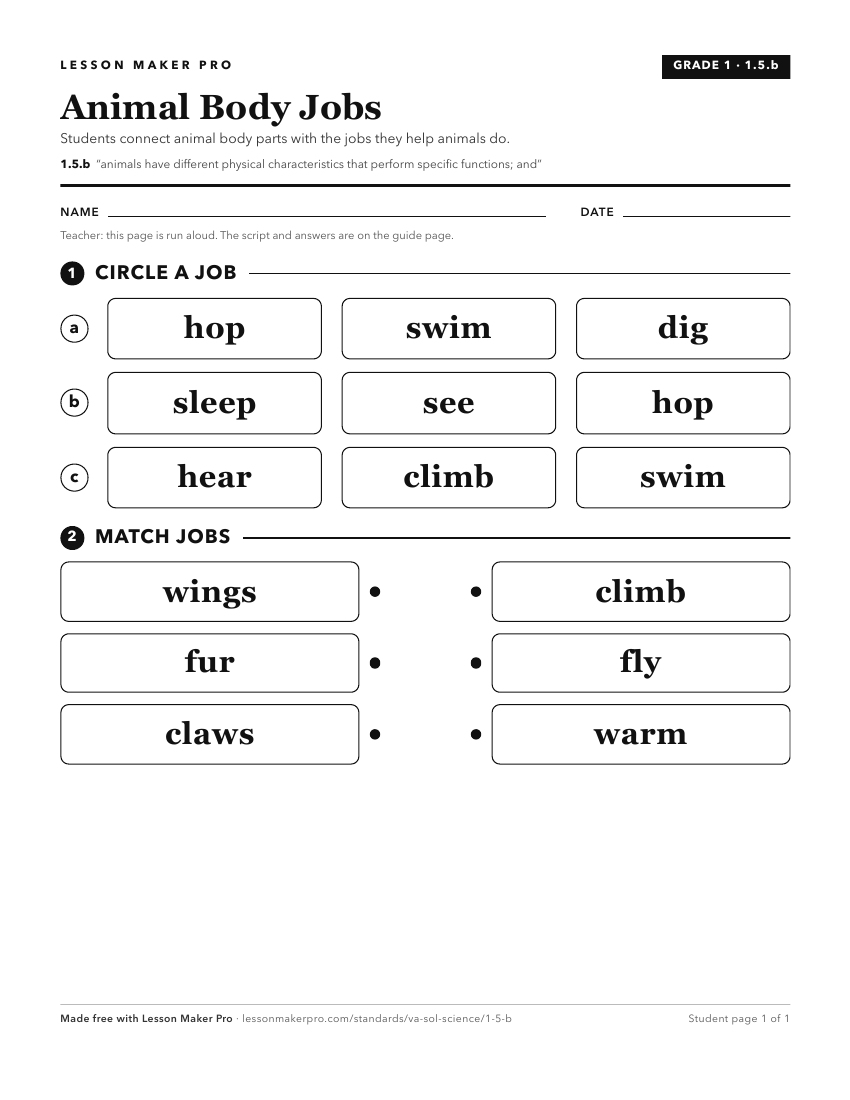
A ready-to-print activity worksheet aligned to 1.5.b, with an answer key for the teacher on its own page. No account needed.
PDF, US Letter, prints cleanly in black and white.
Download the worksheetKeep exploring
Related Standards
Turn this exact standard into a lesson
Grade, subject, topic, and the complete standard are prefilled. Create one free, no account needed.
Also for this standard:Make a WorksheetMake a QuizMake a Sub Lesson