Virginia SOL 5.1.e.ii
The Standard
- 5.1
- The student will demonstrate an understanding of scientific and engineering practices by
developing and using models identify limitations of models
Virginia Standards of Learning for Science · The student will demonstrate an understanding of scientific and engineering practices by
Teacher's field guide
What This Standard Means
What Students Need to Do
- Students compare a model with the object, system, or process it represents. They identify what the model leaves out, changes, or cannot show. They explain how that limit affects the model’s use.
What Mastery Looks Like
- Students can name a specific missing or inaccurate feature in a diagram, physical model, or simulation. They can explain when the model is useful despite that limit.
Common Misconceptions
- Students may think models are exact copies of real objects or systems. They may assume a model is useless if it has a limitation. They may also overlook incorrect scale, color, movement, or missing parts.
How to Assess It
- Show students a water cycle diagram. Ask them to name one feature it explains well and one process it cannot show accurately.
Lesson moves
Ways to Teach It
Build a clay solar system on index cards, then label where size, distance, color, or motion is inaccurate.
Compare a globe and world map, then discuss which features each represents well and which features each distorts.
Give pairs four model cards and have them play Limitation Detective by naming one missing or inaccurate feature on each card.
Compare tomorrow’s local weather forecast with observed conditions, then identify one reason the forecast model may not match exactly.
Free download
Printable 5.1.e.ii Worksheet
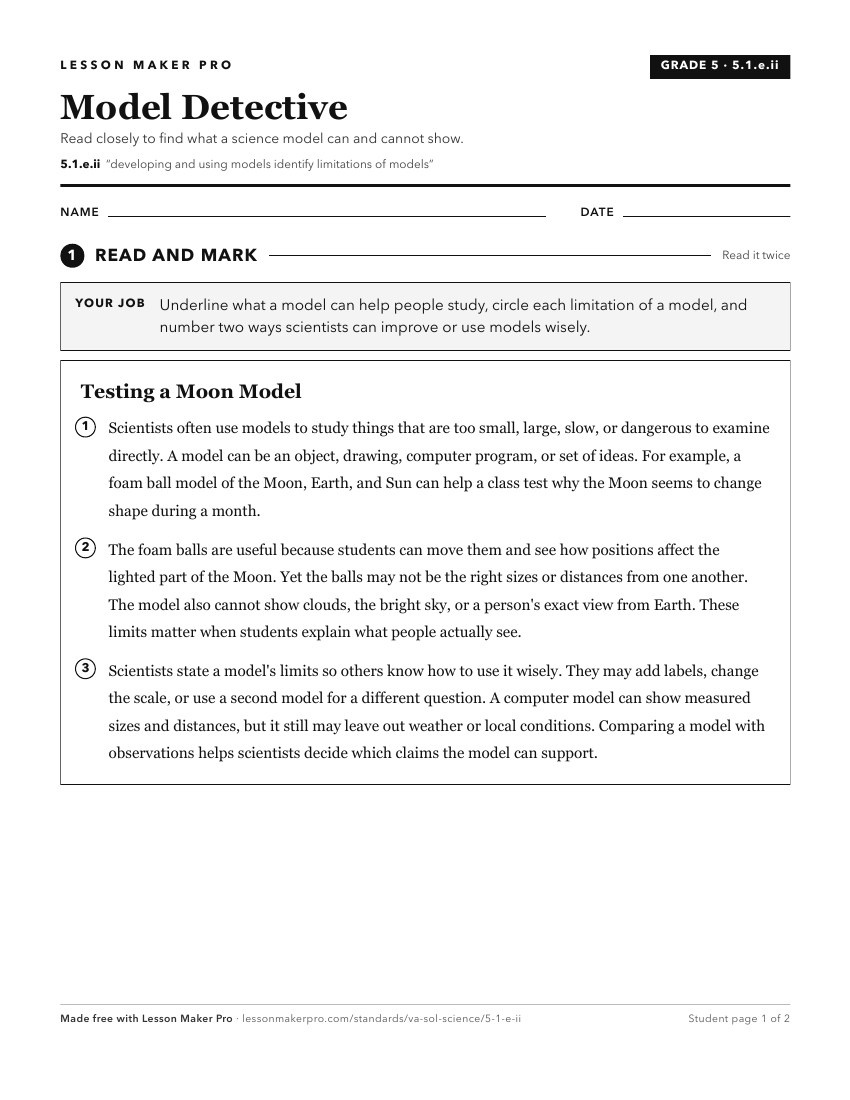
A ready-to-print activity worksheet aligned to 5.1.e.ii, with an answer key for the teacher on its own page. No account needed.
PDF, US Letter, prints cleanly in black and white.
Download the worksheetKeep exploring
Related Standards
Turn this exact standard into a lesson
Grade, subject, topic, and the complete standard are prefilled. Create one free, no account needed.
Also for this standard:Make a WorksheetMake a QuizMake a Sub Lesson