Virginia SOL 5.1.e.i
The Standard
- 5.1
- The student will demonstrate an understanding of scientific and engineering practices by
developing and using models develop models using an analogy, example, or abstract representation to describe a scientific principle or design solution
Virginia Standards of Learning for Science · The student will demonstrate an understanding of scientific and engineering practices by
Teacher's field guide
What This Standard Means
What Students Need to Do
- Students create a physical object, diagram, or comparison that shows how a system works or how a solution could work. They choose useful details and identify ways the model differs from the real thing.
What Mastery Looks Like
- A student can create a labeled model whose parts and relationships match the idea or solution being shown. The student uses it to explain what may happen, names its limits, and revises it when evidence changes.
Common Misconceptions
- Students may treat a model as a decorative copy, include every detail, or assume every model must be three-dimensional. They may think an analogy is exact and overlook missing parts, scale problems, or other limits.
How to Assess It
- Exit ticket: Draw and label a model showing how water moves through a closed terrarium. Use arrows for movement, then name one way the model differs from a real ecosystem.
Lesson moves
Ways to Teach It
Use cups, straws, tape, and water to build a leak-resistant model of a town water system, then mark what each part represents.
Write two ways a cell is like a factory and one place where the comparison breaks down.
Play Model Match by pairing cards showing scientific systems with diagrams, comparisons, or prototypes, then defend each match.
Study a school evacuation map, then redraw it to show a blocked exit and explain how the model guides a safer route.
Free download
Printable 5.1.e.i Worksheet
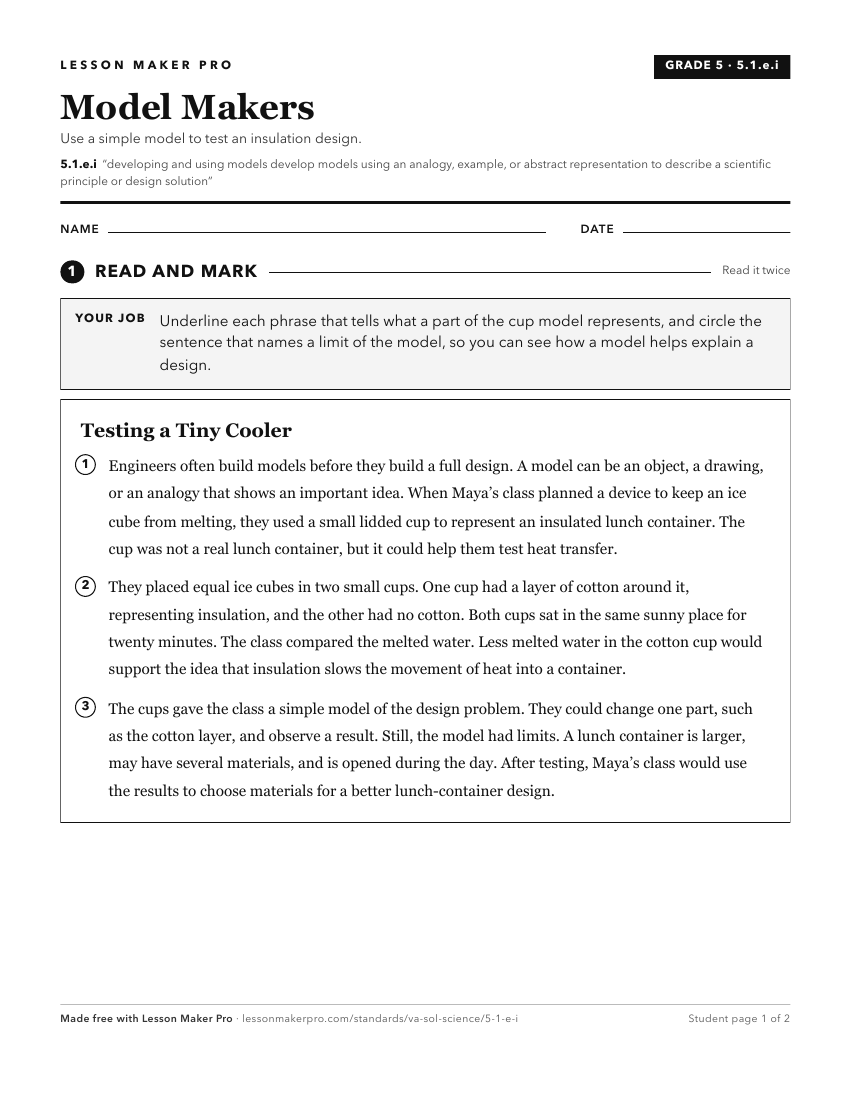
A ready-to-print activity worksheet aligned to 5.1.e.i, with an answer key for the teacher on its own page. No account needed.
PDF, US Letter, prints cleanly in black and white.
Download the worksheetKeep exploring
Related Standards
- 3.1.e.ii
develop a model (e.g., diagram or simple physical prototype) to illustrate a proposed object, tool, or process
- PS.1.e.i
construct, develop, and use models and simulations to illustrate and/or explain observable and unobservable phenomena
- LS.1.e.i
construct and use models and simulations to illustrate, predict, and/or explain observable and unobservable phenomena, life processes, or mechanisms
- 4.1.e.i
develop and/or use models to explain natural phenomena
Turn this exact standard into a lesson
Grade, subject, topic, and the complete standard are prefilled. Create one free, no account needed.
Also for this standard:Make a WorksheetMake a QuizMake a Sub Lesson