Virginia SOL 2.6.a
The Standard
- 2.6
- The student will investigate and understand that there are different types of weather on Earth. Key ideas include
different types of weather have specific characteristics
Virginia Standards of Learning for Science
Teacher's field guide
What This Standard Means
What Students Need to Do
- Students observe conditions such as cloud cover, precipitation, wind, and temperature. They use those observations to identify and compare kinds of weather.
What Mastery Looks Like
- Students can name the weather shown in a picture or short description and cite two visible clues. They can explain how rainy, snowy, windy, cloudy, and sunny conditions differ.
Common Misconceptions
- Students may confuse weather with seasons or assume sunny always means hot. They may call dark clouds rain, even when no precipitation is falling.
How to Assess It
- Show three weather pictures and ask: “Name each kind of weather and write one observation that supports your answer.”
Lesson moves
Ways to Teach It
Set up stations with a thermometer, windsock, rain gauge, and cloud chart, then have students record outdoor observations.
Ask students to compare a rainy day and a snowy day using the sentence frame, “Both have ___, but only ___ has ___.”
Play Weather Clue Match by pairing condition cards, such as strong wind or falling snow, with the correct weather picture.
Read a local weather report and have students choose suitable clothing and explain their choices using two reported conditions.
Free download
Printable 2.6.a Worksheet
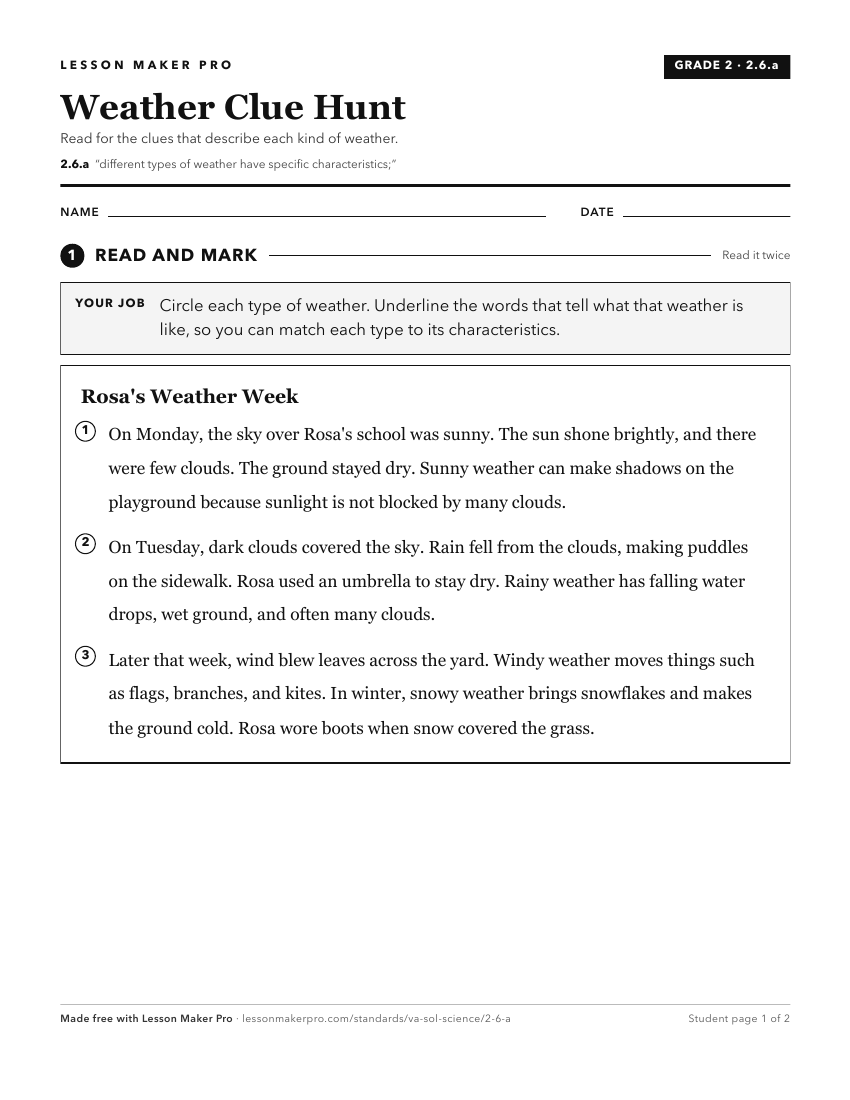
A ready-to-print activity worksheet aligned to 2.6.a, with an answer key for the teacher on its own page. No account needed.
PDF, US Letter, prints cleanly in black and white.
Download the worksheetKeep exploring
Related Standards
- 1.7.b
there are relationships between daily weather and the season
- 2.6.b
measuring, recording, and interpreting weather data allows for identification of weather patterns
- 2.6
The student will investigate and understand that there are different types of weather on Earth. Key ideas include
- 6.7.b
the atmosphere has physical characteristics
Turn this exact standard into a lesson
Grade, subject, topic, and the complete standard are prefilled. Create one free, no account needed.
Also for this standard:Make a WorksheetMake a QuizMake a Sub Lesson