Virginia SOL 2.NS.2
SOL Standard (Knowledge and Skills Cluster)
The student will demonstrate an understanding of the ten-to-one relationships of the base 10 number system to represent, compare, and order whole numbers up to 999. Write the three-digit whole number represented by a given model (e.g., concrete objects, pictures of base 10 blocks). Read, write, and represent three-digit numbers in standard form, expanded form, and word form, using concrete or pictorial representations. Apply patterns within the base 10 system to determine and communicate, orally and in written form, the place (ones, tens, hundreds) and value of each digit in a three-digit whole number (e.g., in 352, the 5 represents 5 tens and its value is 50). Investigate and explain the ten-to-one relationships among ones, tens, and hundreds, using models. Compose and decompose whole numbers up to 200 by making connections between a variety of models (e.g., base 10 blocks, place value cards, presented orally, in expanded or standard form) and counting strategies (e.g., 156 can be 1 hundred, 5 tens, 6 ones; 1 hundred, 4 tens, 16 ones; 15 tens, 6 ones). Plot and justify the position of a given number up to 100 on a number line with pre-marked benchmarks of 1s, 2s, 5s, 10s, or 25s. Compare two whole numbers, each 999 or less, represented concretely, pictorially, or symbolically, using words (greater than, less than, or equal to) and symbols (>, <, or =). Justify reasoning orally, in writing, or with a model. Order up to three whole numbers, each 999 or less, represented concretely, pictorially, or symbolically from least to greatest and greatest to least.
Virginia Standards of Learning for Mathematics
Cluster contents
Knowledge and Skills in This Standard
2.NS.2 is a Standards of Learning standard. These are the knowledge and skills expectations under it.
- 2.NS.2.a
Write the three-digit whole number represented by a given model (e.g., concrete objects, pictures of base 10 blocks).
- 2.NS.2.b
Read, write, and represent three-digit numbers in standard form, expanded form, and word form, using concrete or pictorial representations.
- 2.NS.2.c
Apply patterns within the base 10 system to determine and communicate, orally and in written form, the place (ones, tens, hundreds) and value of each digit in a...
- 2.NS.2.d
Investigate and explain the ten-to-one relationships among ones, tens, and hundreds, using models.
- 2.NS.2.e
Compose and decompose whole numbers up to 200 by making connections between a variety of models (e.g., base 10 blocks, place value cards, presented orally, in e...
- 2.NS.2.f
Plot and justify the position of a given number up to 100 on a number line with pre-marked benchmarks of 1s, 2s, 5s, 10s, or 25s.
- 2.NS.2.g
Compare two whole numbers, each 999 or less, represented concretely, pictorially, or symbolically, using words (greater than, less than, or equal to) and symbol...
- 2.NS.2.h
Order up to three whole numbers, each 999 or less, represented concretely, pictorially, or symbolically from least to greatest and greatest to least.
Teacher's field guide
What This Cluster Means
What Students Need to Do
- Students read, build, write, and break apart numbers through 999 using hundreds, tens, and ones. They explain why each digit has its value and how ten smaller units make one larger unit. They compare and order numbers and place numbers through 100 on marked number lines.
What Mastery Looks Like
- Students move accurately among block models, number words, expanded form, and standard form. They regroup hundreds, tens, and ones without changing the total. They compare, order, and locate numbers, then explain their reasoning with place values or benchmarks.
Common Misconceptions
- Students may read 306 as 36 or write it as 300 + 60. They may name a digit but not its value, such as saying the 5 in 352 is worth 5. Some think regrouping changes the number, compare only the ones digits, or count number line marks instead of intervals.
How to Assess It
- Exit ticket: Draw 1 hundred flat, 7 ten rods, and 4 ones, then ask students to write the number in three forms and decompose it two ways. Have them compare 174 and 147, then place 74 on a number line marked by tens.
Lesson moves
Ways to Teach It
Give pairs base 10 blocks and place value mats; students build 156 in three different ways and label each representation.
Post 352 and 523, then have students explain in writing how each digit 5 gets its value.
Play Place Value War: partners draw three digit cards, build numbers, compare with >, <, or =, and explain the winning number.
Use classroom supply counts, such as 128 pencils, 95 markers, and 210 sheets, then order the quantities and justify the order.
Free download
Printable 2.NS.2 Worksheet
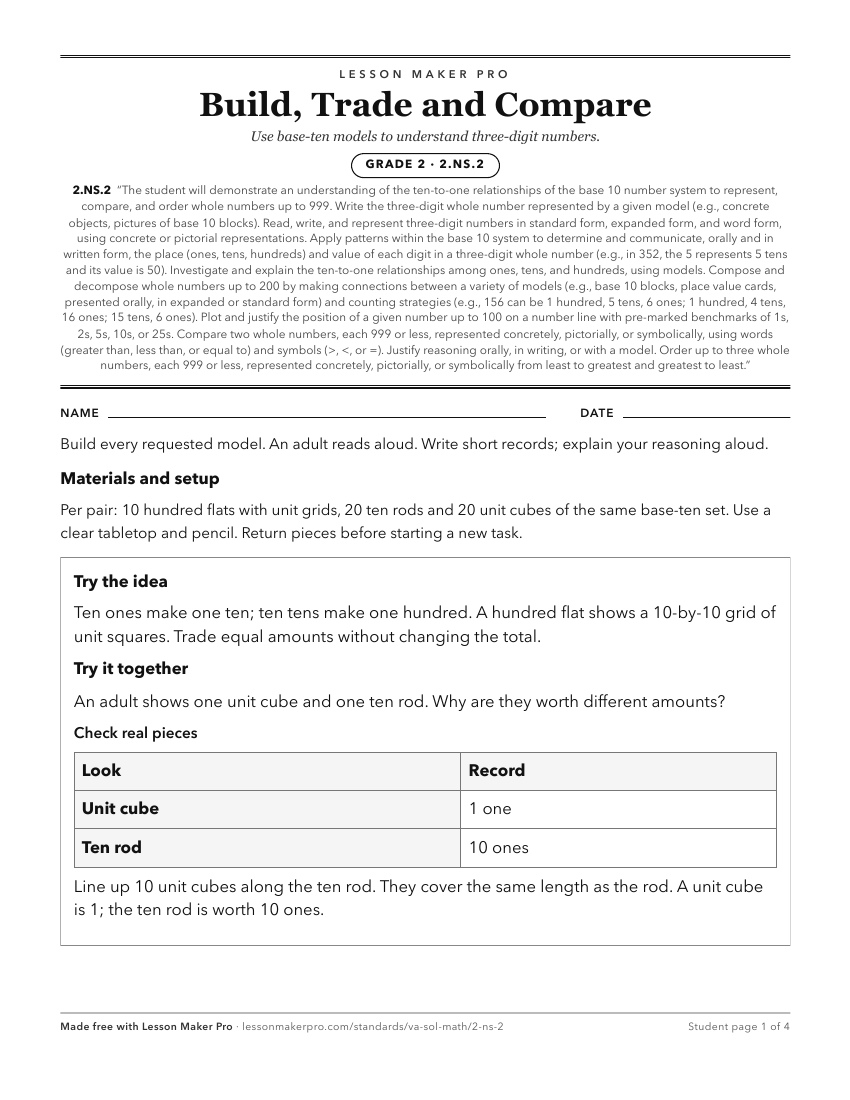
A ready-to-print activity worksheet aligned to 2.NS.2, with an answer key for the teacher on its own page. No account needed.
PDF, US Letter, prints cleanly in black and white.
Download the worksheetKeep exploring
Related Standards
- 3.NS.2
The student will demonstrate an understanding of the base 10 system to compare and order whole numbers up to 9,999.
- 4.NS.2
The student will demonstrate an understanding of the base 10 system to compare and order whole numbers up to seven digits.
- 7.NS.1
The student will investigate and describe the concept of exponents for powers of ten and compare and order numbers greater than zero written in scientific notat...
- 4.NS.1
The student will use place value understanding to read, write, and identify the place and value of each digit in a nine-digit whole number.
Turn this cluster into a lesson
Grade, subject, topic, and the complete cluster are prefilled. Create one free, no account needed.
Also for this cluster:Make a WorksheetMake a QuizMake a Sub Lesson