Virginia SOL 2.NS.2.d
The Standard
Investigate and explain the ten-to-one relationships among ones, tens, and hundreds, using models.
Virginia Standards of Learning for Mathematics · The student will demonstrate an understanding of the ten-to-one relationships of the base 10 number system to represent, compare, and order whole numbers up to 999.
Teacher's field guide
What This Standard Means
What Students Need to Do
- Students use blocks, drawings, or bundled objects to show how ones, tens, and hundreds are related. They explain that 10 of one unit can be exchanged for one of the next larger unit.
What Mastery Looks Like
- Students correctly build and read numbers with hundreds, tens, and ones. They can exchange 10 ones for one ten or 10 tens for one hundred without changing the total.
Common Misconceptions
- Students may think one ten rod equals one unit because each is a single object. They may also believe trading pieces changes the total or confuse a digit with its value.
How to Assess It
- Ask students to model 134, then trade one ten for 10 ones and draw both models. Have them explain why the total stays the same.
Lesson moves
Ways to Teach It
Give pairs base-ten blocks and number cards, then have them build each number and make every possible exchange.
Ask students to explain: How can 10 small cubes have the same value as one ten rod?
Play an exchange race where students roll dice, collect ones, and trade whenever they reach 10 pieces.
Model a store inventory with loose pencils, packs of 10, and boxes of 100, then represent several totals.
Free download
Printable 2.NS.2.d Worksheet
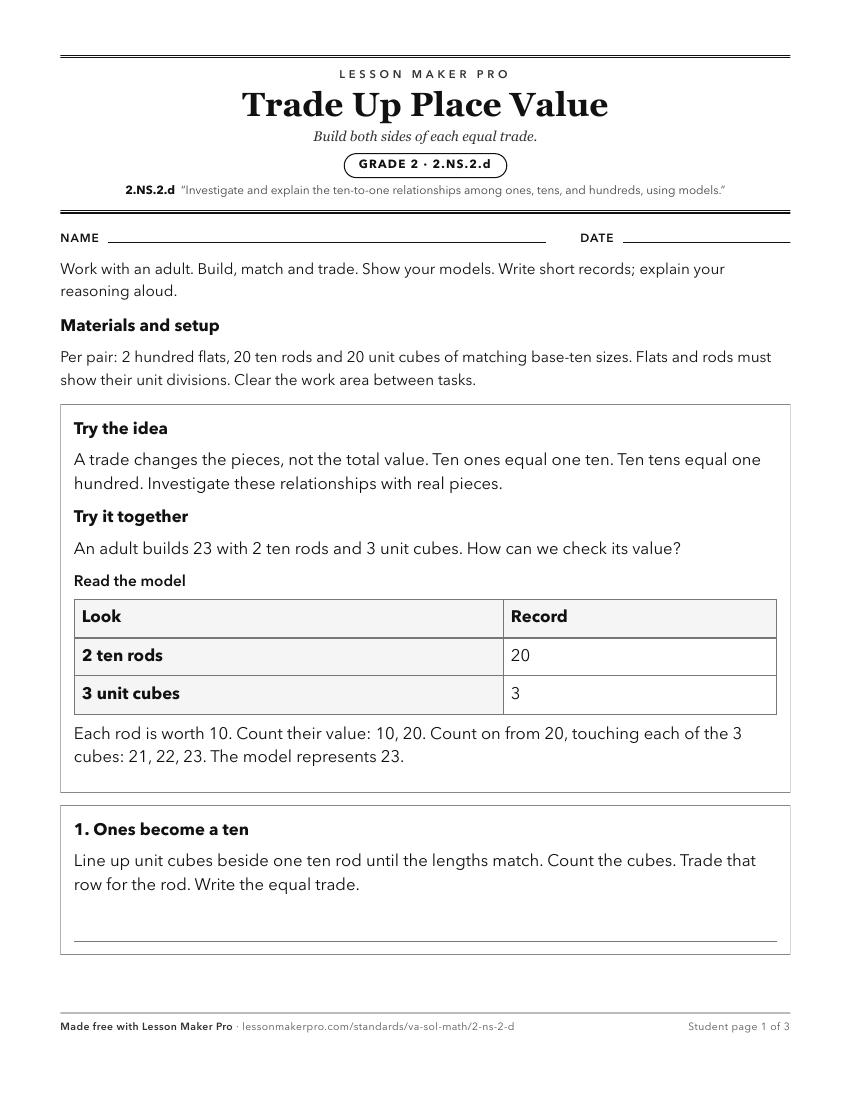
A ready-to-print activity worksheet aligned to 2.NS.2.d, with an answer key for the teacher on its own page. No account needed.
PDF, US Letter, prints cleanly in black and white.
Download the worksheetKeep exploring
Related Standards
- 2.NS.2
The student will demonstrate an understanding of the ten-to-one relationships of the base 10 number system to represent, compare, and order whole numbers up to ...
- 4.NS.4.a
Investigate and describe the ten-to-one place value relationship for decimals through thousandths, using concrete models (e.g., place value mats/charts, decimal...
- 1.CE.1.d
Investigate, recognize, and describe part-part-whole relationships for numbers up to 20 in a variety of configurations (e.g., beaded racks, double ten frames).
- 2.NS.2.e
Compose and decompose whole numbers up to 200 by making connections between a variety of models (e.g., base 10 blocks, place value cards, presented orally, in e...
Turn this exact standard into a lesson
Grade, subject, topic, and the complete standard are prefilled. Create one free, no account needed.
Also for this standard:Make a WorksheetMake a QuizMake a Sub Lesson