Virginia SOL 1.CE.1.d
The Standard
Investigate, recognize, and describe part-part-whole relationships for numbers up to 20 in a variety of configurations (e.g., beaded racks, double ten frames).
Virginia Standards of Learning for Mathematics · The student will recall with automaticity addition and subtraction facts within 10 and represent, solve, and justify solutions to single-step problems, including those in context, using addition and subtraction with whole numbers within 20.
Teacher's field guide
What This Standard Means
What Students Need to Do
- Students split a whole number into two smaller parts and name each part. They use objects or pictures to find different pairs that make the same whole and explain their thinking.
What Mastery Looks Like
- Given a beaded rack, ten frames, or counters, students correctly name both parts and the whole. They can show several ways to break apart one number and explain why the total stays the same.
Common Misconceptions
- Students may name one part as the whole or count the same object twice. They may think moving objects changes the total, or miss that 7 and 5 make the same whole as 5 and 7.
How to Assess It
- Show 13 as 8 red beads and 5 white beads. Ask students to draw a number bond, write 8 + 5 = 13, and label both parts and the whole.
Lesson moves
Ways to Teach It
Give students 16 two-color counters to shake, spill, sort by color, and record each pair in a number bond.
Display 12 on two ten frames and ask, "What parts do you see, and how do you know the whole is 12?"
Play Make My Number: call a whole up to 20, then partners race to build and record three different part pairs.
Set out 15 classroom supplies, sort them into two groups by type or color, and write the matching part-part-whole equation.
Free download
Printable 1.CE.1.d Worksheet
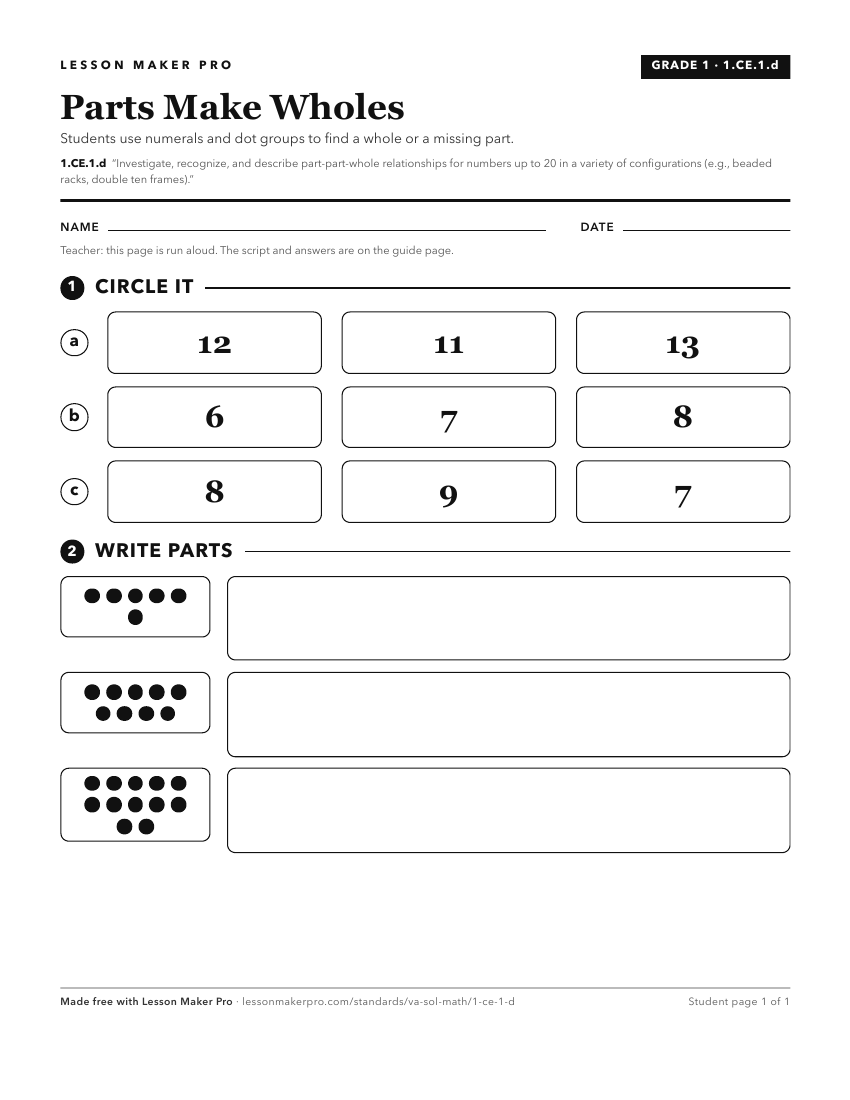
A ready-to-print activity worksheet aligned to 1.CE.1.d, with an answer key for the teacher on its own page. No account needed.
PDF, US Letter, prints cleanly in black and white.
Download the worksheetKeep exploring
Related Standards
- 2.NS.2.d
Investigate and explain the ten-to-one relationships among ones, tens, and hundreds, using models.
- K.CE.1.b
Recognize and describe with fluency part-part-whole relationships for numbers up to 5 in a variety of configurations.
- 4.NS.4.a
Investigate and describe the ten-to-one place value relationship for decimals through thousandths, using concrete models (e.g., place value mats/charts, decimal...
- 1.CE.1.a
Recognize and describe with fluency part-part-whole relationships for numbers up to 10 in a variety of configurations.
Turn this exact standard into a lesson
Grade, subject, topic, and the complete standard are prefilled. Create one free, no account needed.
Also for this standard:Make a WorksheetMake a QuizMake a Sub Lesson