Virginia SOL 1.CE.1.a
The Standard
Recognize and describe with fluency part-part-whole relationships for numbers up to 10 in a variety of configurations.
Virginia Standards of Learning for Mathematics · The student will recall with automaticity addition and subtraction facts within 10 and represent, solve, and justify solutions to single-step problems, including those in context, using addition and subtraction with whole numbers within 20.
Teacher's field guide
What This Standard Means
What Students Need to Do
- Students identify two parts and the whole in groups of up to 10 without counting each object one by one. They explain the relationship with words, objects, drawings, or equations.
What Mastery Looks Like
- Students quickly identify the whole and its two parts in dot cards, ten-frames, pictures, and objects. They describe several ways to break apart the same number and write matching equations.
Common Misconceptions
- Students may recount every object instead of recognizing familiar groups. They may reverse the whole and a part, or think a number has only one pair of parts.
How to Assess It
- Show a ten-frame with 7 counters, 5 red and 2 blue. Ask students to name the whole, both parts, and write two matching equations.
Lesson moves
Ways to Teach It
Give students 10 counters and two cups; call a number, then have them split that amount between the cups and record it.
Show 8 as 6 red dots and 2 blue dots; ask, “What are the parts and whole, and how do you know?”
Play Make My Number: students turn over two number cards and keep pairs that combine to the target number.
Use a carton holding 10 eggs; cover some spaces and ask students to identify the filled part, empty part, and whole.
Free download
Printable 1.CE.1.a Worksheet
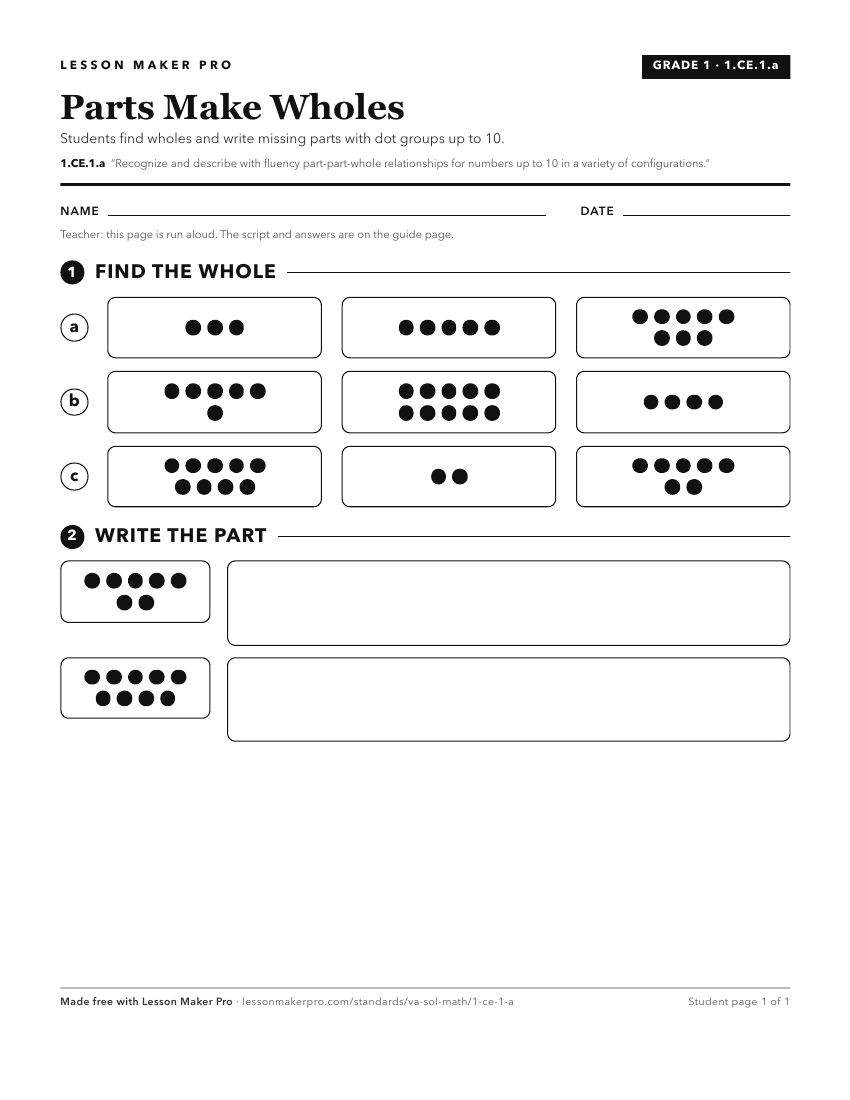
A ready-to-print activity worksheet aligned to 1.CE.1.a, with an answer key for the teacher on its own page. No account needed.
PDF, US Letter, prints cleanly in black and white.
Download the worksheetKeep exploring
Related Standards
- K.CE.1.b
Recognize and describe with fluency part-part-whole relationships for numbers up to 5 in a variety of configurations.
- 1.CE.1.b
Demonstrate fluency with addition and subtraction within 10 by applying reasoning strategies (e.g., count on/count back, one more/one less, doubles, make ten).
- 3.NS.1.c
Compose, decompose, and represent numbers up to 9,999 in multiple ways, according to place value (e.g., 256 can be 1 hundred, 14 tens, 16 ones, but also 25 tens...
- 1.CE.1.d
Investigate, recognize, and describe part-part-whole relationships for numbers up to 20 in a variety of configurations (e.g., beaded racks, double ten frames).
Turn this exact standard into a lesson
Grade, subject, topic, and the complete standard are prefilled. Create one free, no account needed.
Also for this standard:Make a WorksheetMake a QuizMake a Sub Lesson