Virginia SOL WG.11.d
The Standard
- WG.11
- The student will analyze the characteristics of the Australian and Pacific Islands regions by
explaining important economic characteristics, including the distribution of economic activities and global trade.
Virginia Standards of Learning for History and Social Science · The student will analyze the characteristics of the Australian and Pacific Islands regions by
Teacher's field guide
What This Standard Means
What Students Need to Do
- Students locate major economic activities across Australia and the Pacific Islands. They explain how resources, climate, population, and access to trade routes shape mining, farming, fishing, tourism, and trade.
What Mastery Looks Like
- Students accurately connect economic activities to specific places, such as mining in Western Australia or tourism in Fiji. They can identify major exports and explain why island economies often depend on imports.
Common Misconceptions
- Students may treat Australia and all Pacific islands as one similar economy. They may also assume small islands produce everything they need or overlook services, tourism, remittances, and imported goods.
How to Assess It
- Give students a blank regional map and this prompt: Label two economic activities and explain how one of them connects the region to global trade.
Lesson moves
Ways to Teach It
Give groups resource, product, and location cards to place on a map, then have them explain each match.
Ask students to write which matters more to Fiji, tourism or farming, using two pieces of geographic evidence.
Play a trade matching game where students pair Australia, Fiji, and New Zealand with likely exports, imports, and trading partners.
Examine labels on classroom products, then trace one item from Australia or a Pacific nation through the global trade network.
Free download
Printable WG.11.d Worksheet
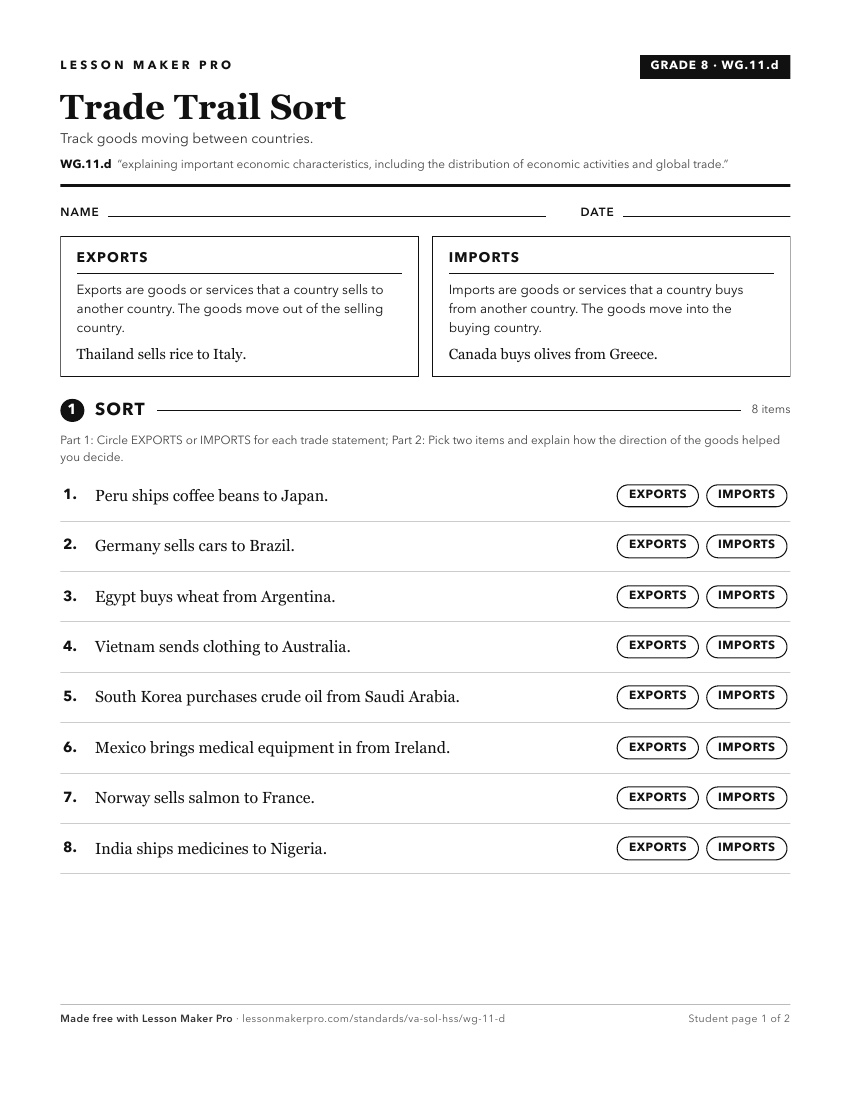
A ready-to-print activity worksheet aligned to WG.11.d, with an answer key for the teacher on its own page. No account needed.
PDF, US Letter, prints cleanly in black and white.
Download the worksheetKeep exploring
Related Standards
Turn this exact standard into a lesson
Grade, subject, topic, and the complete standard are prefilled. Create one free, no account needed.
Also for this standard:Make a WorksheetMake a QuizMake a Sub Lesson