Virginia SOL CE.1.f
The Standard
- CE.1
- The student will apply history and social science skills to explain the foundations of the American constitutional democracy by
describing the procedures for amending the Constitution of Virginia and the Constitution of the United States.
Virginia Standards of Learning for History and Social Science · The student will apply history and social science skills to explain the foundations of the American constitutional democracy by
Teacher's field guide
What This Standard Means
What Students Need to Do
- Students sequence the proposal and ratification steps for both constitutions. They identify who acts at each stage and the required vote thresholds. They compare federal ratification by states with Virginia ratification by voters.
What Mastery Looks Like
- A student can explain both federal proposal methods and both ratification methods, including the two-thirds and three-fourths thresholds. The student can sequence Virginia’s two legislative approvals, separated by a House election, followed by voter ratification. They can also identify a convention as another proposal route.
Common Misconceptions
- Students often think the president or governor signs constitutional amendments. They may confuse a simple majority with the federal two-thirds and three-fourths thresholds. Some miss Virginia’s second legislative approval or assume citizens vote directly on federal amendments.
How to Assess It
- Exit ticket: Draw two labeled flowcharts, one federal and one Virginia. Include who proposes, required thresholds, who ratifies, and Virginia’s election between legislative approvals.
Lesson moves
Ways to Teach It
Give pairs mixed step cards for both constitutions, then have them build and label two amendment process flowcharts.
Ask students to write which process gives voters a direct role, using one step from each process as evidence.
Run a threshold game where groups decide whether sample vote totals meet two-thirds, three-fourths, or Virginia majority requirements.
Trace the Twenty-Sixth Amendment and Virginia’s 2020 redistricting amendment from proposal through ratification using official timelines.
Free download
Printable CE.1.f Worksheet
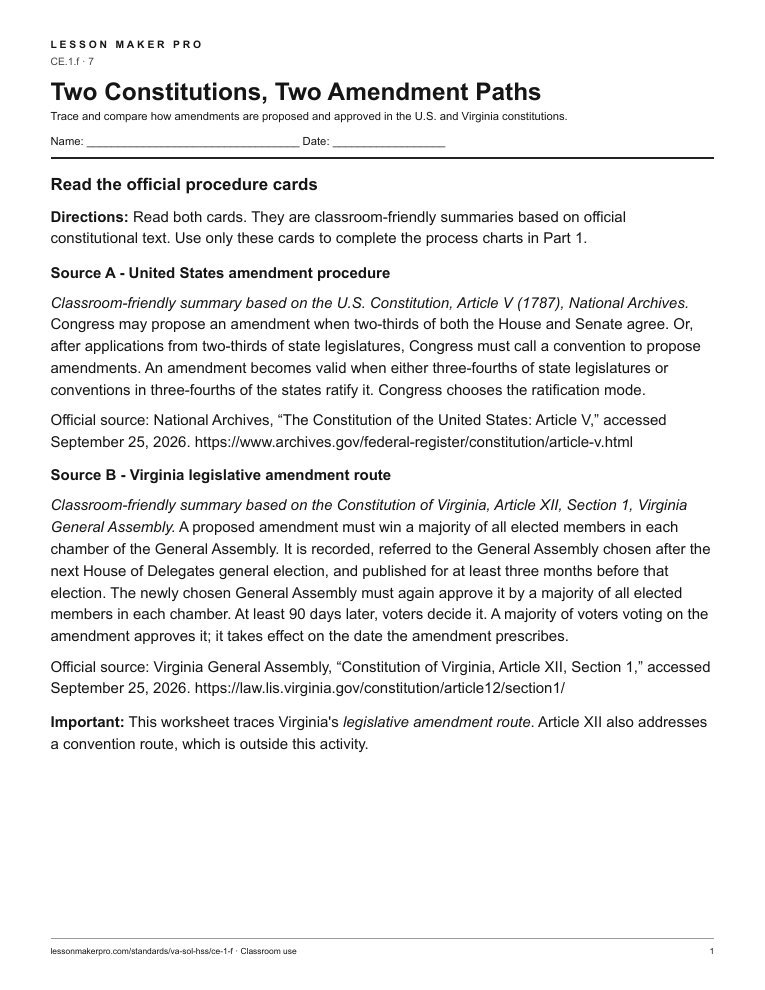
A ready-to-print activity worksheet aligned to CE.1.f, with an answer key for the teacher on its own page. No account needed.
PDF, US Letter, prints cleanly in black and white.
Download the worksheetKeep exploring
Related Standards
- CE.10.b
evaluating voting responsibilities, voting dates, voting and processes in Virginia
- VS.6.c
describing how principles of these founding Virginia documents inspired the Declaration of Independence, the Constitution of Virginia, the Constitution of the U...
- CE.1.b
describing the Magna Carta, English common law, the charters of the Virginia Company of London (April 10, 1606; May 23, 1609; and March 12, 1612), the Virginia ...
- CE.5
The student will apply history and social science skills to explain the judicial systems established by the Constitution of Virginia and the Constitution of the...
Turn this exact standard into a lesson
Grade, subject, topic, and the complete standard are prefilled. Create one free, no account needed.
Also for this standard:Make a WorksheetMake a QuizMake a Sub Lesson