Virginia SOL CE.1.b
The Standard
- CE.1
- The student will apply history and social science skills to explain the foundations of the American constitutional democracy by
describing the Magna Carta, English common law, the charters of the Virginia Company of London (April 10, 1606; May 23, 1609; and March 12, 1612), the Virginia Declaration of Rights, the Declaration of Independence, the Articles of Confederation, and the Virginia Statute for Religious Freedom and their influence on the Constitution of Virginia and the Constitution of the United States, including the Bill of Rights
Virginia Standards of Learning for History and Social Science · The student will apply history and social science skills to explain the foundations of the American constitutional democracy by
Teacher's field guide
What This Standard Means
What Students Need to Do
- Students summarize the main principle in each document and place the documents in chronological order. They explain how limited government, natural rights, representative government, religious liberty, and lessons from weak central rule shaped later constitutional protections.
What Mastery Looks Like
- A student can identify each document from a short excerpt or description. They can build accurate influence chains, such as Magna Carta to due process and the Virginia Declaration of Rights to the Bill of Rights. They can explain why the Articles of Confederation led to a stronger federal system.
Common Misconceptions
- Students may call Magna Carta a democratic constitution or treat the Declaration of Independence as a governing plan. They often confuse the Articles of Confederation with the Constitution or assume the Virginia Company charters declared independence. They may also mix up the Virginia Declaration of Rights with the religious freedom statute.
How to Assess It
- Use a seven-row exit ticket. For each source, students write one key idea and name one later constitutional feature it influenced.
Lesson moves
Ways to Teach It
Pairs arrange dated document cards on a string timeline, then attach principle and constitutional feature cards to create labeled influence chains.
Students write one claim naming the earlier document that most shaped the Bill of Rights, supported by two document details.
Play Influence Match: teams pair source cards with principle cards and earn a point only after giving an accurate explanation.
Give a school discipline or religious-expression scenario, and ask students which inherited principle should guide the policy and why.
Free download
Printable CE.1.b Worksheet
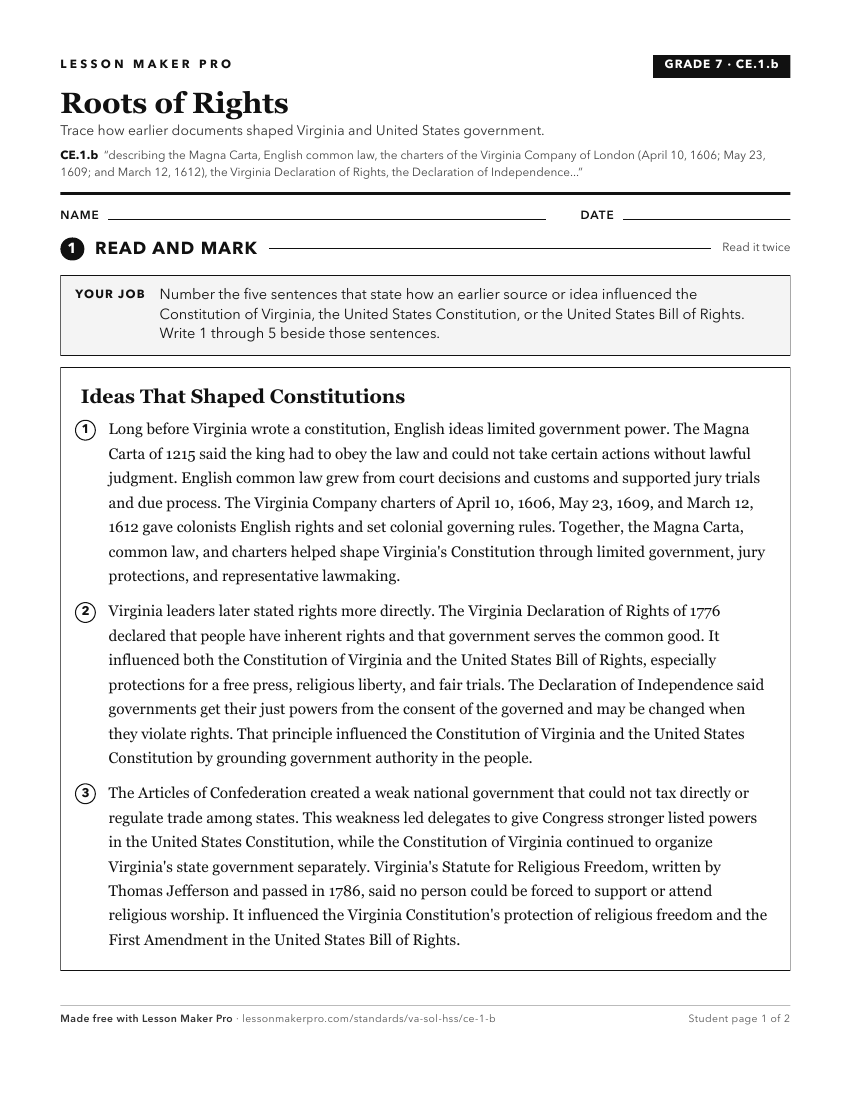
A ready-to-print activity worksheet aligned to CE.1.b, with an answer key for the teacher on its own page. No account needed.
PDF, US Letter, prints cleanly in black and white.
Download the worksheetKeep exploring
Related Standards
- CE.1.f
describing the procedures for amending the Constitution of Virginia and the Constitution of the United States.
- VS.6.c
describing how principles of these founding Virginia documents inspired the Declaration of Independence, the Constitution of Virginia, the Constitution of the U...
- VS.3.c
describing the importance of the Virginia Company of London Charter (April 10, 1606) in establishing the Jamestown colony
- VS.6.b
explaining the development of founding Virginia documents, including the Virginia Declaration of Rights (written by George Mason) and the Virginia Statute for R...
Turn this exact standard into a lesson
Grade, subject, topic, and the complete standard are prefilled. Create one free, no account needed.
Also for this standard:Make a WorksheetMake a QuizMake a Sub Lesson