Virginia SOL 3.1.a
The Standard
- 3.1
- The student will apply history and social science skills to define citizenship and explain the rights and responsibilities of United States citizenship by
recognizing that Americans are people of diverse ethnic origins, customs, and traditions that are united by the basic principles of a republican form of government and respect for individual rights and freedoms
Virginia Standards of Learning for History and Social Science
Teacher's field guide
What This Standard Means
What Students Need to Do
- Students compare examples of family traditions, cultural practices, and backgrounds. They explain how shared civic rules protect each person’s choices and participation in government.
What Mastery Looks Like
- Students can explain that people do not need the same customs to belong in one country. They can name voting for representatives and protecting freedoms as shared civic practices.
Common Misconceptions
- Students may think all Americans follow the same traditions or that one tradition is more American than another. They may confuse republican government with the Republican Party. They may also think individual freedom means people can ignore laws or harm others.
How to Assess It
- Exit ticket: Read, “Two families celebrate different holidays, and both parents vote for city council.” Write what differs and what they share as citizens.
Lesson moves
Ways to Teach It
Give pairs picture cards showing foods, celebrations, languages, voting, and peaceful speech, then sort them into cultural traditions and civic practices.
Ask students to write: “How can neighbors with different traditions still be members of the same community?”
Play a matching game that pairs civic actions, such as voting, with the rights or responsibilities they represent.
Examine a sample local ballot and discuss how choosing representatives gives community members a voice in government.
Free download
Printable 3.1.a Worksheet
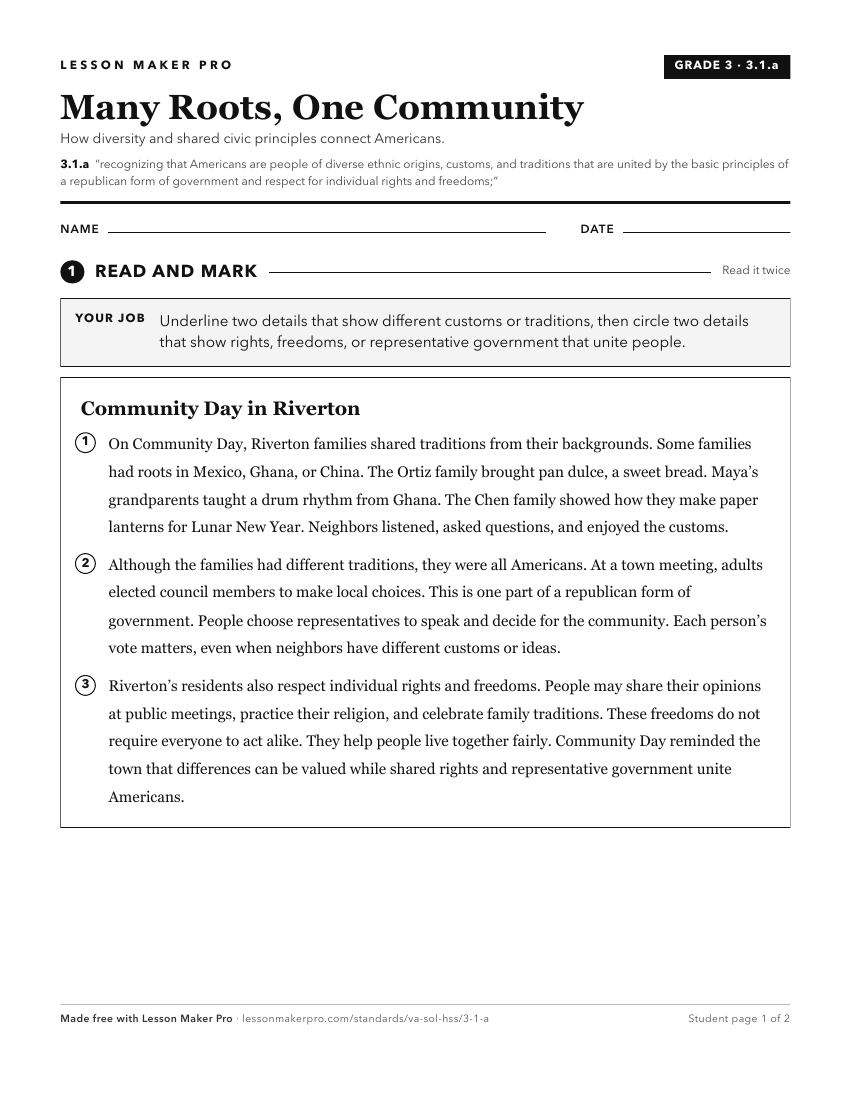
A ready-to-print activity worksheet aligned to 3.1.a, with an answer key for the teacher on its own page. No account needed.
PDF, US Letter, prints cleanly in black and white.
Download the worksheetKeep exploring
Related Standards
- CE.12.a
evaluating the shared fundamental principles and connection of free enterprise and democracy
- 1.1.c
being respectful of others and celebrating differences in ethnic origins, customs, and traditions
- 2.1.g
respecting the rights, beliefs, and opinions of others
- CE.1.a
explaining the fundamental principles of limited government, republicanism, federalism, checks and balances, separation of powers, and popular sovereignty
Turn this exact standard into a lesson
Grade, subject, topic, and the complete standard are prefilled. Create one free, no account needed.
Also for this standard:Make a WorksheetMake a QuizMake a Sub Lesson