Virginia SOL 2.2.a
The Standard
- 2.2
- The student will apply history and social science skills to understand citizenship by
identifying the benefits of being a U.S. citizen
Virginia Standards of Learning for History and Social Science
Teacher's field guide
What This Standard Means
What Students Need to Do
- Students name rights and opportunities citizens have, such as voting as adults, holding public office, and getting a U.S. passport. They match each benefit to a simple example.
What Mastery Looks Like
- A student can identify several citizen benefits from pictures or short situations. The student can explain how one benefit helps a person participate or receive protection.
Common Misconceptions
- Students may think anyone living in the United States is automatically a citizen. They may also confuse benefits with responsibilities, such as obeying laws or serving on a jury.
How to Assess It
- Give students three choices: voting in an election, following school rules, and recycling. Ask them to circle the citizen benefit and explain their choice.
Lesson moves
Ways to Teach It
Have pairs sort picture cards showing citizen benefits and responsibilities into two labeled hoops.
Ask students to write one sentence explaining which citizen benefit they would use as an adult and why.
Play Benefit or Responsibility, reading short examples while students hold up the matching word card.
Examine a sample U.S. passport and discuss how it helps citizens travel and receive help abroad.
Free download
Printable 2.2.a Worksheet
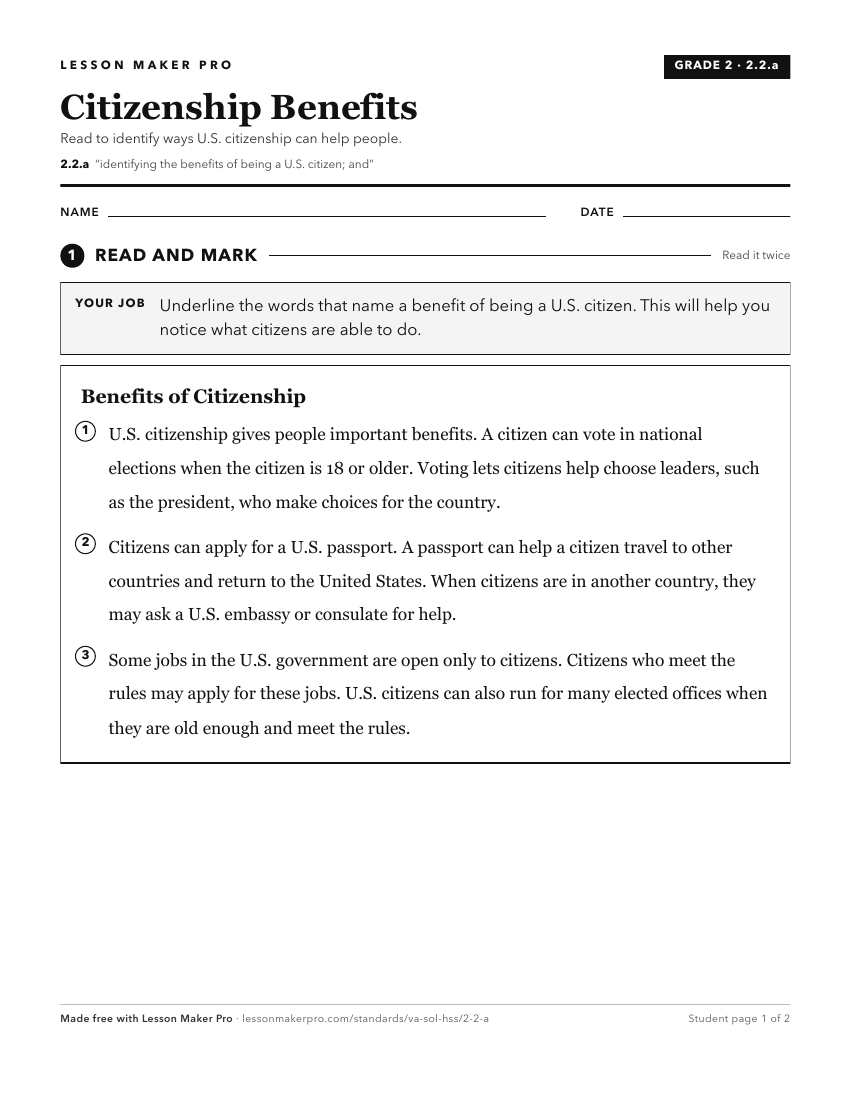
A ready-to-print activity worksheet aligned to 2.2.a, with an answer key for the teacher on its own page. No account needed.
PDF, US Letter, prints cleanly in black and white.
Download the worksheetKeep exploring
Related Standards
- CE.6.a
describing the processes by which an individual becomes a citizen of the United States
- CE.6.f
reviewing the criteria and exam for naturalizing U.S. citizens.
- 3.1
The student will apply history and social science skills to define citizenship and explain the rights and responsibilities of United States citizenship by
- 2.2.b
identifying the responsibilities of being a U.S. citizen.
Turn this exact standard into a lesson
Grade, subject, topic, and the complete standard are prefilled. Create one free, no account needed.
Also for this standard:Make a WorksheetMake a QuizMake a Sub Lesson