Virginia SOL 9.R
SOL Standard (Knowledge and Skills Cluster)
The student will conduct research and read a series of conceptually related texts on selected topics to build knowledge on grade-nine content, texts and areas prompted by student interest. Evaluation and Synthesis of Information Formulate and revise questions about a research topic, broadening or narrowing the inquiry as necessary. Gather and organize information from various sources, including internet resources, electronic databases, and other technology. Analyze and evaluate the primary and secondary sources gathered for their credibility, reliability, accuracy, and usefulness that includes identifying their main and supporting ideas, points of view, conflicting information, and any misconceptions or biases. Synthesize multiple streams of information to support claims and introduce counterclaims. Create research products aligned with the demands of the reading and writing standards. Cite sources for quoted and paraphrased ideas using a standard method of documentation, such as the Modern Language Association (MLA) or the American Psychological Association (APA). Define plagiarism's meaning and legal consequences and follow ethical and legal guidelines for gathering and using information. Demonstrate ethical and responsible use of all sources, including the Internet, Artificial Intelligence (AI), and new technologies, as they develop.
Virginia Standards of Learning for English
Cluster contents
Knowledge and Skills in This Standard
9.R is a Standards of Learning standard. These are the knowledge and skills expectations under it.
- 9.R.1
Evaluation and Synthesis of Information
- 9.R.1.A
Formulate and revise questions about a research topic, broadening or narrowing the inquiry as necessary.
- 9.R.1.B
Gather and organize information from various sources, including internet resources, electronic databases, and other technology.
- 9.R.1.C
Analyze and evaluate the primary and secondary sources gathered for their credibility, reliability, accuracy, and usefulness that includes identifying their mai...
- 9.R.1.D
Synthesize multiple streams of information to support claims and introduce counterclaims.
- 9.R.1.E
Create research products aligned with the demands of the reading and writing standards.
- 9.R.1.F
Cite sources for quoted and paraphrased ideas using a standard method of documentation, such as the Modern Language Association (MLA) or the American Psychologi...
- 9.R.1.G
Define plagiarism's meaning and legal consequences and follow ethical and legal guidelines for gathering and using information.
- 9.R.1.H
Demonstrate ethical and responsible use of all sources, including the Internet, Artificial Intelligence (AI), and new technologies, as they develop.
Teacher's field guide
What This Cluster Means
What Students Need to Do
- Students ask a focused research question, revise it as they learn, and locate information in print and digital sources. They judge source quality, compare conflicting ideas, and combine evidence into claims and counterclaims. They document borrowed ideas and use AI and other tools responsibly.
What Mastery Looks Like
- Students refine a broad topic into a focused question and gather useful sources from several places. They compare evidence and viewpoints, build a supported claim, address a counterclaim, and cite quoted or paraphrased material. They explain how to use sources and AI without plagiarism.
Common Misconceptions
- Students may trust the first search result or assume a polished website is reliable. They may treat bias as proof that a source is false. They may think paraphrases and AI-generated material need no citation.
How to Assess It
- Give students two conflicting source excerpts about school start times. Ask them to select the stronger source, explain why, write a claim and counterclaim, and add one correct citation.
Lesson moves
Ways to Teach It
Give pairs four printed sources and sticky notes to label each source’s claim, evidence, viewpoint, bias, credibility, and usefulness.
Write a response to this prompt: When should a biased source still be used in research, and what warning should a writer provide?
Run a Source Showdown where teams rank three websites by credibility and earn points for citing specific evidence from each page.
Research a proposed school phone policy using student surveys, district documents, and news reports, then present a recommendation with a counterclaim.
Free download
Printable 9.R Worksheet
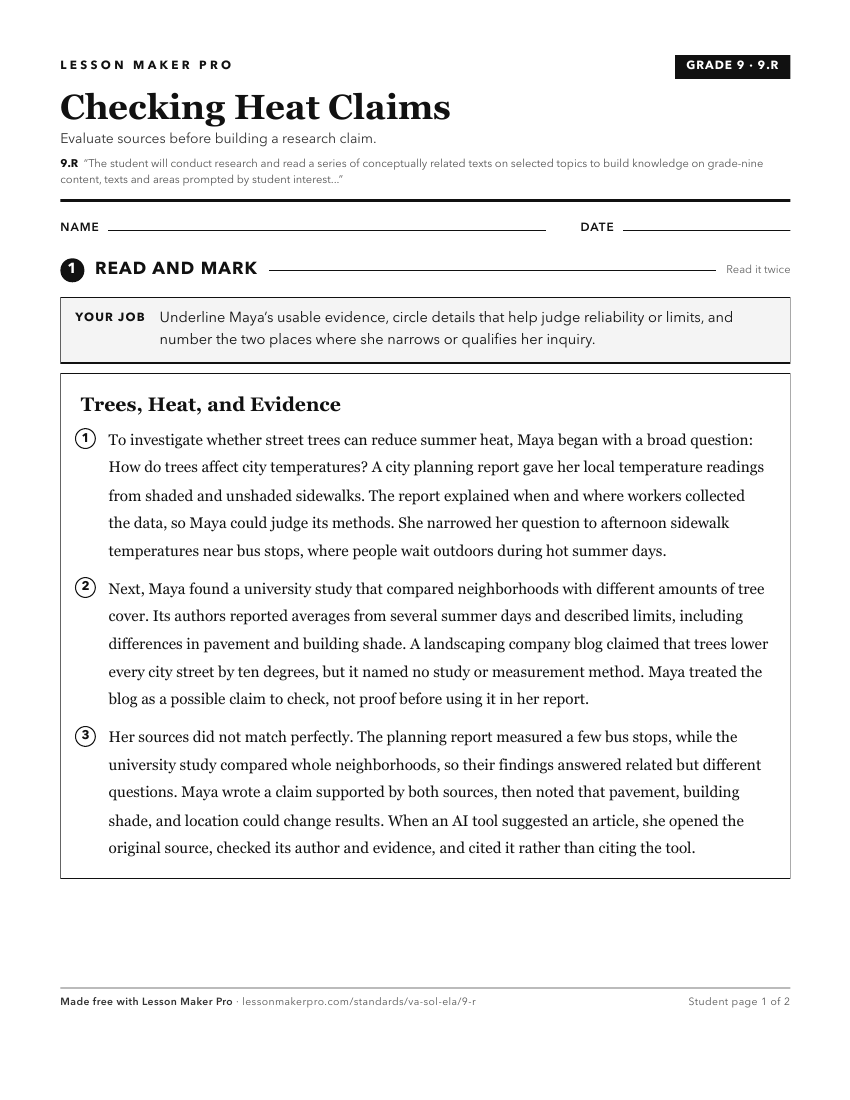
A ready-to-print activity worksheet aligned to 9.R, with an answer key for the teacher on its own page. No account needed.
PDF, US Letter, prints cleanly in black and white.
Download the worksheetKeep exploring
Related Standards
- 10.R
The student will conduct research and read a series of conceptually related texts on selected topics to build knowledge on grade-ten content, texts, and areas p...
- 11.R
The student will conduct research and read a series of conceptually related texts on selected topics to build knowledge on grade-eleven content, texts, and area...
- 8.R
The student will conduct research and read a series of conceptually related texts on selected topics to build knowledge on grade-eight content and texts, solve ...
- 12.R
The student will conduct research and read a series of conceptually related texts on selected topics to build knowledge on grade-twelve content, texts, and area...
Turn this cluster into a lesson
Grade, subject, topic, and the complete cluster are prefilled. Create one free, no account needed.
Also for this cluster:Make a WorksheetMake a QuizMake a Sub Lesson