Virginia SOL 4.W
SOL Standard (Knowledge and Skills Cluster)
The student will compose various works for diverse audiences and purposes, linked to grade four content and texts.
Virginia Standards of Learning for English
Cluster contents
Knowledge and Skills in This Standard
4.W is a Standards of Learning standard. These are the knowledge and skills expectations under it.
- 4.W.1
Modes and Purposes for Writing
- 4.W.1.A
Recognize different forms of writing (narrative, expository, and persuasive) have distinctive patterns of organization to support their purpose.
- 4.W.1.B
Write personal or fictional narratives that are logically organized around a central problem or experience.
- 4.W.1.C
Write expository texts to examine a topic that develops the focus with facts, details, or other information and uses linking words to connect ideas.
- 4.W.1.D
Write persuasive pieces on topics or texts that express a clear opinion supported by facts, details, and reasons.
- 4.W.1.E
Write in response to text(s) read (including summaries, reflections and descriptions) to demonstrate thinking with details, examples, and other evidence from th...
- 4.W.2
Organization and Composition
- 4.W.2.A.i
Providing an introduction that includes a clear topic sentence that connects to the central idea.
- 4.W.2.A.ii
Developing, selecting, and organizing ideas relevant to the topic, purpose, and genre using precise language and topic-specific words and phrases, descriptive d...
- 4.W.2.A.iii
Using transition words and prepositional phrases to vary sentence structure and link sentences.
- 4.W.2.A.iv
Providing a concluding statement or section.
- 4.W.3
Usage and Mechanics
- 4.W.3.A
With guidance and support from peers and adults, develop and strengthen writing as needed by revising for quality of ideas, organization, sentence fluency, and ...
- 4.W.3.B
Self-and peer-edit the writing for capitalization, spelling, punctuation, sentence structure, paragraphing, and Standard English (See Language Usage for grade l...
Teacher's field guide
What This Cluster Means
What Students Need to Do
- Students choose a narrative, expository, persuasive, or text-response structure to fit the audience and purpose. They organize paragraphs with a focused opening, connected details, precise words, transitions, and a conclusion. They revise ideas and organization, then edit conventions.
What Mastery Looks Like
- Given a prompt, students choose the correct form and organize ideas in a logical order. They support the focus with narrative details, facts, reasons, or text evidence, then connect ideas with transitions. Their final copy has a clear opening and ending, developed paragraphs, varied sentences, and few distracting errors.
Common Misconceptions
- Students may retell a text instead of explaining an idea with evidence. They often mix forms, such as giving opinions without reasons or listing facts without a clear focus. Some treat revising as fixing spelling only, rather than improving ideas, order, and word choice.
How to Assess It
- Give students a familiar class passage and this exit prompt: “State one idea the author develops and explain it with two details from the text.” Require a topic sentence, one linking word, and a concluding sentence.
Lesson moves
Ways to Teach It
Give groups mixed sentence strips from three sample texts to arrange, then label each as narrative, expository, or persuasive.
Ask students to explain how writing a principal differs from writing a friend about the same playground problem.
Play Transition Match by pairing sentence cards with linking words such as because, however, for example, later, and therefore.
Have students write a review of a school lunch, using a clear opinion, specific facts, reasons, and a recommendation.
Free download
Printable 4.W Worksheet
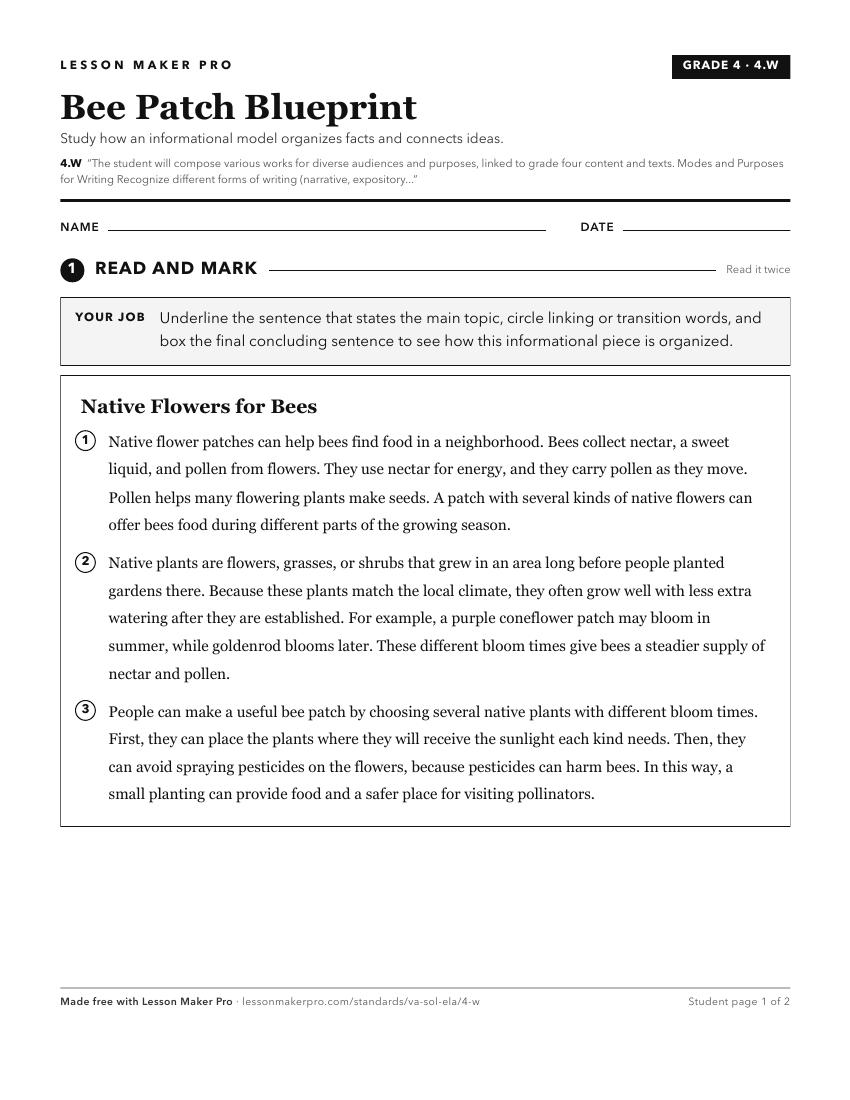
A ready-to-print activity worksheet aligned to 4.W, with an answer key for the teacher on its own page. No account needed.
PDF, US Letter, prints cleanly in black and white.
Download the worksheetKeep exploring
Related Standards
- 8.W
The student will compose various works for diverse audiences and purposes, linked to grade eight content and texts.
- 3.W
The student will compose various works for diverse audiences and purposes, linked to grade three content and texts.
- 5.W
The student will compose various works for diverse audiences and purposes, linked to grade five content and texts.
- 6.W
The student will compose various works for diverse audiences and purposes, linked to grade six content and texts.
Turn this cluster into a lesson
Grade, subject, topic, and the complete cluster are prefilled. Create one free, no account needed.
Also for this cluster:Make a WorksheetMake a QuizMake a Sub Lesson