Virginia SOL 4.W.1.A
The Standard
Recognize different forms of writing (narrative, expository, and persuasive) have distinctive patterns of organization to support their purpose.
Virginia Standards of Learning for English · Modes and Purposes for Writing
Teacher's field guide
What This Standard Means
What Students Need to Do
- Students identify narrative, expository, and persuasive writing by looking at purpose and organization. They use clues such as event sequence, grouped facts, or claims with supporting reasons.
What Mastery Looks Like
- Students correctly identify each form and explain which structural clues reveal its purpose. They can describe chronological events, grouped facts, or claims supported by reasons and evidence.
Common Misconceptions
- Students may identify a form by topic instead of purpose and structure. They may also assume every narrative is fictional or mistake any text with facts for expository writing.
How to Assess It
- Give students three short passages, one of each form. Ask them to label each form and underline two organization clues that support each answer.
Lesson moves
Ways to Teach It
Give groups cut-up passages to rebuild, then have them label each as narrative, expository, or persuasive and name the organization clues.
Ask students to compare two passages on the same topic and explain how each writer’s purpose shapes the organization.
Play Structure Clue Match by pairing cards showing features, such as sequence or claim and reasons, with the correct writing form.
Collect a news article, advertisement, and personal story, then have students classify each text and explain how its organization fits its purpose.
Free download
Printable 4.W.1.A Worksheet
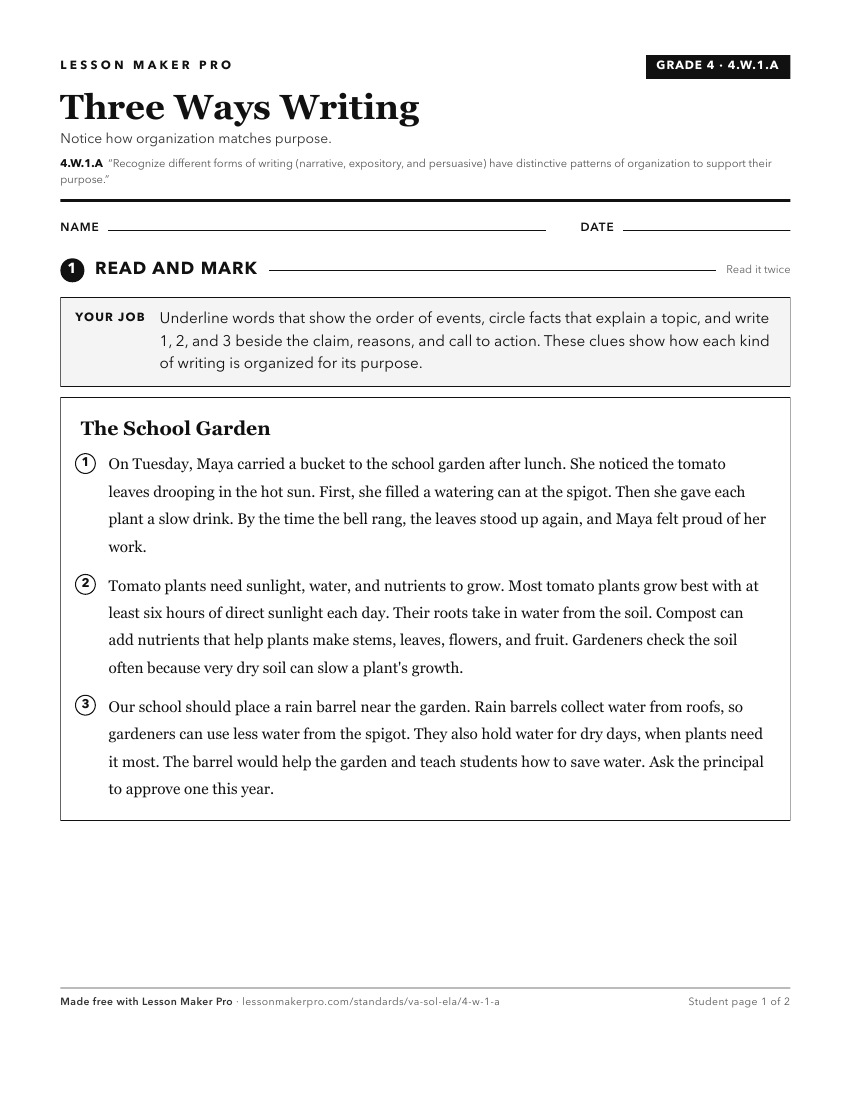
A ready-to-print activity worksheet aligned to 4.W.1.A, with an answer key for the teacher on its own page. No account needed.
PDF, US Letter, prints cleanly in black and white.
Download the worksheetKeep exploring
Related Standards
- 9.RL.1.B
Examine and analyze the characteristics that distinguish literary forms (e.g., fiction, nonfiction, poetry, prose, novel, drama, essay, speech) and analyze how ...
- 3.W.1.A
Recognize different forms of writing (narrative, expository, and opinion) have distinctive patterns of organization to support their purpose.
- 3.RI.2.A
Describe major structural differences between the organizational patterns of different informational texts (e.g., cause/effect, comparison/contrast, problem/sol...
- 9.RI.2.A
Compare characteristics of expository, technical, and persuasive texts, including their differences in purpose, format, and text structure.
Turn this exact standard into a lesson
Grade, subject, topic, and the complete standard are prefilled. Create one free, no account needed.
Also for this standard:Make a WorksheetMake a QuizMake a Sub Lesson