Virginia SOL 4.DSR
SOL Standard (Knowledge and Skills Cluster)
The student will build knowledge and comprehension skills from reading a range of challenging, content-rich texts. This includes fluently reading and gathering evidence from grade-level complex texts, reading widely on topics to gain purposeful knowledge and vocabulary, and using reading strategies when comprehension breaks down.
Virginia Standards of Learning for English
Cluster contents
Knowledge and Skills in This Standard
4.DSR is a Standards of Learning standard. These are the knowledge and skills expectations under it.
- 4.DSR.A
Read a variety of grade-level complex texts with accuracy, automaticity, appropriate rate, and meaningful expression in successive readings to support comprehen...
- 4.DSR.B
Proficiently read and comprehend a variety of literary and informational texts that exhibit complexity at the lower range of the grades 4-5 band (See the Quanti...
- 4.DSR.C
When responding to texts through discussion and/or writing, draw several pieces of evidence from grade-level complex texts to support claims, conclusions, and i...
- 4.DSR.D
Regularly engage in reading a series of conceptually related texts organized around topics of study to build knowledge and vocabulary (These texts should be at ...
- 4.DSR.E
Use reading strategies as needed to aid and monitor comprehension when encountering challenging sections of text. These sense-making strategies attend to common...
Teacher's field guide
What This Cluster Means
What Students Need to Do
- Students read challenging literary and informational texts accurately, smoothly, and with understanding. They notice when meaning breaks down and choose a strategy to fix it. They gather evidence across related texts to build knowledge, vocabulary, and supported ideas.
What Mastery Looks Like
- Students read unfamiliar grade-level texts accurately, at a steady rate, and with expression. They notice confusion, reread, self-correct, and use structure or context to regain meaning. They support conclusions with several accurate quotations or paraphrases.
Common Misconceptions
- Students may think fluent reading means reading as fast as possible. They may choose evidence that mentions the topic but does not support their idea. They may keep reading after meaning breaks down instead of rereading, questioning, or using text structure.
How to Assess It
- Give students a 200-word passage to record themselves reading aloud. Ask them to summarize it, answer one inference question with two details, and name one strategy they used.
Lesson moves
Ways to Teach It
Give groups mixed paragraph strips from an article to reorder, using headings, transitions, and repeated ideas as clues.
After reading two related texts, write: What new understanding did the second text add, and which details support your answer?
Play Evidence Match by pairing claim cards with evidence cards, then explaining each match and rejecting unrelated details.
Compare a school lunch menu with a nutrition article, then write a recommendation using evidence and topic vocabulary.
Free download
Printable 4.DSR Worksheet
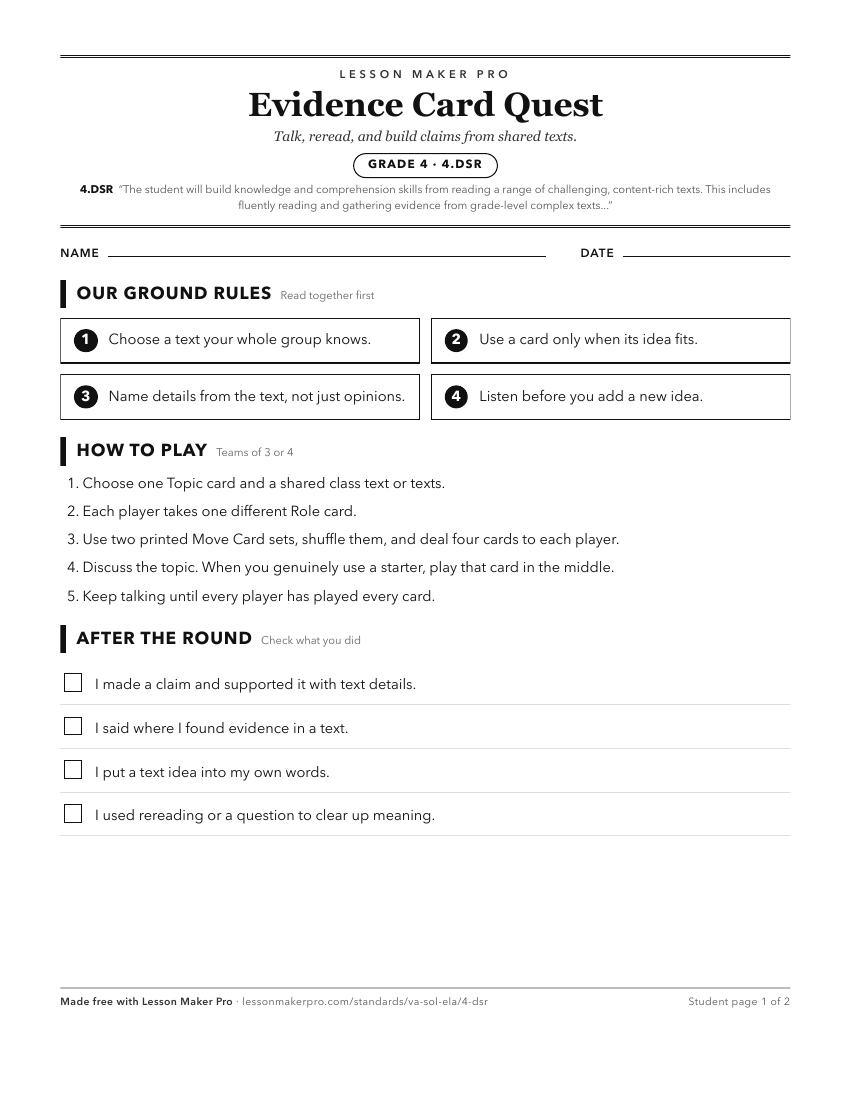
A ready-to-print activity worksheet aligned to 4.DSR, with an answer key for the teacher on its own page. No account needed.
PDF, US Letter, prints cleanly in black and white.
Download the worksheetKeep exploring
Related Standards
Turn this cluster into a lesson
Grade, subject, topic, and the complete cluster are prefilled. Create one free, no account needed.
Also for this cluster:Make a WorksheetMake a QuizMake a Sub Lesson