Virginia SOL 2.RV.1.D
The Standard
Use the context of a sentence to apply knowledge of homophones.
Virginia Standards of Learning for English · Vocabulary Development and Word Analysis
Teacher's field guide
What This Standard Means
What Students Need to Do
- Students recognize words that sound alike but have different spellings and meanings. They use clues from the whole sentence to choose the word that makes sense.
What Mastery Looks Like
- A student selects “hear” in “I can hear the bell” and names “bell” as a clue. The student can also write clear sentences showing both meanings in a homophone pair.
Common Misconceptions
- Students may think words that sound alike also mean the same thing. They may choose the spelling they know best without checking the whole sentence. They also may confuse common pairs such as to, two, and too.
How to Assess It
- Exit ticket: Circle the correct word and underline the clue in each sentence: “I can hear/here the bell” and “We ate two/to pears.”
Lesson moves
Ways to Teach It
Place homophone cards beside matching picture cards, then have students build a sentence that clearly fits each word.
Ask students to explain why “sea” does not fit in “I can see the bird,” using a clue from the sentence.
Play Homophone Match by giving teams sentence strips and word cards such as right and write to pair correctly.
Have students create a classroom sign using a homophone pair, such as “Write your name right here,” then explain each spelling.
Free download
Printable 2.RV.1.D Worksheet
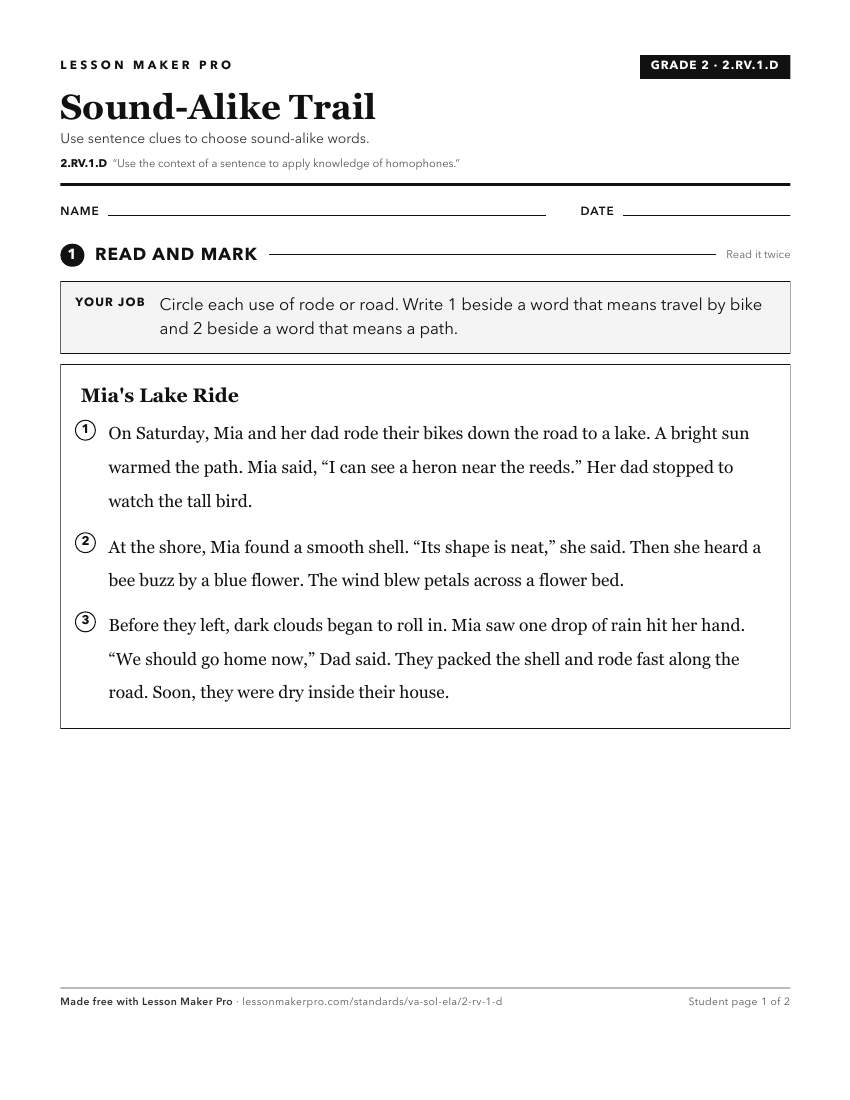
A ready-to-print activity worksheet aligned to 2.RV.1.D, with an answer key for the teacher on its own page. No account needed.
PDF, US Letter, prints cleanly in black and white.
Download the worksheetKeep exploring
Related Standards
Turn this exact standard into a lesson
Grade, subject, topic, and the complete standard are prefilled. Create one free, no account needed.
Also for this standard:Make a WorksheetMake a QuizMake a Sub Lesson