Virginia SOL 2.DSR
SOL Standard (Knowledge and Skills Cluster)
The student will build knowledge and comprehension skills from reading and listening to a range of challenging, content-rich texts. This includes fluently reading and gathering evidence from grade-level complex texts and reading widely (through read alouds) on topics to gain purposeful knowledge and vocabulary. Read a variety of grade-level text with accuracy, automaticity, appropriate rate, and meaningful expression in successive readings to support comprehension. Monitor while reading to confirm or self-correct word recognition and understanding as necessary (Reading Fluency, K-12). Proficiently read and comprehend texts from a variety of literary forms that exhibit complexity at the lower range of the grades 2-3 band (See the Quantitative and Qualitative Analysis charts for determining complexity in the Appendix.) (Text Complexity, 2-12). When responding to text through discussion and/or writing, draw several pieces of evidence from read-alouds and grade-level texts to support claims, conclusions, and inferences, including quoting or paraphrasing from texts accurately and tracing where relevant evidence is located (Textual Evidence, K-12). Regularly engage in listening to a series of conceptually related texts organized around topics of study to build knowledge and vocabulary. Use this background knowledge as context for new learning (Deep Reading on Topics to Build Knowledge and Vocabulary, K-12). (Reading Strategies, 3-12): Introduced in Grade Three.
Virginia Standards of Learning for English
Cluster contents
Knowledge and Skills in This Standard
2.DSR is a Standards of Learning standard. These are the knowledge and skills expectations under it.
- 2.DSR.A
Read a variety of grade-level text with accuracy, automaticity, appropriate rate, and meaningful expression in successive readings to support comprehension. Mon...
- 2.DSR.B
Proficiently read and comprehend texts from a variety of literary forms that exhibit complexity at the lower range of the grades 2-3 band (See the Quantitative ...
- 2.DSR.C
When responding to text through discussion and/or writing, draw several pieces of evidence from read-alouds and grade-level texts to support claims, conclusions...
- 2.DSR.D
Regularly engage in listening to a series of conceptually related texts organized around topics of study to build knowledge and vocabulary. Use this background ...
- 2.DSR.E
(Reading Strategies, 3-12): Introduced in Grade Three.
Teacher's field guide
What This Cluster Means
What Students Need to Do
- Students read grade-level stories and informational texts accurately, smoothly, and with expression. They stop, reread, and correct errors when words or meaning do not make sense. They use details from reading and listening to explain ideas, make inferences, and build topic knowledge and vocabulary.
What Mastery Looks Like
- Students read a new grade-level passage accurately, at a steady pace, and with phrasing that matches the meaning. They notice mistakes, reread when meaning breaks down, and use several accurate details to explain an idea or inference.
Common Misconceptions
- Students may think fluent reading means reading as fast as possible. They may give an opinion without pointing to details in the text. Some keep reading after a word or sentence stops making sense instead of rereading and correcting it.
How to Assess It
- Give students a short passage to read aloud twice. Ask, "What can you conclude, and which two details support your answer?"
Lesson moves
Ways to Teach It
Give pairs sentence strips from a familiar passage to arrange, reread, and mark with counters where their voices should pause or change.
After a read-aloud, ask, "What did the character learn, and which two details helped you decide?"
Play Fluency Coach: partners reread a paragraph three times and award points for accuracy, phrasing, self-correction, and attention to punctuation.
Read two short weather texts, then have students use new vocabulary to record a classroom forecast and cite facts that support it.
Free download
Printable 2.DSR Worksheet
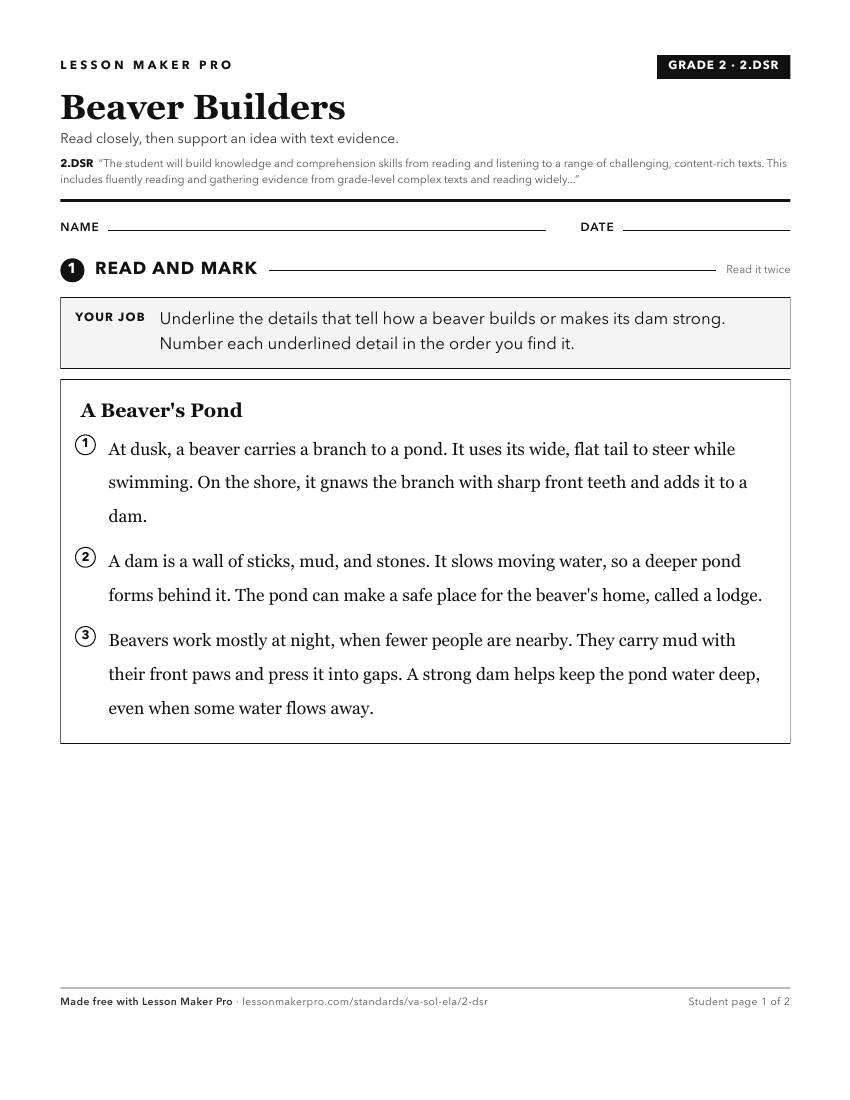
A ready-to-print activity worksheet aligned to 2.DSR, with an answer key for the teacher on its own page. No account needed.
PDF, US Letter, prints cleanly in black and white.
Download the worksheetKeep exploring
Related Standards
- 1.DSR
The student will build knowledge and comprehension skills from reading and listening to a range of challenging, content-rich texts. This includes fluently readi...
- 5.DSR
The student will build knowledge and comprehension skills from reading a range of challenging, content-rich texts. This includes fluently reading and gathering ...
- 4.DSR
The student will build knowledge and comprehension skills from reading a range of challenging, content-rich texts. This includes fluently reading and gathering ...
- 11.DSR
The student will build knowledge and comprehension skills from reading a range of challenging, content-rich texts. This includes fluently reading and gathering ...
Turn this cluster into a lesson
Grade, subject, topic, and the complete cluster are prefilled. Create one free, no account needed.
Also for this cluster:Make a WorksheetMake a QuizMake a Sub Lesson