Virginia SOL 1.DSR
SOL Standard (Knowledge and Skills Cluster)
The student will build knowledge and comprehension skills from reading and listening to a range of challenging, content-rich texts. This includes fluently reading decodable texts and gathering evidence from reading widely (through content-rich read alouds) on topics to gain purposeful knowledge and vocabulary
Virginia Standards of Learning for English
Cluster contents
Knowledge and Skills in This Standard
1.DSR is a Standards of Learning standard. These are the knowledge and skills expectations under it.
- 1.DSR.A
Use knowledge of letter-sound correspondences to read a variety of decodable and gradelevel texts with accuracy, automaticity, appropriate rate, and meaningful ...
- 1.DSR.B
(Text Complexity, 2-12) Introduced in Grade Two.
- 1.DSR.C
With prompting and support, when responding to text through discussions and/or writing, draw several pieces of evidence from read-alouds to support claims, conc...
- 1.DSR.D
Regularly engage in listening to a series of conceptually related texts organized around topics of study to build knowledge and vocabulary. Use this background ...
- 1.DSR.E
(Reading Strategies, 3-12): Introduced in Grade Three.
Teacher's field guide
What This Cluster Means
What Students Need to Do
- Students use letter sounds and spelling patterns to read decodable texts accurately and smoothly. They notice when a word or idea does not make sense and reread to fix it. They listen across related texts, learn topic words, and use details from those texts to explain their thinking.
What Mastery Looks Like
- A student reads a familiar decodable passage accurately, smoothly, and with phrasing that matches the meaning. The student notices errors and rereads to fix them. After related read-alouds, the student explains an idea using several accurate details and new topic words.
Common Misconceptions
- Students may guess from pictures or the first letter instead of checking every sound. They may read quickly without noticing that a sentence makes no sense. They may give an opinion about a read-aloud but cannot name details that support it.
How to Assess It
- Have each student read a short decodable passage twice, then ask, “What did you learn, and which words or sentences helped you?” Note accuracy, self-corrections, expression, and evidence.
Lesson moves
Ways to Teach It
Give pairs sentence strips from a decodable passage to arrange, read aloud, and reread after checking each word against the printed text.
After two read-alouds about frogs, ask, “How do frogs survive?” and have students answer with two details from the texts.
Play Reread Relay, where students read one passage three times and mark each accurate, smooth reading with a colored dot.
Read a school lunch menu, identify unfamiliar words, and use headings and nearby words to explain what each lunch includes.
Free download
Printable 1.DSR Worksheet
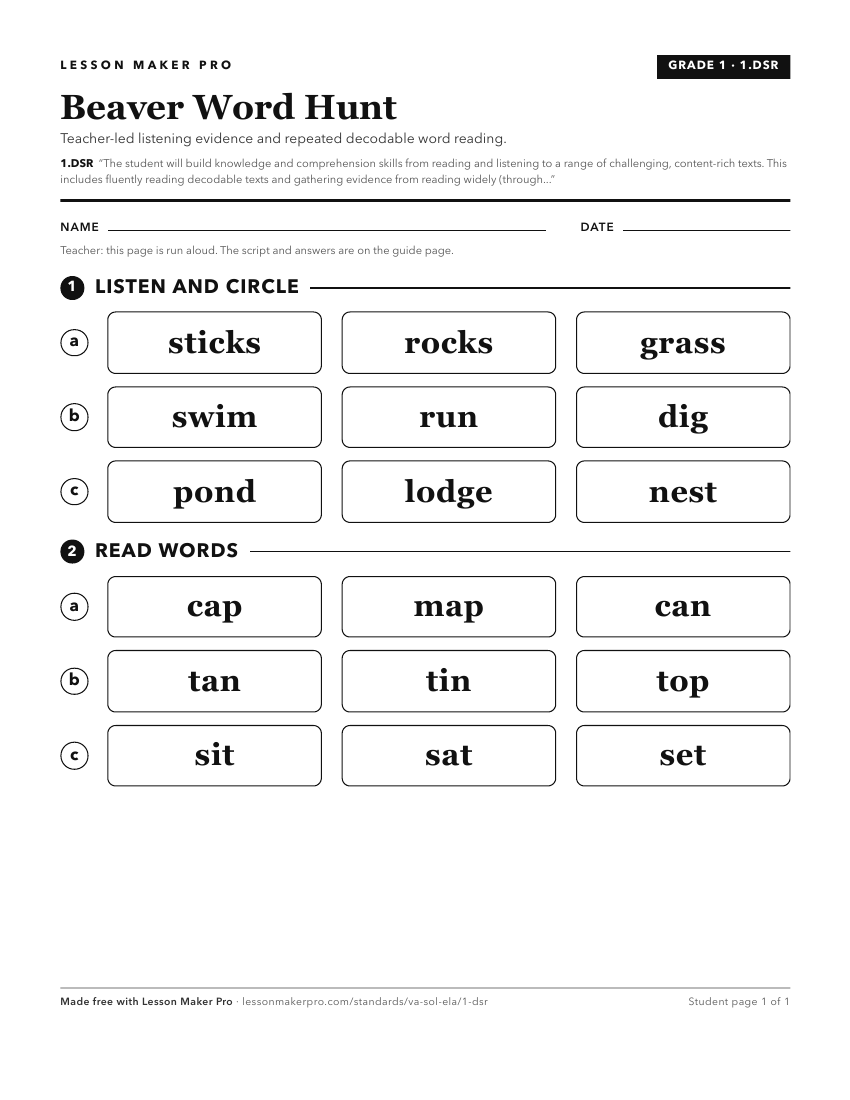
A ready-to-print activity worksheet aligned to 1.DSR, with an answer key for the teacher on its own page. No account needed.
PDF, US Letter, prints cleanly in black and white.
Download the worksheetKeep exploring
Related Standards
- 3.DSR
The student will build knowledge and comprehension skills from reading and listening to a range of challenging, content-rich texts. This includes fluently readi...
- 10.DSR
The student will build knowledge and comprehension skills from reading a range of challenging, content-rich texts. This includes fluently reading and gathering ...
- 2.DSR
The student will build knowledge and comprehension skills from reading and listening to a range of challenging, content-rich texts. This includes fluently readi...
- K.DSR.1
The student will build knowledge and comprehension skills from reading and listening to a range of texts. This includes fluently reading decodable sentences and...
Turn this cluster into a lesson
Grade, subject, topic, and the complete cluster are prefilled. Create one free, no account needed.
Also for this cluster:Make a WorksheetMake a QuizMake a Sub Lesson