Virginia SOL 11.W.1
SOL Standard (Knowledge and Skills Cluster)
Modes and Purposes for Writing
Virginia Standards of Learning for English
Cluster contents
Knowledge and Skills in This Standard
11.W.1 is a Standards of Learning standard. These are the knowledge and skills expectations under it.
- 11.W.1.A.i
Introduce a topic clearly by providing context, presenting well-defined theses, and previewing what follows.
- 11.W.1.A.ii
Adopt an organizational structure that clarifies relationships among ideas and concepts.
- 11.W.1.A.iii
Develop the topic through sustained use of the most significant and relevant facts, concrete details, quotations, or other information from multiple authoritati...
- 11.W.1.A.iv
Provide a concluding section that follows from the information or explanation presented.
- 11.W.1.B.i
Develop a thesis that demonstrates knowledgeable judgments.
- 11.W.1.B.ii
Interpret and investigate evidence from various sources and texts to draw reasonable conclusions that support the writer’s position or assertion.
- 11.W.1.B.iii
Examine and evaluate processes and/or problems to propose solutions.
- 11.W.1.B.iv
Organize claims, counterclaims, and evidence in a sustained and logical sequence that explains how the credible evidence supports well-defined points of view.
- 11.W.1.C
Write to describe personal qualifications for potential occupational or educational opportunities, producing clear and coherent writing in which the development...
- 11.W.1.D
Choose appropriate modes and blend multiple forms of writing by routinely engaging in the production of shorter and longer pieces that adapt writing content, te...
Teacher's field guide
What This Cluster Means
What Students Need to Do
- Students write longer explanatory, analytical, and persuasive pieces built around a clear controlling idea. They select credible evidence, explain its meaning, address other views, and shape each piece for its audience and purpose.
What Mastery Looks Like
- Students produce focused writing with a clear position, logical sections, credible evidence, and explanations connecting evidence to claims. They adjust structure, detail, tone, and voice for essays, applications, letters, and other tasks.
Common Misconceptions
- Students may treat a topic as a thesis, list evidence without explaining it, or organize paragraphs by source rather than idea. They may ignore counterclaims, use weak sources, or keep the same tone for every audience.
How to Assess It
- Give students two short sources and this prompt: “Should high schools require a financial literacy course?” Ask for a thesis, evidence-based paragraph, counterclaim, and conclusion.
Lesson moves
Ways to Teach It
Give groups a cut-up essay to sequence, then have them label the thesis, claims, evidence, counterclaim, transitions, and conclusion.
Ask students to compare a college application paragraph and a text message, then explain how audience changes tone, detail, and word choice.
Run an evidence draft game where teams rank source cards by credibility and relevance, then defend their top two choices.
Have students write a one-page cover letter for a posted local job, using specific qualifications and a professional tone.
Free download
Printable 11.W.1 Worksheet
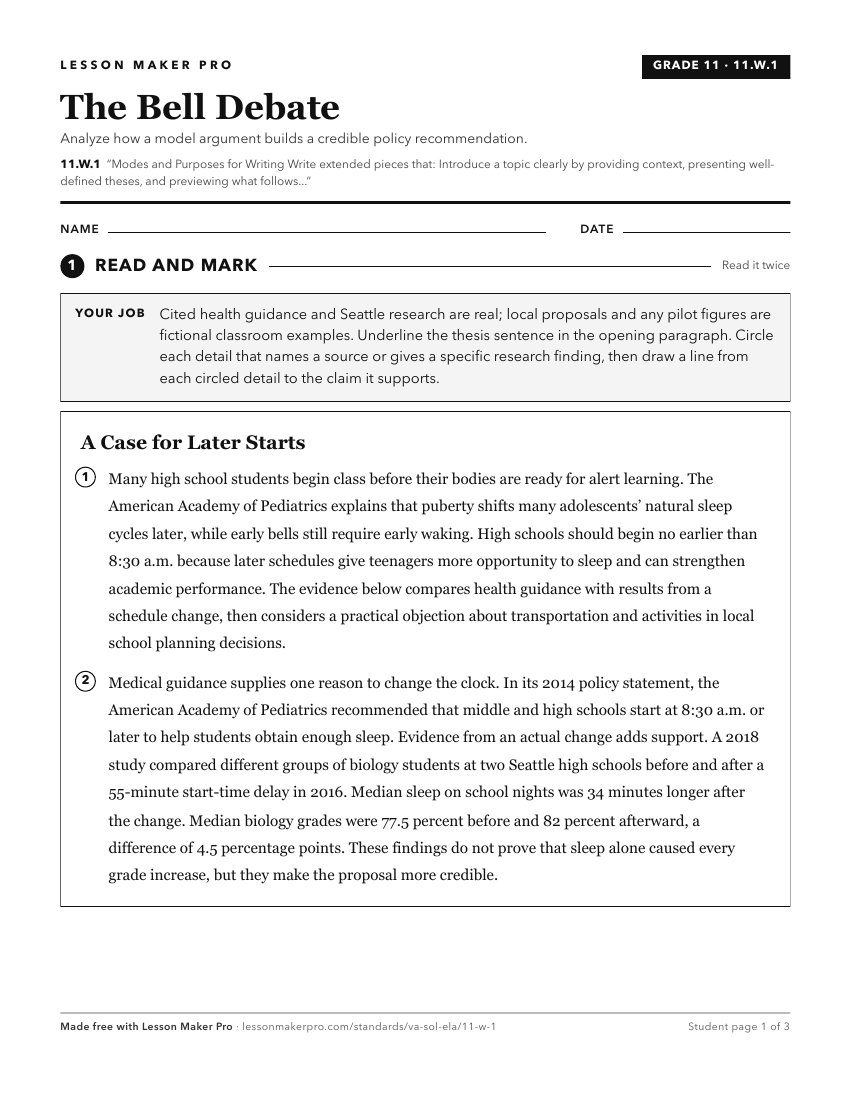
A ready-to-print activity worksheet aligned to 11.W.1, with an answer key for the teacher on its own page. No account needed.
PDF, US Letter, prints cleanly in black and white.
Download the worksheetKeep exploring
Related Standards
Turn this cluster into a lesson
Grade, subject, and topic are prefilled; the lesson picks the standards under this heading. Create one free, no account needed.
Also for this cluster:Make a WorksheetMake a QuizMake a Sub Lesson