Texas TEKS K.14.D
The Standard
- K.14
- Social studies skills. The student communicates in oral and visual forms. The student is expected to:
create and interpret visuals, including pictures and maps
Texas Essential Knowledge and Skills for Social Studies
Teacher's field guide
What This Standard Means
What Students Need to Do
- Students make simple pictures and maps to show places, people, objects, or events. They use details, symbols, and locations to explain what a visual shows.
What Mastery Looks Like
- A student can draw a clear picture or simple map with recognizable features and sensible locations. The student can answer questions using visual clues and explain the visual aloud.
Common Misconceptions
- Students may treat a map as a scene instead of a view from above, or place objects without showing where they belong. They may ignore symbols or confuse left and right.
How to Assess It
- Give students a simple classroom map and ask what is beside the teacher's desk. Have them add and explain a symbol for the class library.
Lesson moves
Ways to Teach It
Build a tabletop classroom map with blocks, then draw the room from above and label the door, rug, and desks.
Show a playground picture and ask students to name three details that tell what happens there.
Play Map Detective by giving location clues, such as beside the tree, and having students point to the matching place.
Walk to the school office, then have students draw a route map showing two landmarks they passed.
Free download
Printable K.14.D Worksheet
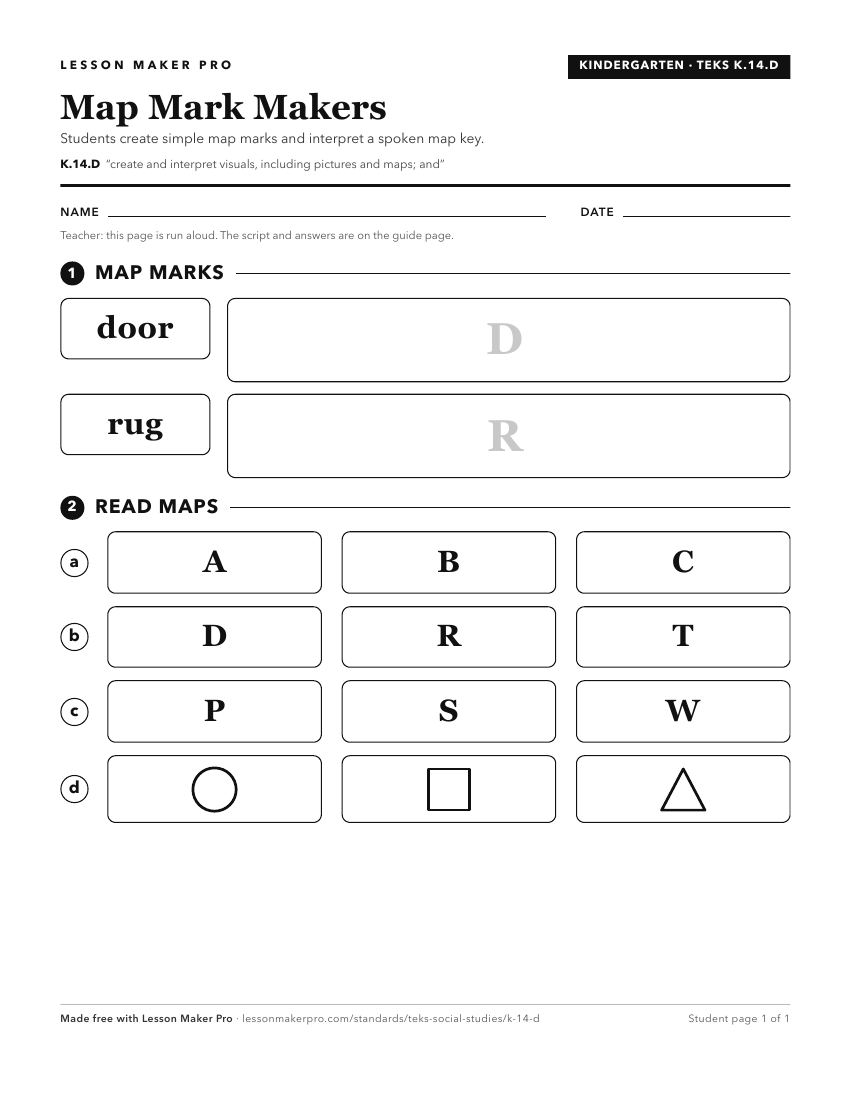
A ready-to-print activity worksheet aligned to K.14.D, with an answer key for the teacher on its own page. No account needed.
PDF, US Letter, prints cleanly in black and white.
Download the worksheetKeep exploring
Related Standards
- 3.14.D
interpret and create visuals, including graphs, charts, tables, timelines, illustrations, and maps
- 1.17.D
create and interpret visual and written material
- 2.16.F
create written and visual material such as stories, maps, and graphic organizers to express ideas
- 3.15.E
create written and visual material such as stories, pictures, maps, and graphic organizers to express ideas
Turn this exact standard into a lesson
Grade, subject, topic, and the complete standard are prefilled. Create one free, no account needed.
Also for this standard:Make a WorksheetMake a QuizMake a Sub Lesson