Texas TEKS 8.30.D
The Standard
- 8.30
- Social studies skills. The student communicates in written, oral, and visual forms. The student is expected to:
apply foundational language skills to engage in civil discourse about social studies topics, including those with multiple perspectives.
Texas Essential Knowledge and Skills for Social Studies
Teacher's field guide
What This Standard Means
What Students Need to Do
- Students state a clear claim, support it with relevant evidence, and use topic words accurately. They listen, paraphrase another view, ask clarifying questions, and disagree without insults or interruptions.
What Mastery Looks Like
- A student can explain more than one position and respond to the idea rather than the person. The student cites evidence, summarizes a classmate's point fairly, and clarifies unclear wording.
Common Misconceptions
- Students may think civil discourse means avoiding disagreement or simply taking turns. They may attack the speaker, paraphrase inaccurately, or give opinions without evidence.
How to Assess It
- Give pairs the prompt, “How did Patriots and Loyalists justify their positions?” Each student must state one evidence-based claim, paraphrase the partner, and ask one clarifying question.
Lesson moves
Ways to Teach It
Give groups perspective cards and evidence slips about school uniforms, then have them build and present one evidence-based claim.
Have students write three sentences explaining which viewpoint changed their thinking and why, then respond respectfully to a partner.
Play a paraphrase relay where students earn a point only after a partner confirms that the previous statement was summarized accurately.
Show two short public comments on a local issue, then have students identify each claim, supporting evidence, and respectful response.
Free download
Printable 8.30.D Worksheet
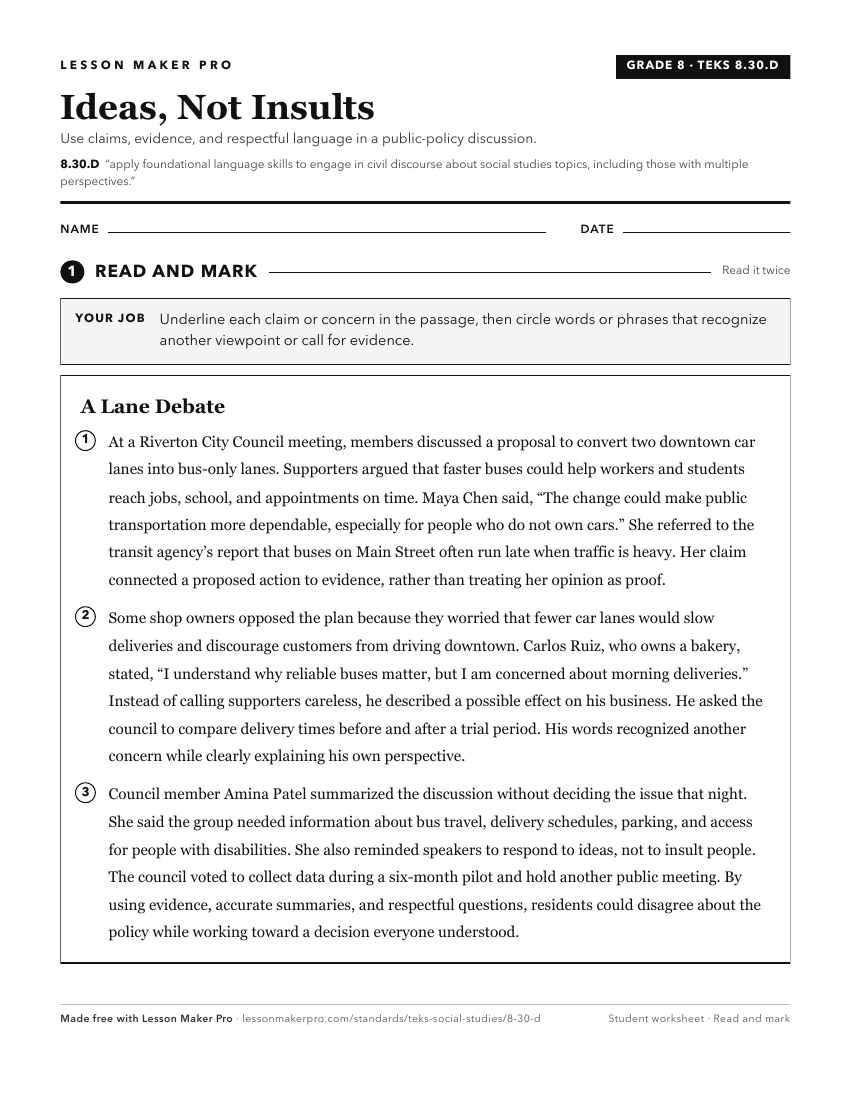
A ready-to-print activity worksheet aligned to 8.30.D, with an answer key for the teacher on its own page. No account needed.
PDF, US Letter, prints cleanly in black and white.
Download the worksheetKeep exploring
Related Standards
- 7.22.D
apply foundational language skills to engage in civil discourse about social studies topics, including those with multiple perspectives.
- 3.15.F
apply foundational language skills to engage in civil discourse about social studies topics, including those with multiple perspectives.
- 5.25.E
apply foundational language skills to engage in civil discourse about social studies topics, including those with multiple perspectives.
- 4.21.E
apply foundational language skills to engage in civil discourse about social studies topics, including those with multiple perspectives.
Turn this exact standard into a lesson
Grade, subject, topic, and the complete standard are prefilled. Create one free, no account needed.
Also for this standard:Make a WorksheetMake a QuizMake a Sub Lesson