Texas TEKS 8.20
TEKS Knowledge Statement (Expectation Cluster)
Citizenship. The student understands the importance of voluntary individual participation in the democratic process. The student is expected to: evaluate the contributions of the Founding Fathers as models of civic virtue; and analyze reasons for and the impact of selected examples of civil disobedience in U.S. history such as the Boston Tea Party and Henry David Thoreau's refusal to pay a tax.
Texas Essential Knowledge and Skills for Social Studies
Cluster contents
Student Expectations in This Statement
8.20 is a TEKS knowledge and skills statement. These are the student expectations under it.
Teacher's field guide
What This Cluster Means
What Students Need to Do
- Students judge how choices made by early American leaders showed public service, responsibility, restraint, or sacrifice. They explain why people deliberately broke laws in protest and trace the intended and unintended results.
What Mastery Looks Like
- Students make a clear judgment about a leader’s civic virtue and support it with historical evidence. They connect the motives, methods, consequences, and wider impact of the Boston Tea Party or Thoreau’s tax refusal.
Common Misconceptions
- Students may treat famous leaders as perfect rather than weighing both strengths and failures. They may label every protest as civil disobedience or overlook whether a law was deliberately broken. They may assume protests always achieve their intended results.
How to Assess It
- Exit ticket: “Use one fact about an early American leader to evaluate civic virtue, then explain one reason for and one impact of either the Boston Tea Party or Thoreau’s tax refusal.”
Lesson moves
Ways to Teach It
Have groups sort evidence cards about Washington, Franklin, the Boston Tea Party, and Thoreau into motives, actions, civic virtues, and impacts.
Ask students to write: “When, if ever, is breaking a law a responsible act of citizenship?” Use two historical examples.
Play an evidence match game connecting each leader or protest to a motive, action, consequence, and supported judgment.
Give students a local protest scenario and have them compare its goals, methods, risks, and likely effects with one historical case.
Free download
Printable 8.20 Worksheet
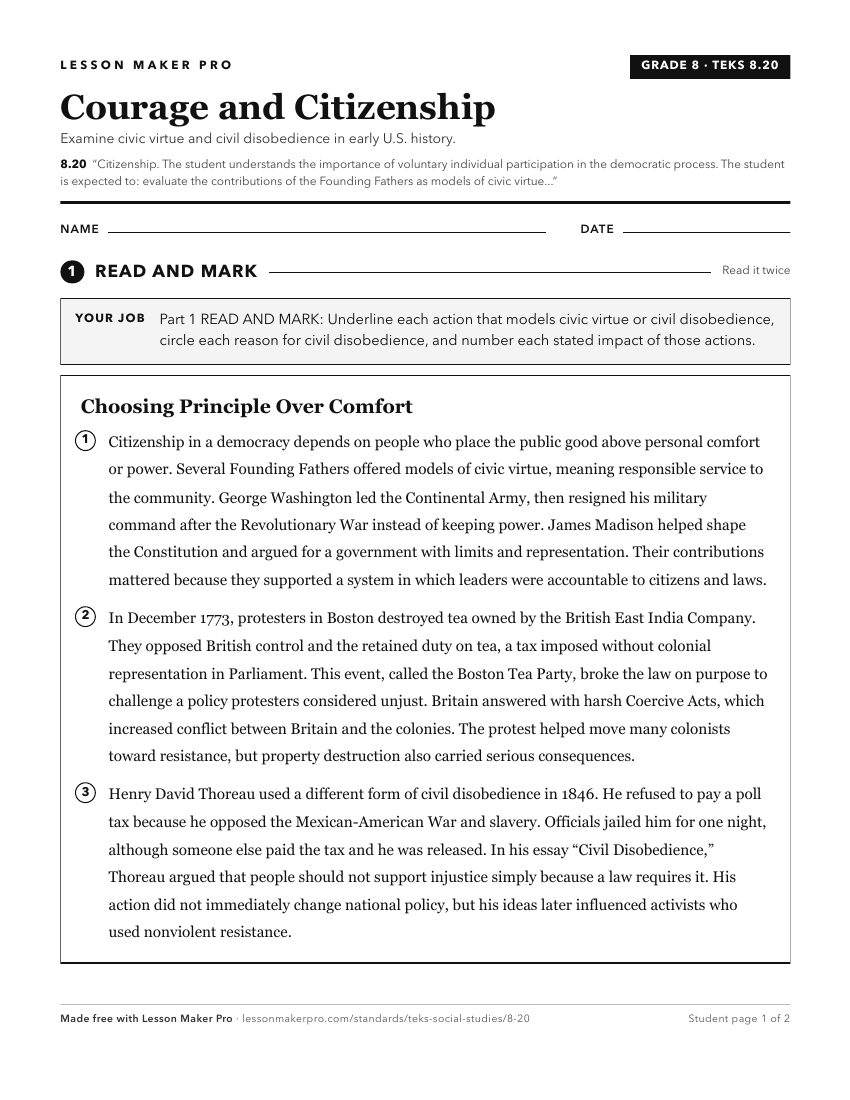
A ready-to-print activity worksheet aligned to 8.20, with an answer key for the teacher on its own page. No account needed.
PDF, US Letter, prints cleanly in black and white.
Download the worksheetKeep exploring
Related Standards
- 7.17
Citizenship. The student understands the importance of effective leadership in a democratic society. The student is expected to:
- 7.16
Citizenship. The student understands the importance of the expression of different points of view in a democratic society. The student is expected to:
- 4.15
Citizenship. The student understands the importance of active individual participation in the democratic process. The student is expected to:
- 5.17
Citizenship. The student understands the importance of individual participation in the democratic process at the local, state, and national levels. The student ...
Turn this cluster into a lesson
Grade, subject, topic, and the complete cluster are prefilled. Create one free, no account needed.
Also for this cluster:Make a WorksheetMake a QuizMake a Sub Lesson