Texas TEKS 7.19
TEKS Knowledge Statement (Expectation Cluster)
Science, technology, and society. The student understands the impact of scientific discoveries and technological innovations on the political, economic, and social development of Texas. The student is expected to: compare types and uses of technology, past and present; identify Texas leaders in science and technology such as Walter Cunningham, Michael DeBakey, Denton Cooley, Benjy Brooks, Michael Dell, and Howard Hughes Sr.; analyze the effects of various scientific discoveries and technological innovations on the development of Texas such as advancements in the agricultural, energy, medical, computer, and aerospace industries; evaluate the effects of scientific discoveries and technological innovations on the use of resources such as fossil fuels, water, and land; and analyze how scientific discoveries and technological innovations have resulted in an interdependence among Texas, the United States, and the world.
Texas Essential Knowledge and Skills for Social Studies
Cluster contents
Student Expectations in This Statement
7.19 is a TEKS knowledge and skills statement. These are the student expectations under it.
- 7.19.A
compare types and uses of technology, past and present
- 7.19.B
identify Texas leaders in science and technology such as Walter Cunningham, Michael DeBakey, Denton Cooley, Benjy Brooks, Michael Dell, and Howard Hughes Sr.
- 7.19.C
analyze the effects of various scientific discoveries and technological innovations on the development of Texas such as advancements in the agricultural, energy...
- 7.19.D
evaluate the effects of scientific discoveries and technological innovations on the use of resources such as fossil fuels, water, and land
- 7.19.E
analyze how scientific discoveries and technological innovations have resulted in an interdependence among Texas, the United States, and the world.
Teacher's field guide
What This Cluster Means
What Students Need to Do
- Students compare older and current technologies by purpose, speed, cost, and reach. They connect Texas science and technology leaders to specific contributions. They explain effects on government choices, jobs, communities, resources, and global connections.
What Mastery Looks Like
- A student can match Cunningham with spaceflight, DeBakey and Cooley with heart medicine, Brooks with pediatric surgery, Dell with computers, and Hughes with oil drilling. They can compare technologies and explain effects on people, industries, and resources. They can show how a Texas industry depends on national and global materials, workers, research, or markets.
Common Misconceptions
- Students often treat technology as only digital devices, overlooking drill bits, irrigation systems, medical tools, and spacecraft. They may mix up DeBakey and Cooley or confuse Hughes and Dell. They may list only benefits, assume newer is always better, or miss tradeoffs involving water, land, fossil fuels, and outside markets.
How to Assess It
- Show an early oil derrick and a modern drilling site. Ask students to name one changed use, one economic or social effect, one resource tradeoff, and one outside connection.
Lesson moves
Ways to Teach It
Have pairs sort picture cards of Texas technologies by era and industry, then build a cause and effect chain with yarn.
Ask students to write: Which Texas innovation produced the greatest benefit and cost, and what evidence supports your claim?
Play a matching relay using leader, innovation, industry, resource effect, and global connection cards, then require teams to justify each match.
Trace a smartphone supply chain from Texas chip design to overseas materials and markets, marking jobs, resources, and dependencies on a map.
Free download
Printable 7.19 Worksheet
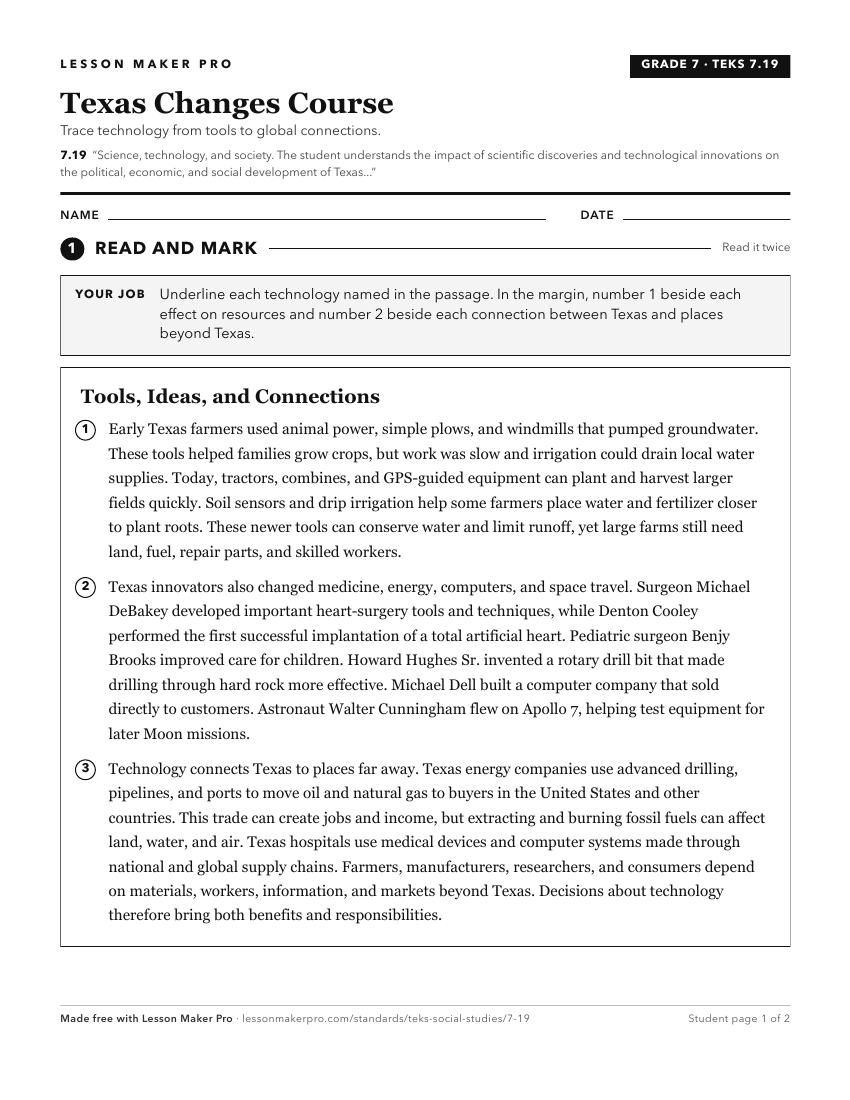
A ready-to-print activity worksheet aligned to 7.19, with an answer key for the teacher on its own page. No account needed.
PDF, US Letter, prints cleanly in black and white.
Download the worksheetKeep exploring
Related Standards
- 5.22
Science, technology, and society. The student understands the impact of science and technology on society in the United States. The student is expected to:
- 4.18
Science, technology, and society. The student understands the impact of science and technology on life in Texas. The student is expected to:
- 8.27
Science, technology, and society. The student understands the impact of science and technology on the economic development of the United States. The student is ...
- 8.28
Science, technology, and society. The student understands the impact of scientific discoveries and technological innovations on daily life in the United States....
Turn this cluster into a lesson
Grade, subject, topic, and the complete cluster are prefilled. Create one free, no account needed.
Also for this cluster:Make a WorksheetMake a QuizMake a Sub Lesson