Texas TEKS 7.10.D
The Standard
- 7.10
- Geography. The student understands the characteristics, distribution, and migration of population in Texas in the 19th, 20th, and 21st centuries. The student is expected to:
analyze the effects of the changing population distribution and growth in Texas and the additional need for education, health care, and transportation.
Texas Essential Knowledge and Skills for Social Studies
Teacher's field guide
What This Standard Means
What Students Need to Do
- Students read maps, graphs, and tables to identify where Texas populations are growing, shrinking, or shifting. They explain how those changes affect demand for schools, health care, roads, and public transit.
What Mastery Looks Like
- Students can compare two Texas regions or time periods and describe differences in population growth and location. They use data to connect each change to a specific public service need.
Common Misconceptions
- Students may assume population growth is spread evenly across Texas or that only total population matters. They may think schools, hospitals, and roads expand automatically when population grows. They may also overlook service needs in rural areas with shrinking or aging populations.
How to Assess It
- Exit ticket: A county grows from 100,000 to 130,000 residents, mostly in one suburb. Name one likely education, health care, and transportation need, citing the data.
Lesson moves
Ways to Teach It
Using county population cards, students place counters on a Texas map, then mark where new schools, clinics, and roads may be needed.
Ask students to write: How does rapid suburban growth change decisions about schools, hospitals, roads, and public transit?
Students sort Texas population scenarios into education, health care, and transportation needs, then justify each match to a partner.
Students compare local census growth data with nearby school construction, clinic locations, or road projects and explain one connection.
Free download
Printable 7.10.D Worksheet
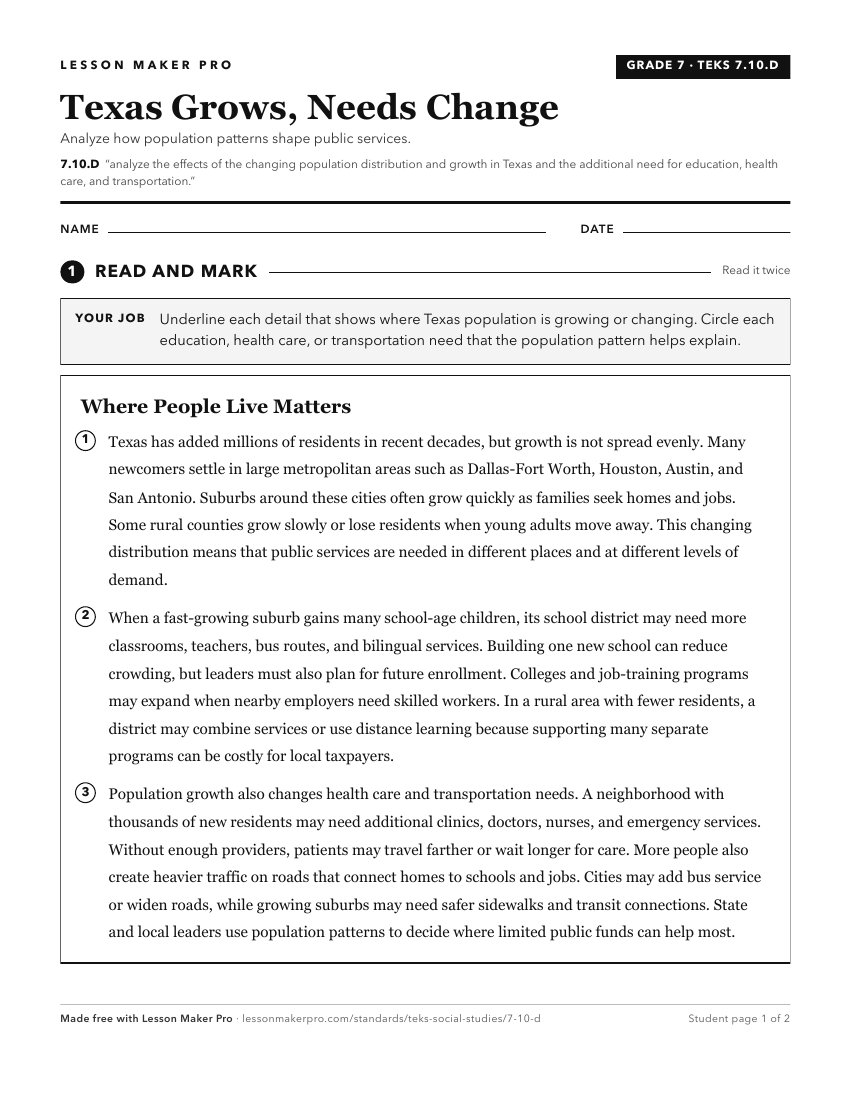
A ready-to-print activity worksheet aligned to 7.10.D, with an answer key for the teacher on its own page. No account needed.
PDF, US Letter, prints cleanly in black and white.
Download the worksheetKeep exploring
Related Standards
- 7.10.C
describe the structure of the population of Texas using demographic concepts such as growth rate and age distribution
- 4.11.C
identify the effects of exploration, immigration, migration, and limited resources on the economic development and growth of Texas
- 7.21.B
analyze and interpret geographic distributions and patterns in Texas during the 19th, 20th, and 21st centuries.
- 7.19.C
analyze the effects of various scientific discoveries and technological innovations on the development of Texas such as advancements in the agricultural, energy...
Turn this exact standard into a lesson
Grade, subject, topic, and the complete standard are prefilled. Create one free, no account needed.
Also for this standard:Make a WorksheetMake a QuizMake a Sub Lesson