Texas TEKS 8.7
TEKS Knowledge Statement (Expectation Cluster)
Force, motion, and energy. The student understands the relationship between force and motion within systems. The student is expected to: calculate and analyze how the acceleration of an object is dependent upon the net force acting on the object and the mass of the object using Newton's Second Law of Motion; and investigate and describe how Newton's three laws of motion act simultaneously within systems such as in vehicle restraints, sports activities, amusement park rides, Earth's tectonic activities, and rocket launches.
Texas Essential Knowledge and Skills for Science
Cluster contents
Student Expectations in This Statement
8.7 is a TEKS knowledge and skills statement. These are the student expectations under it.
- 8.7.A
calculate and analyze how the acceleration of an object is dependent upon the net force acting on the object and the mass of the object using Newton's Second La...
- 8.7.B
investigate and describe how Newton's three laws of motion act simultaneously within systems such as in vehicle restraints, sports activities, amusement park ri...
Teacher's field guide
What This Cluster Means
What Students Need to Do
- Students calculate net force and use a = Fnet ÷ m to find acceleration. They explain how force and mass affect acceleration, then identify all three Newton’s laws operating in one system.
What Mastery Looks Like
- Students combine forces with correct directions, calculate acceleration with units, and predict changes when force or mass changes. They can analyze a seatbelt, sport, ride, tectonic event, or rocket and explain each law with evidence.
Common Misconceptions
- Students may add all forces without considering direction, or think an object needs a net force to keep moving. They may think greater mass always means greater acceleration. They may also think action-reaction forces cancel, even though they act on different objects.
How to Assess It
- Give this exit ticket: “A 4 kg cart has 18 N right and 6 N left. Find its acceleration, then explain all three laws during a sudden stop.”
Lesson moves
Ways to Teach It
Push empty and loaded carts with the same spring scale force, measure acceleration, and graph acceleration against mass.
Write how all three laws act when a soccer player kicks a ball, naming the objects in each action-reaction pair.
Play a net-force card sort, matching force diagrams, masses, calculated accelerations, and motion predictions.
Analyze a seatbelt and airbag diagram, then explain how each reduces injury using force, mass, acceleration, and inertia.
Free download
Printable 8.7 Worksheet
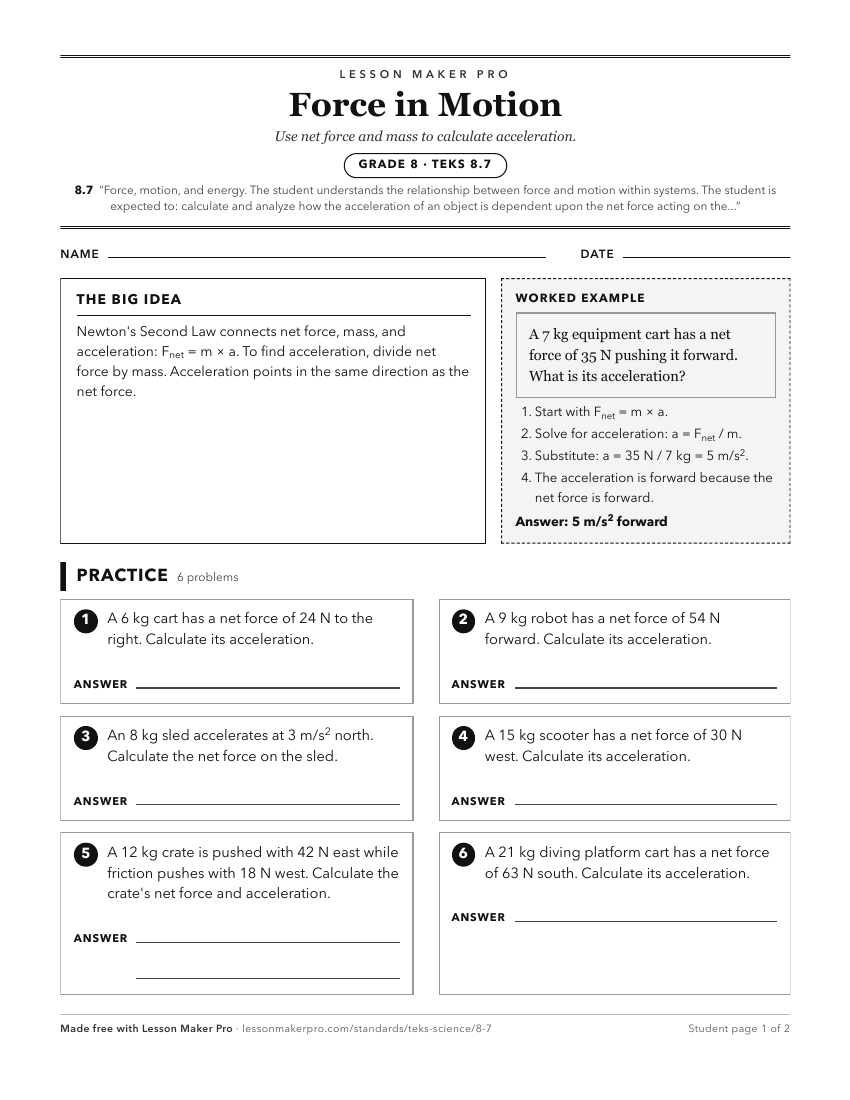
A ready-to-print activity worksheet aligned to 8.7, with an answer key for the teacher on its own page. No account needed.
PDF, US Letter, prints cleanly in black and white.
Download the worksheetKeep exploring
Related Standards
- 6.7
Force, motion, and energy. The student knows the nature of forces and their role in systems that experience stability or change. The student is expected to:
- 1.7
Force, motion, and energy. The student knows that forces cause changes in motion and position in everyday life. The student is expected to:
- 3.7
Force, motion, and energy. The student knows the nature of forces and the patterns of their interactions. The student is expected to:
- 5.7
Force, motion, and energy. The student knows the nature of forces and the patterns of their interactions. The student is expected to:
Turn this cluster into a lesson
Grade, subject, topic, and the complete cluster are prefilled. Create one free, no account needed.
Also for this cluster:Make a WorksheetMake a QuizMake a Sub Lesson