Texas TEKS 8.7.A
The Standard
- 8.7
- The student understands the relationship between force and motion within systems.
calculate and analyze how the acceleration of an object is dependent upon the net force acting on the object and the mass of the object using Newton's Second Law of Motion
Texas Essential Knowledge and Skills for Science
Teacher's field guide
What This Standard Means
What Students Need to Do
- Students find the net force, then use a = Fnet/m to calculate acceleration. They explain that greater net force increases acceleration, while greater mass decreases it.
What Mastery Looks Like
- Given force and mass data, a student calculates acceleration with correct units and direction. The student can predict how acceleration changes when force or mass changes.
Common Misconceptions
- Students may add opposing forces instead of subtracting them to find net force. They may confuse force with acceleration or assume a heavier object accelerates faster under the same force.
How to Assess It
- Exit ticket: A 6 kg cart has 18 N pushing right and 6 N pushing left. Find its acceleration, then predict the acceleration if its mass doubles.
Lesson moves
Ways to Teach It
Use a cart, spring scale, added masses, and motion sensor to compare acceleration when force changes and when mass changes.
Ask students to explain why the same push accelerates an empty shopping cart more than a loaded cart.
Play a card-matching game where students pair force and mass values with the correct acceleration, units, and direction.
Compare acceleration data for an empty wagon and a loaded wagon pulled with the same measured force.
Free download
Printable 8.7.A Worksheet
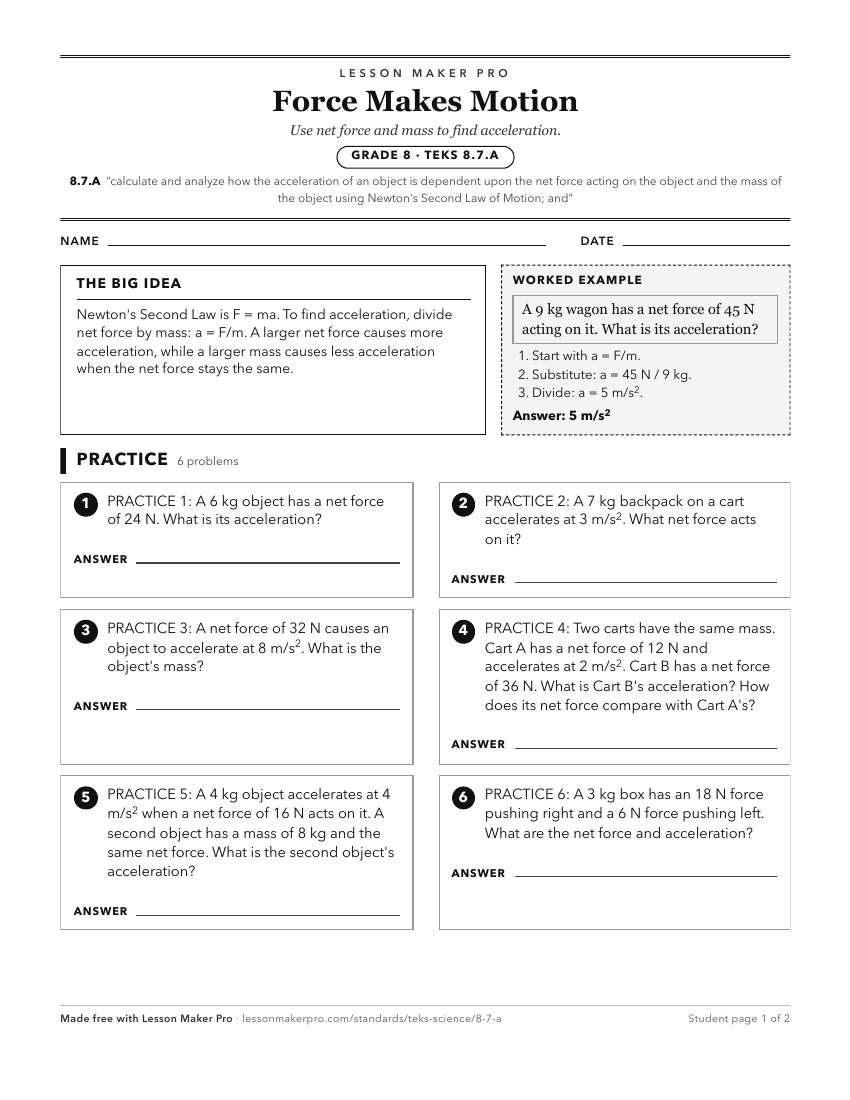
A ready-to-print activity worksheet aligned to 8.7.A, with an answer key for the teacher on its own page. No account needed.
PDF, US Letter, prints cleanly in black and white.
Download the worksheetKeep exploring
Related Standards
- 6.7.C
identify simultaneous force pairs that are equal in magnitude and opposite in direction that result from the interactions between objects using Newton's Third L...
- 7.7.D
analyze the effect of balanced and unbalanced forces on the state of motion of an object using Newton's First Law of Motion.
- 6.7.B
calculate the net force on an object in a horizontal or vertical direction using diagrams and determine if the forces are balanced or unbalanced
- 5.7.A
investigate and explain how equal and unequal forces acting on an object cause patterns of motion and transfer of energy
Turn this exact standard into a lesson
Grade, subject, topic, and the complete standard are prefilled. Create one free, no account needed.
Also for this standard:Make a WorksheetMake a QuizMake a Sub Lesson