Texas TEKS 7.2.A
The Standard
- 7.2
- Scientific and engineering practices. The student analyzes and interprets data to derive meaning, identify features and patterns, and discover relationships or correlations to develop evidence-based arguments or evaluate designs. The student is expected to:
identify advantages and limitations of models such as their size, scale, properties, and materials
Texas Essential Knowledge and Skills for Science
Teacher's field guide
What This Standard Means
What Students Need to Do
- Students compare a model with the object, system, or process it represents. They explain what the model shows well and what it leaves out or distorts.
What Mastery Looks Like
- Students can name a specific benefit and drawback of a model using evidence. They can explain how construction choices affect the model’s accuracy and usefulness.
Common Misconceptions
- Students may think a model is an exact copy or that larger models are always more accurate. They may also call a missing feature a flaw even when it was left out on purpose.
How to Assess It
- Show students a globe and a flat world map. Ask them to write one advantage and one limitation of each, with a reason.
Lesson moves
Ways to Teach It
Give groups a cell diagram, clay cell, and microscope image, then have them record what each represents well and poorly.
Ask students to write which model they would use to explain an eclipse to a younger student and defend their choice.
Play Model Match by having teams pair model cards with advantage and limitation cards, then explain each match.
Compare a weather forecast map with the next day’s actual weather, then discuss why forecast models cannot predict every local condition.
Free download
Printable 7.2.A Worksheet
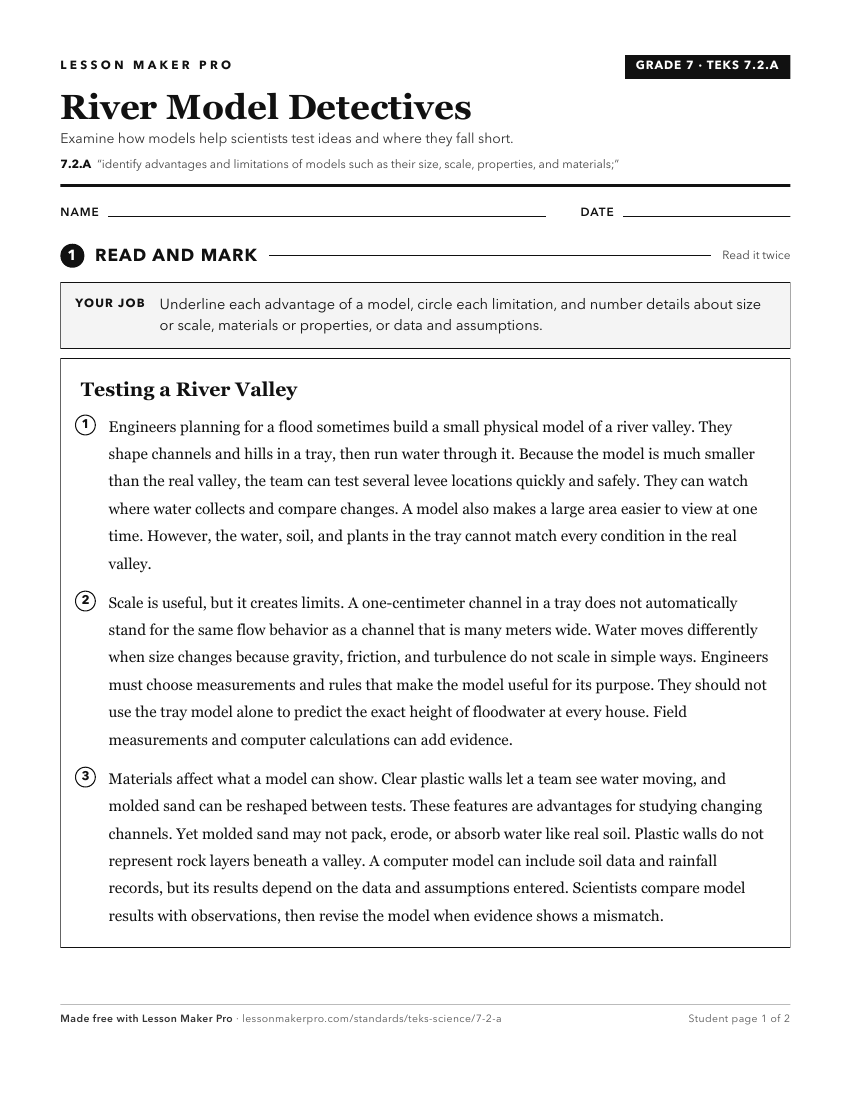
A ready-to-print activity worksheet aligned to 7.2.A, with an answer key for the teacher on its own page. No account needed.
PDF, US Letter, prints cleanly in black and white.
Download the worksheetKeep exploring
Related Standards
Turn this exact standard into a lesson
Grade, subject, topic, and the complete standard are prefilled. Create one free, no account needed.
Also for this standard:Make a WorksheetMake a QuizMake a Sub Lesson