Texas TEKS 7.14.B
The Standard
- 7.14
- Organisms and environments. The student knows how the taxonomic system is used to describe relationships between organisms. The student is expected to:
describe the characteristics of the recognized kingdoms and their importance in ecosystems such as bacteria aiding digestion or fungi decomposing organic matter.
Texas Essential Knowledge and Skills for Science
Teacher's field guide
What This Standard Means
What Students Need to Do
- Students compare kingdoms using cell type, number of cells, and how organisms get food. They connect each kingdom to ecosystem roles such as producing food, recycling nutrients, supporting digestion, or causing disease.
What Mastery Looks Like
- Students can place an unfamiliar organism in a likely kingdom using given traits. They can explain how members of that kingdom affect other organisms or the flow of matter in an ecosystem.
Common Misconceptions
- Students may classify fungi as plants or assume all microorganisms are bacteria. They often think all bacteria are harmful and overlook helpful species. Some describe decomposers as removing matter rather than recycling nutrients.
How to Assess It
- Give students traits for yeast and a gut bacterium. Ask them to name each kingdom and explain one ecosystem or organism-level benefit.
Lesson moves
Ways to Teach It
Have pairs sort organism cards by cell type, cell number, food source, and ecosystem role, then label each kingdom group.
Ask students to write which kingdom would cause the greatest ecosystem change if removed and defend their choice with two effects.
Play Kingdom Clue Relay, where teams identify an organism's kingdom after receiving one trait card at a time.
Students examine yogurt, bread, and compost labels or photos, then identify which kingdoms help produce or break down each item.
Free download
Printable 7.14.B Worksheet
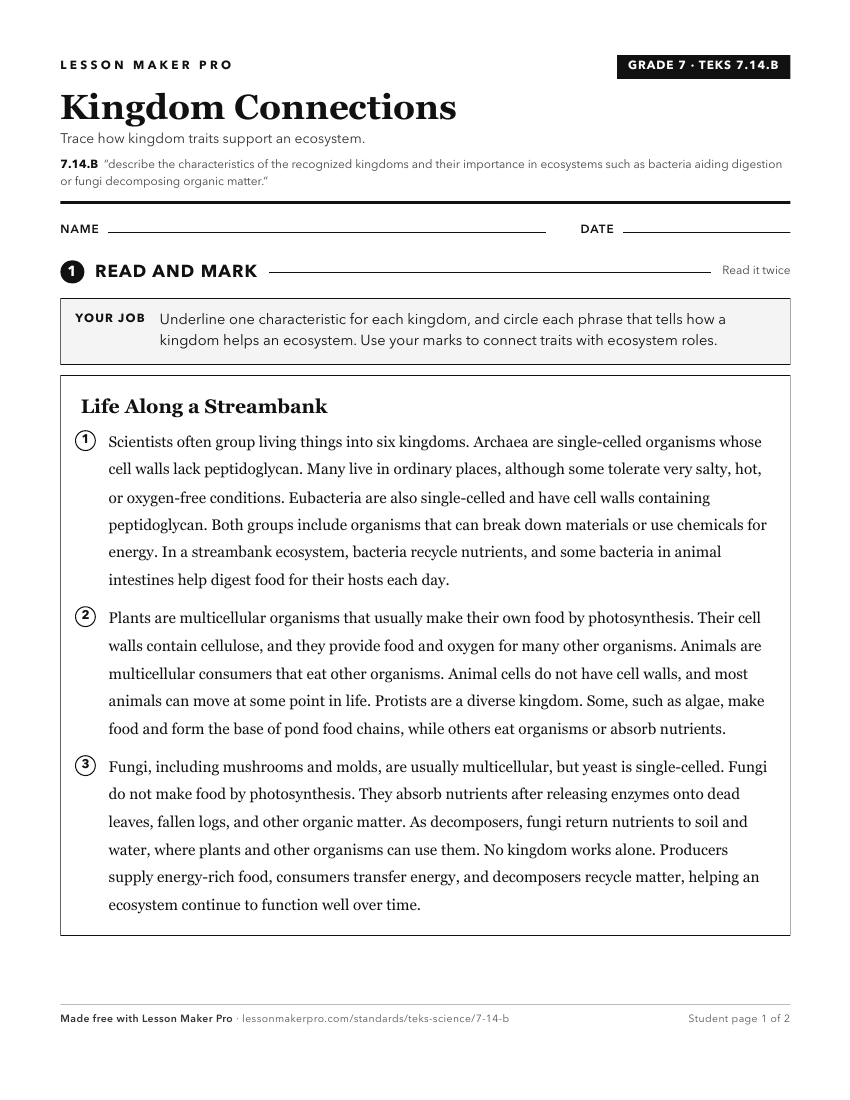
A ready-to-print activity worksheet aligned to 7.14.B, with an answer key for the teacher on its own page. No account needed.
PDF, US Letter, prints cleanly in black and white.
Download the worksheetKeep exploring
Related Standards
- 8.12.C
describe how biodiversity contributes to the stability and sustainability of an ecosystem and the health of the organisms within the ecosystem
- 1.12.C
identify and illustrate how living organisms depend on each other through food chains.
- 6.13.B
identify and compare the basic characteristics of organisms, including prokaryotic and eukaryotic, unicellular and multicellular, and autotrophic and heterotrop...
- 6.12.B
describe and give examples of predatory, competitive, and symbiotic relationships between organisms, including mutualism, parasitism, and commensalism
Turn this exact standard into a lesson
Grade, subject, topic, and the complete standard are prefilled. Create one free, no account needed.
Also for this standard:Make a WorksheetMake a QuizMake a Sub Lesson