Texas TEKS 7.1.E
The Standard
- 7.1
- Scientific and engineering practices. The student, for at least 40% of instructional time, asks questions, identifies problems, and plans and safely conducts classroom, laboratory, and field investigations to answer questions, explain phenomena, or design solutions using appropriate tools and models. The student is expected to:
collect quantitative data using the International System of Units (SI) and qualitative data as evidence
Texas Essential Knowledge and Skills for Science
Teacher's field guide
What This Standard Means
What Students Need to Do
- Students use tools such as rulers, balances, and graduated cylinders to record measurements with SI units. They also record observable features such as color, texture, and odor. They use both types of data to support a claim.
What Mastery Looks Like
- Students choose the right tool and unit, measure carefully, and label every value. They write objective descriptions and explain how specific observations support a conclusion.
Common Misconceptions
- Students may record numbers without units or choose units that do not fit the measurement. They may confuse qualitative observations with opinions or guesses. They may also report more precision than the tool allows.
How to Assess It
- Give each student a leaf and this prompt: Record two SI measurements, two qualitative observations, and one claim supported by your data.
Lesson moves
Ways to Teach It
Have students measure and describe three rocks using a ruler, balance, hand lens, and a prepared data table.
Ask students to explain why “the liquid looks unsafe” is weaker evidence than specific measurements and observations.
Play a unit-match relay where teams pair measurement cards with the correct tool and SI unit.
Compare nutrition labels by recording package mass and describing food color, texture, and shape as evidence for sorting products.
Free download
Printable 7.1.E Worksheet
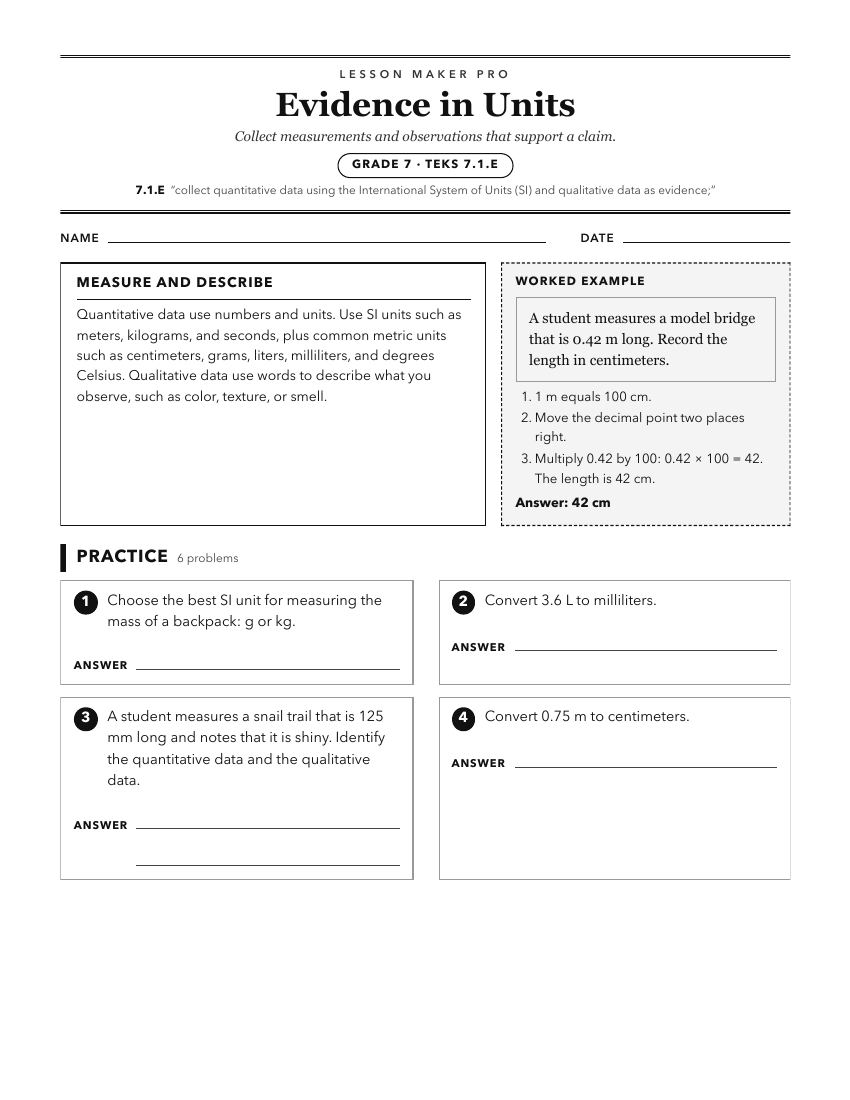
A ready-to-print activity worksheet aligned to 7.1.E, with an answer key for the teacher on its own page. No account needed.
PDF, US Letter, prints cleanly in black and white.
Download the worksheetKeep exploring
Related Standards
Turn this exact standard into a lesson
Grade, subject, topic, and the complete standard are prefilled. Create one free, no account needed.
Also for this standard:Make a WorksheetMake a QuizMake a Sub Lesson