Texas TEKS 2.6.B
The Standard
- 2.6
- Matter and its properties. The student knows that matter has physical properties that determine how it is described, classified, and used. The student is expected to:
conduct a descriptive investigation to explain how physical properties can be changed through processes such as cutting, folding, sanding, melting, or freezing
Texas Essential Knowledge and Skills for Science
Teacher's field guide
What This Standard Means
What Students Need to Do
- Students observe a material before and after an action. They record changes in shape, size, texture, or state, then explain which action caused each change.
What Mastery Looks Like
- Students accurately describe at least two properties before and after an action. They use observations to explain the change and recognize that the material remains the same kind of material.
Common Misconceptions
- Students may describe only the action, such as “I cut it,” instead of the resulting property change. They may think melted material disappeared or that folded paper became a new material.
How to Assess It
- Give each student an index card to observe, fold, and cut. Ask them to record two before-and-after property changes and name the action that caused each one.
Lesson moves
Ways to Teach It
Set up stations where students cut paper, fold foil, sand wood, and observe ice melting while recording before-and-after properties.
Ask students to write: How did the material change, and what observations prove that change?
Play a matching game with action cards, before-and-after pictures, and property words such as rough, smooth, solid, and liquid.
Examine butter, ice, folded clothing, and sanded furniture, then identify how each material’s physical properties changed during everyday use.
Free download
Printable 2.6.B Worksheet
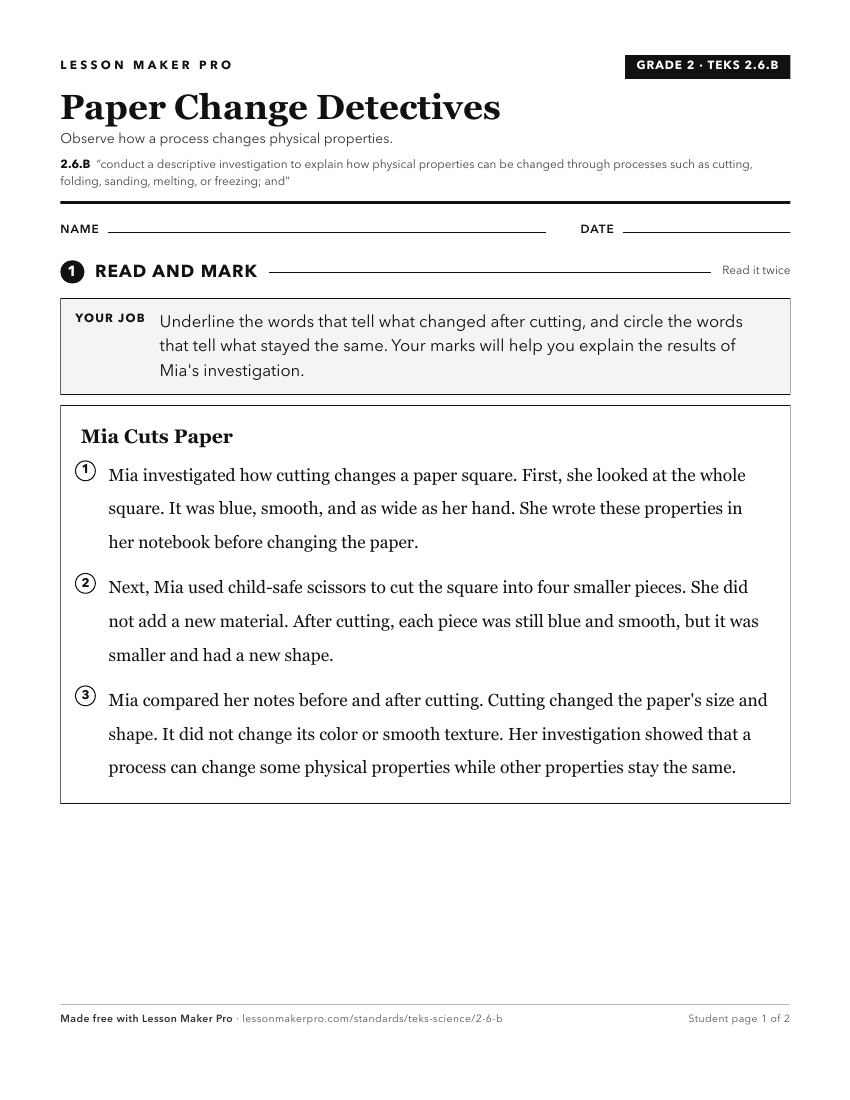
A ready-to-print activity worksheet aligned to 2.6.B, with an answer key for the teacher on its own page. No account needed.
PDF, US Letter, prints cleanly in black and white.
Download the worksheetKeep exploring
Related Standards
- 2.6.A
classify matter by observable physical properties, including texture, flexibility, and relative temperature, and identify whether a material is a solid or liqui...
- 3.6.D
demonstrate that materials can be combined based on their physical properties to create or modify objects such as building a tower or adding clay to sand to mak...
- 1.6.B
explain and predict changes in materials caused by heating and cooling
- 2.6.C
demonstrate that small units such as building blocks can be combined or reassembled to form new objects for different purposes and explain the materials chosen ...
Turn this exact standard into a lesson
Grade, subject, topic, and the complete standard are prefilled. Create one free, no account needed.
Also for this standard:Make a WorksheetMake a QuizMake a Sub Lesson