Texas TEKS 1.6.B
The Standard
- 1.6
- Matter and its properties. The student knows that objects have physical properties that determine how they are described and classified. The student is expected to:
explain and predict changes in materials caused by heating and cooling
Texas Essential Knowledge and Skills for Science
Teacher's field guide
What This Standard Means
What Students Need to Do
- Students observe what happens to materials when their temperature changes. They make a prediction, then use what they see to explain melting, freezing, softening, or hardening.
What Mastery Looks Like
- A student can predict that ice will melt in a warm place and water will freeze in a freezer. The student can describe evidence using words or drawings.
Common Misconceptions
- Students may think every material melts or freezes in the same way. They may believe cooling makes materials disappear or that all temperature changes are permanent.
How to Assess It
- Show pictures of a frozen juice pop before and after sitting outside. Ask students to draw what happens next in a freezer and explain why.
Lesson moves
Ways to Teach It
Place sealed bags of butter in warm and ice water, then have students sketch and label how each sample changes.
Ask, “What will happen to an ice cube on the playground, and what evidence supports your prediction?”
Play a card sort where students match each material to heated and cooled pictures, then explain one match to a partner.
Compare a packed lunch with and without an ice pack, and discuss how cooling helps food stay firm and fresh.
Free download
Printable 1.6.B Worksheet
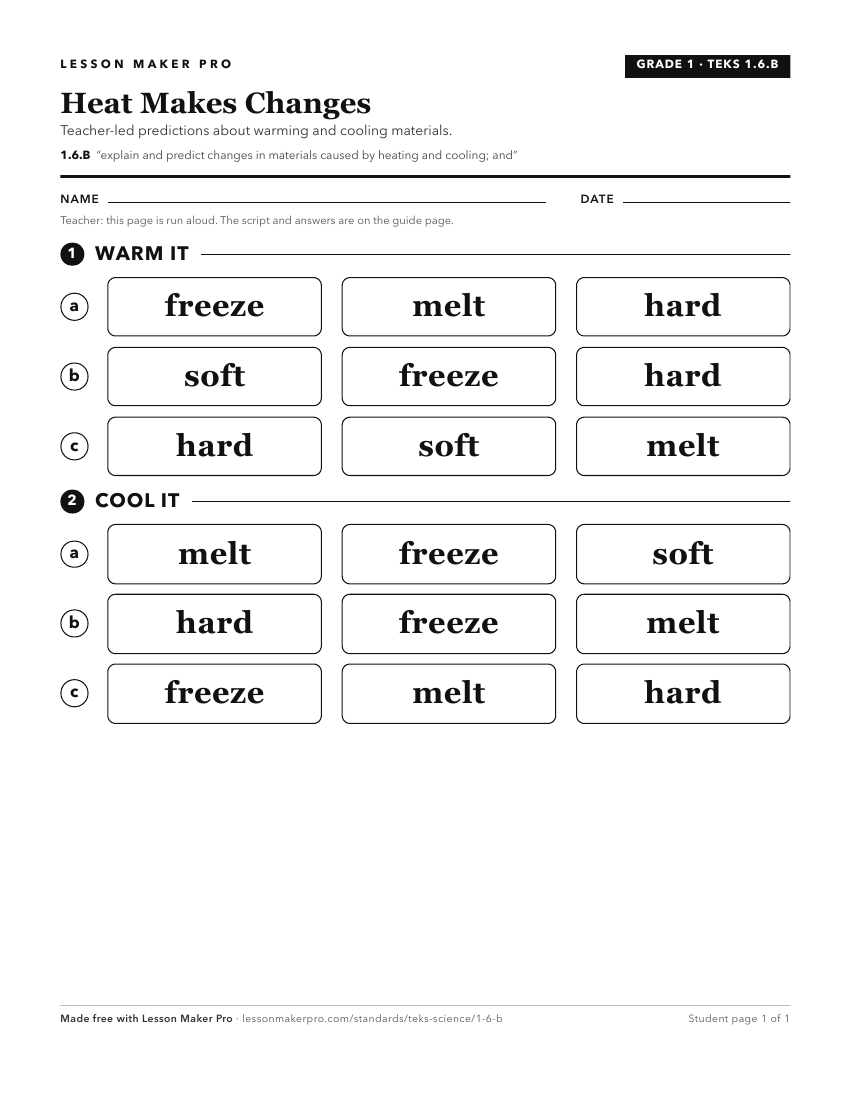
A ready-to-print activity worksheet aligned to 1.6.B, with an answer key for the teacher on its own page. No account needed.
PDF, US Letter, prints cleanly in black and white.
Download the worksheetKeep exploring
Related Standards
- 7.8.B
investigate how thermal energy moves in a predictable pattern from warmer to cooler until all substances within the system reach thermal equilibrium
- 2.6.B
conduct a descriptive investigation to explain how physical properties can be changed through processes such as cutting, folding, sanding, melting, or freezing
- 3.6.C
predict, observe, and record changes in the state of matter caused by heating or cooling in a variety of substances such as ice becoming liquid water, condensat...
- 1.8.A
investigate and describe applications of heat in everyday life such as cooking food or using a clothes dryer
Turn this exact standard into a lesson
Grade, subject, topic, and the complete standard are prefilled. Create one free, no account needed.
Also for this standard:Make a WorksheetMake a QuizMake a Sub Lesson