Texas TEKS 1.8.B
The Standard
- 1.8
- Force, motion, and energy. The student knows that energy is everywhere and can be observed in everyday life. The student is expected to:
describe how some changes caused by heat may be reversed such as melting butter and other changes cannot be reversed such as cooking an egg or baking a cake.
Texas Essential Knowledge and Skills for Science
Teacher's field guide
What This Standard Means
What Students Need to Do
- Students observe how materials change when warmed. They decide whether cooling can return each material to its earlier state and describe the evidence they see.
What Mastery Looks Like
- A student can sort examples such as melted chocolate, toasted bread, and a cooked pancake by whether the change can be reversed. The student explains what cooling would do in each case.
Common Misconceptions
- Students may think every heated material returns to normal when it cools. They may also confuse changing shape with forming a material that cannot return to its earlier state.
How to Assess It
- Show pictures of a melting ice pop and a cooked pancake. Ask, “Which change could be reversed by cooling, and how do you know?”
Lesson moves
Ways to Teach It
Seal an ice cube in a clear bag, let students warm it with their hands, then refreeze it and compare each stage.
Ask students to draw one heated material before and after heating, then explain whether cooling would restore it.
Give pairs picture cards of heated foods and materials to sort into “can change back” and “cannot change back” groups.
Study kitchen photos of melted cheese, toasted bread, and frozen juice, then discuss what happens when each item cools.
Free download
Printable 1.8.B Worksheet
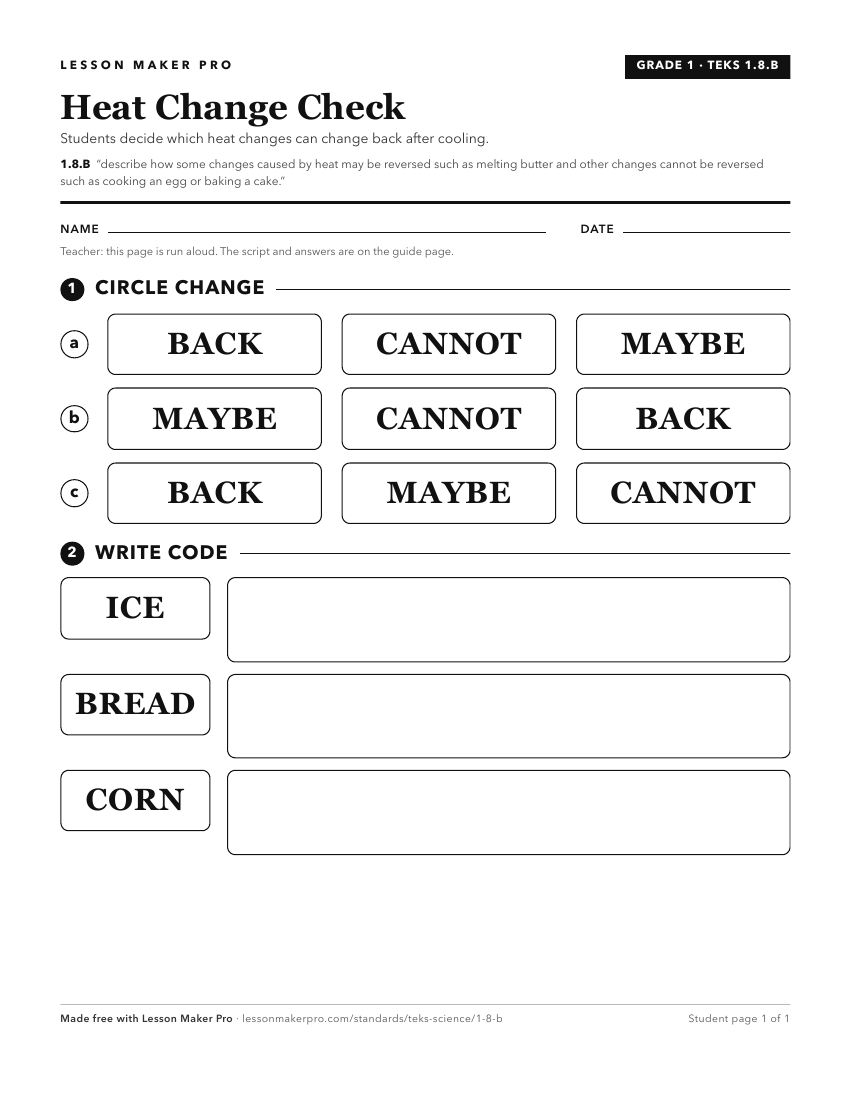
A ready-to-print activity worksheet aligned to 1.8.B, with an answer key for the teacher on its own page. No account needed.
PDF, US Letter, prints cleanly in black and white.
Download the worksheetKeep exploring
Related Standards
- 1.6.B
explain and predict changes in materials caused by heating and cooling
- 2.6.B
conduct a descriptive investigation to explain how physical properties can be changed through processes such as cutting, folding, sanding, melting, or freezing
- 3.6.C
predict, observe, and record changes in the state of matter caused by heating or cooling in a variety of substances such as ice becoming liquid water, condensat...
- 1.8.A
investigate and describe applications of heat in everyday life such as cooking food or using a clothes dryer
Turn this exact standard into a lesson
Grade, subject, topic, and the complete standard are prefilled. Create one free, no account needed.
Also for this standard:Make a WorksheetMake a QuizMake a Sub Lesson