TEKS Math K.5
The Standard
The student applies mathematical process standards to identify the pattern in the number word list. The student is expected to recite numbers up to at least 100 by ones and tens beginning with any given number
Texas Essential Knowledge and Skills for Mathematics
Teacher's field guide
What This Standard Means
What Students Need to Do
- Students continue a spoken number sequence from a number the teacher chooses. They count forward by ones or add ten each time without beginning again at 1.
What Mastery Looks Like
- A student can begin at an unfamiliar number and continue the sequence without restarting. The student counts by ones across decade changes and by tens while keeping the same ones digit.
Common Misconceptions
- Students may restart at 1 or 10 instead of using the given starting number. They may skip numbers at decade changes, such as going from 39 to 50. When counting by tens, they may change the ones digit instead of keeping it the same.
How to Assess It
- Ask each student to count by ones from 46 to 55, then by tens from 7 to 97. Note any pauses, skipped numbers, or incorrect decade changes.
Lesson moves
Ways to Teach It
Students place a counter on a hundred chart and move one square or ten squares while saying each number.
Ask, “What stays the same and what changes when we count by tens from 6?” Students explain using 6, 16, and 26.
Play Start and Step: students draw a starting-number card and a ones-or-tens card, then count aloud toward 100.
Count classroom supplies by ones, then mark every tenth item on a tally sheet to connect counting with inventory.
Free download
Printable K.5 Worksheet
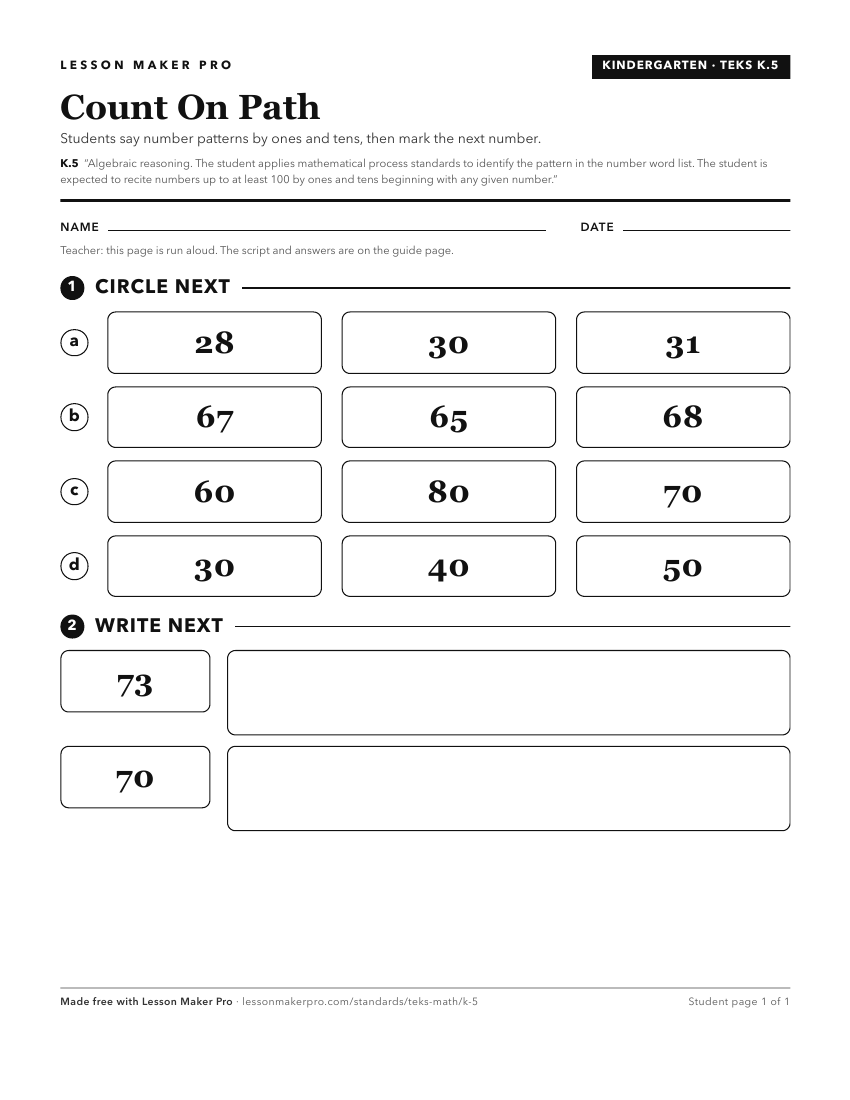
A ready-to-print activity worksheet aligned to K.5, with an answer key for the teacher on its own page. No account needed.
PDF, US Letter, prints cleanly in black and white.
Download the worksheetKeep exploring
Related Standards
- K.2
The student applies mathematical process standards to understand how to represent and compare whole numbers, the relative position and magnitude of whole number...
- 1.5
The student applies mathematical process standards to identify and apply number patterns within properties of numbers and operations in order to describe relati...
- 1.2
The student applies mathematical process standards to represent and compare whole numbers, the relative position and magnitude of whole numbers, and relationsh...
- 4.2
The student applies mathematical process standards to represent, compare, and order whole numbers and decimals and understand relationships related to place val...
Turn this exact standard into a lesson
Grade, subject, topic, and the complete standard are prefilled. Create one free, no account needed.
Also for this standard:Make a WorksheetMake a QuizMake a Sub Lesson