TEKS Math 7.6.E
The Standard
find the probabilities of a simple event and its complement and describe the relationship between the two
Texas Essential Knowledge and Skills for Mathematics
Teacher's field guide
What This Standard Means
What Students Need to Do
- Students calculate the chance that one named result occurs. They identify all outcomes outside that result and use subtraction from 1 to find the opposite probability.
What Mastery Looks Like
- Given a spinner, die, deck, or written situation, students identify the relevant outcomes and write each probability as a fraction, decimal, or percent. Their two probabilities add to 1, and they can explain why.
Common Misconceptions
- Students may treat the complement as one different outcome rather than every outcome outside the event. They may use an incorrect total or think both probabilities must equal one-half. They may also forget that the two values must add to 1.
How to Assess It
- Exit ticket: A bag has 5 red, 3 blue, and 2 green tiles. Find P(red) and P(not red), then explain their relationship in one sentence.
Lesson moves
Ways to Teach It
Give pairs a bag of colored cubes, then have them count outcomes and record the probability of drawing blue and not blue.
Ask students to respond: If P(rain) is 0.35, what is P(no rain), and why must the two values total 1?
Play Complement Match with cards showing events and probabilities, and have teams pair each card with its complement before checking sums.
Use a basketball player's 72 percent free throw rate to calculate the chance of a miss and interpret both values.
Free download
Printable 7.6.E Worksheet
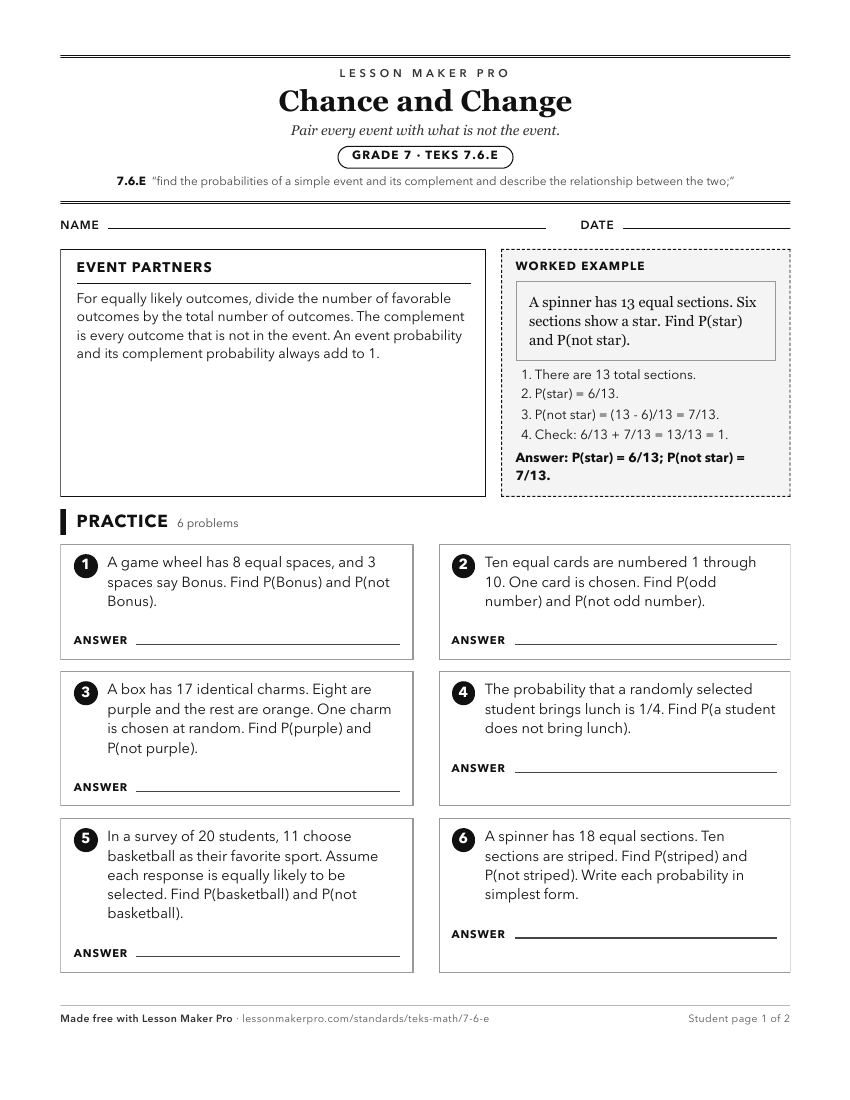
A ready-to-print activity worksheet aligned to 7.6.E, with an answer key for the teacher on its own page. No account needed.
PDF, US Letter, prints cleanly in black and white.
Download the worksheetKeep exploring
Related Standards
- 7.6.D
make predictions and determine solutions using theoretical probability for simple and compound events
- 7.6.C
make predictions and determine solutions using experimental data for simple and compound events
- 7.6.I
determine experimental and theoretical probabilities related to simple and compound events using data and sample spaces.
- 7.6.A
represent sample spaces for simple and compound events using lists and tree diagrams
Turn this exact standard into a lesson
Grade, subject, topic, and the complete standard are prefilled. Create one free, no account needed.
Also for this standard:Make a WorksheetMake a QuizMake a Sub Lesson