TEKS Math 7.6.D
The Standard
make predictions and determine solutions using theoretical probability for simple and compound events
Texas Essential Knowledge and Skills for Mathematics
Teacher's field guide
What This Standard Means
What Students Need to Do
- Students list all possible outcomes for one-step and multistep chance events. They calculate theoretical probabilities from those outcomes. They use the probabilities to predict how often an outcome should occur over many trials.
What Mastery Looks Like
- A student builds a complete sample space using a list, table, or tree diagram. The student calculates probabilities for simple and compound events. The student then uses each probability to make a reasonable frequency prediction.
Common Misconceptions
- Students may count only desired outcomes and ignore the total number of possible outcomes. They may add probabilities when both events must happen, or multiply when either event can happen. They may treat a prediction as an exact result instead of an expected long-run result.
How to Assess It
- Exit ticket: A bag holds three red and two blue tiles. If a tile is replaced after each draw, find the probability of two reds and predict how often this occurs in 100 trials.
Lesson moves
Ways to Teach It
Have pairs roll two number cubes, build a 36-outcome table, and calculate the theoretical probability of selected sums.
Ask students to explain why a probability of one-fourth does not guarantee exactly 25 successes in 100 trials.
Give teams event cards to sort into addition or multiplication problems, then award points for correct calculations and explanations.
Use a school raffle with numbered tickets to calculate winning probabilities and predict winners across several identical raffles.
Free download
Printable 7.6.D Worksheet
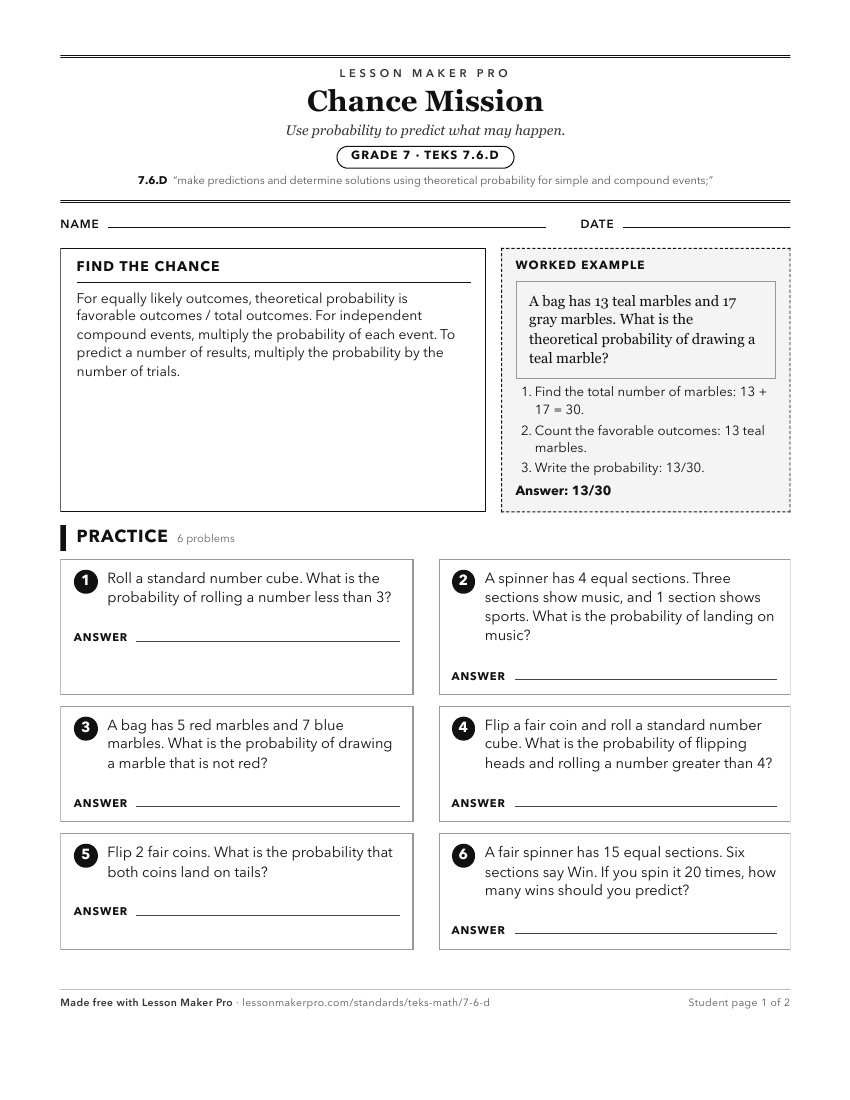
A ready-to-print activity worksheet aligned to 7.6.D, with an answer key for the teacher on its own page. No account needed.
PDF, US Letter, prints cleanly in black and white.
Download the worksheetKeep exploring
Related Standards
- 7.6.C
make predictions and determine solutions using experimental data for simple and compound events
- 7.6.I
determine experimental and theoretical probabilities related to simple and compound events using data and sample spaces.
- 7.6.A
represent sample spaces for simple and compound events using lists and tree diagrams
- 7.6.H
solve problems using qualitative and quantitative predictions and comparisons from simple experiments; and
Turn this exact standard into a lesson
Grade, subject, topic, and the complete standard are prefilled. Create one free, no account needed.
Also for this standard:Make a WorksheetMake a QuizMake a Sub Lesson