TEKS Math 7.6.C
The Standard
make predictions and determine solutions using experimental data for simple and compound events
Texas Essential Knowledge and Skills for Mathematics
Teacher's field guide
What This Standard Means
What Students Need to Do
- Students turn trial counts into experimental probabilities for one outcome or combined outcomes. They use those rates to predict how often an event should occur in more trials.
What Mastery Looks Like
- Given a results table, a student counts trials matching an event such as red or even and divides by total trials. The student scales that rate to a new number of trials and labels the prediction as an estimate.
Common Misconceptions
- Students may use theoretical outcomes instead of the recorded counts. They may count overlapping categories twice for an "or" event, or multiply rates automatically for an "and" event. Some treat a prediction as an exact future count.
How to Assess It
- Give this exit ticket: "In 100 trials, results were red circle 18, red square 22, blue circle 25, and blue square 35. Estimate the probability of red, then predict how many of 200 future trials will be red or circle." Require students to show which counts they combined.
Lesson moves
Ways to Teach It
Pairs toss two coins 50 times, record each outcome, estimate two heads and at least one head, then predict results for 100 tosses.
Display two groups' spinner data and ask, "Why do their estimates differ, and which estimate would you trust more?"
Give teams trial-data cards; they earn points by calculating an event's experimental probability and making the closest reasonable forecast.
Use a basketball player's last 40 free throws to predict makes in the next 25, then compare predictions after another game.
Free download
Printable 7.6.C Worksheet
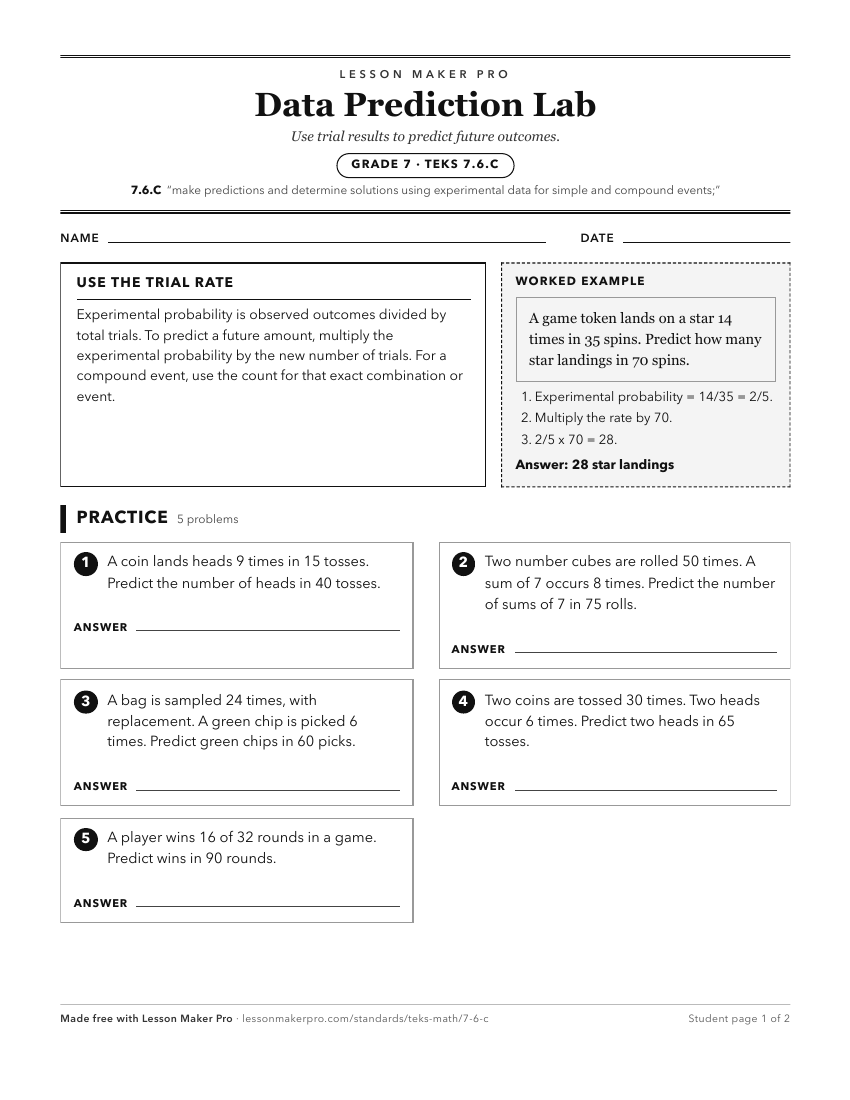
A ready-to-print activity worksheet aligned to 7.6.C, with an answer key for the teacher on its own page. No account needed.
PDF, US Letter, prints cleanly in black and white.
Download the worksheetKeep exploring
Related Standards
- 7.6.D
make predictions and determine solutions using theoretical probability for simple and compound events
- 7.6.B
select and use different simulations to represent simple and compound events with and without technology
- 7.6.I
determine experimental and theoretical probabilities related to simple and compound events using data and sample spaces.
- 7.6.H
solve problems using qualitative and quantitative predictions and comparisons from simple experiments; and
Turn this exact standard into a lesson
Grade, subject, topic, and the complete standard are prefilled. Create one free, no account needed.
Also for this standard:Make a WorksheetMake a QuizMake a Sub Lesson