TEKS Math 7.6.B
The Standard
select and use different simulations to represent simple and compound events with and without technology
Texas Essential Knowledge and Skills for Mathematics
Teacher's field guide
What This Standard Means
What Students Need to Do
- Students choose a physical or digital simulation that matches a chance event. They run repeated trials for simple or compound events, record outcomes, and use the results to estimate probability.
What Mastery Looks Like
- A student can match an event to a spinner, number cube, card draw, table, or digital random generator. They can run repeated trials, record results, estimate probability, and explain why the model fits.
Common Misconceptions
- Students may assume simulation outcomes must be equally likely, even when the event gives different probabilities. They may run too few trials, forget to replace an item, or model only one stage of a compound event.
How to Assess It
- Give this exit ticket: “A player wins by rolling an even number and flipping heads. Choose a simulation, run 20 trials, record wins, and estimate the probability.”
Lesson moves
Ways to Teach It
Place colored counters in a bag, have students model a simple draw and a two-draw event, then compare results after 30 trials.
Ask students to explain whether a spinner or random number generator better models a carnival game with unequal prize chances.
Give groups event cards and simulation tool cards, then award points for correct matches and clear explanations.
Simulate whether two randomly selected students share a birth month, then discuss how planners might estimate attendance conflicts.
Free download
Printable 7.6.B Worksheet
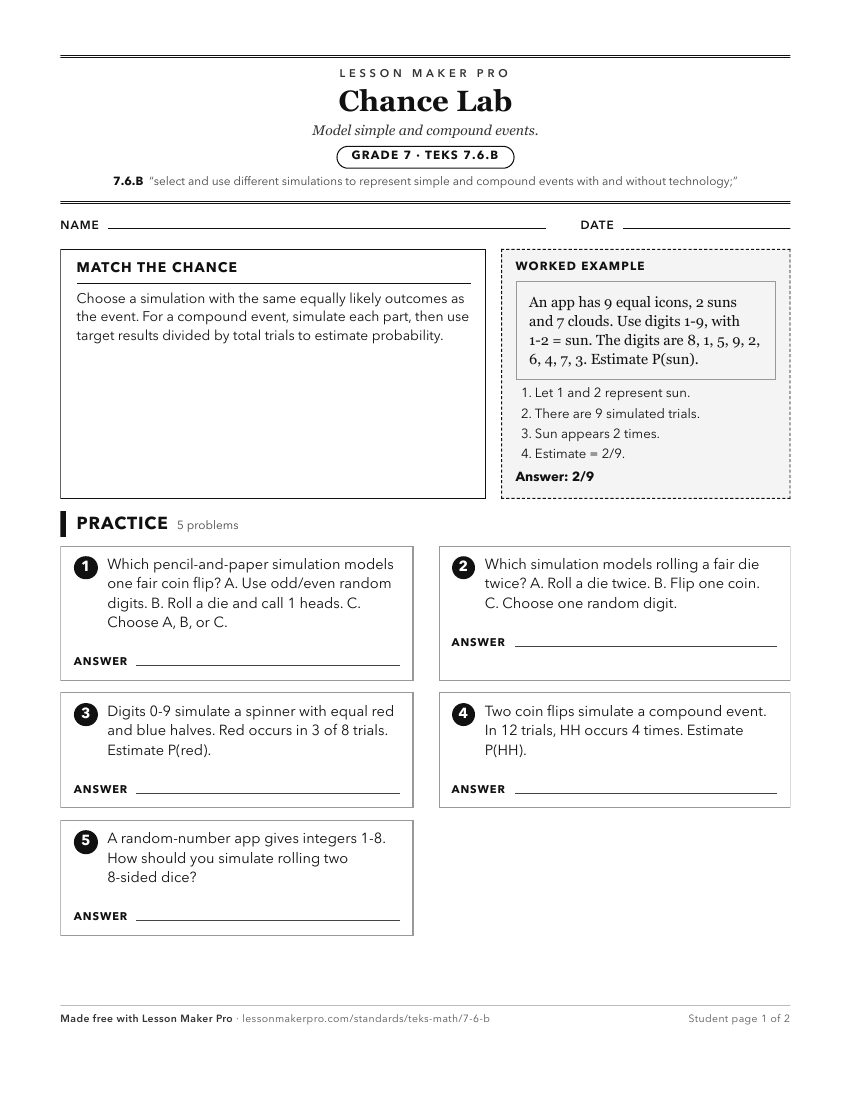
A ready-to-print activity worksheet aligned to 7.6.B, with an answer key for the teacher on its own page. No account needed.
PDF, US Letter, prints cleanly in black and white.
Download the worksheetKeep exploring
Related Standards
- 7.6.D
make predictions and determine solutions using theoretical probability for simple and compound events
- 7.6.C
make predictions and determine solutions using experimental data for simple and compound events
- 7.6.I
determine experimental and theoretical probabilities related to simple and compound events using data and sample spaces.
- 7.6.A
represent sample spaces for simple and compound events using lists and tree diagrams
Turn this exact standard into a lesson
Grade, subject, topic, and the complete standard are prefilled. Create one free, no account needed.
Also for this standard:Make a WorksheetMake a QuizMake a Sub Lesson