TEKS Math 7.11.B
The Standard
determine if the given value(s) make(s) one-variable, two-step equations and inequalities true
Texas Essential Knowledge and Skills for Mathematics
Teacher's field guide
What This Standard Means
What Students Need to Do
- Students replace the variable with each given value. They simplify both sides, compare the results, and decide whether the equation or inequality is true.
What Mastery Looks Like
- A student substitutes accurately and simplifies both sides in the correct order. The student states true or false and supports the decision with a correct numerical comparison.
Common Misconceptions
- Students may solve for the variable instead of testing the given value. They may use the wrong operation order or reverse an inequality sign when only substituting.
How to Assess It
- Exit ticket: Decide whether x = 4 makes 3x - 2 = 10 and 2x + 1 < 8 true. Show each substitution.
Lesson moves
Ways to Teach It
Give students value cards and expression cards, then have them substitute, calculate, and sort each result under true or false.
Ask students to explain why x = 3 makes 4x - 1 > 10 true without solving the inequality.
Play a true-or-false relay where teams test one given value in an equation or inequality before passing the marker.
Use phone plans with a fixed fee and per-gigabyte charge, then test whether given usage amounts match or stay under a bill limit.
Free download
Printable 7.11.B Worksheet
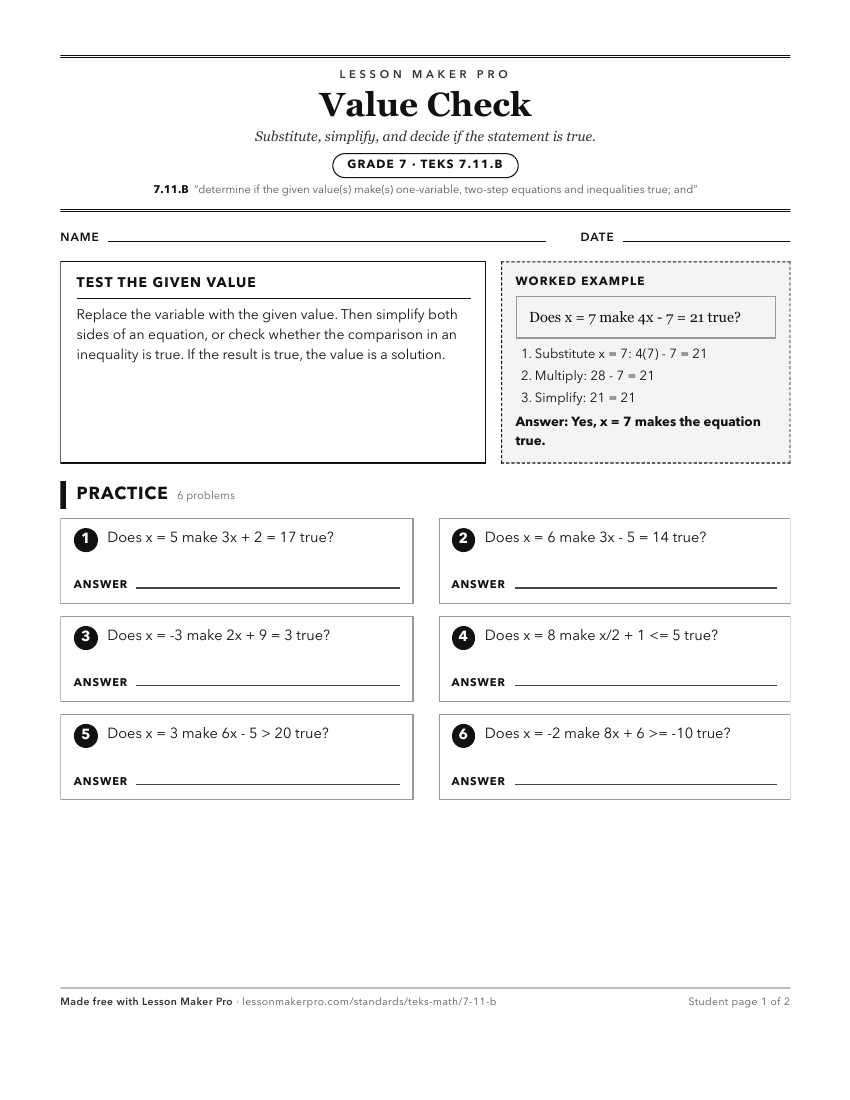
A ready-to-print activity worksheet aligned to 7.11.B, with an answer key for the teacher on its own page. No account needed.
PDF, US Letter, prints cleanly in black and white.
Download the worksheetKeep exploring
Related Standards
- 7.11.A
model and solve one-variable, two-step equations and inequalities
- 7.10.A
write one-variable, two-step equations and inequalities to represent constraints or conditions within problems
- 6.10.B
determine if the given value(s) make(s) one-variable, one-step equations or inequalities true
- 7.10.C
write a corresponding real-world problem given a one-variable, two-step equation or inequality
Turn this exact standard into a lesson
Grade, subject, topic, and the complete standard are prefilled. Create one free, no account needed.
Also for this standard:Make a WorksheetMake a QuizMake a Sub Lesson