TEKS Math 6.10.B
The Standard
determine if the given value(s) make(s) one-variable, one-step equations or inequalities true
Texas Essential Knowledge and Skills for Mathematics
Teacher's field guide
What This Standard Means
What Students Need to Do
- Students substitute each given number for the variable, then simplify both sides. They decide whether the resulting equation or inequality is true or false.
What Mastery Looks Like
- A student writes the substituted expression, computes accurately, and labels each value true or false. The student explains the decision by comparing both sides.
Common Misconceptions
- Students may solve for the variable instead of checking the provided value. They may confuse < with ≤ or > with ≥. Negative values and multiplication beside a variable can also cause errors.
How to Assess It
- Exit ticket: Test x = 4 in 2x + 3 = 11 and x = 5 in 3x - 2 < 12. Show each substitution and write true or false.
Lesson moves
Ways to Teach It
Place variable, operation, number, and relation cards on a mat, then replace the variable with a value card and evaluate both sides.
Students answer the prompt, “How does substitution prove whether x = 6 fits 2x + 1 = 13?” in two written sentences.
Play True or False Relay: teams substitute a posted value, calculate, and place the card under the correct heading.
Each arcade game costs $3, so use 3g ≤ 20 to test whether 4, 5, or 6 games stay within a $20 budget.
Free download
Printable 6.10.B Worksheet
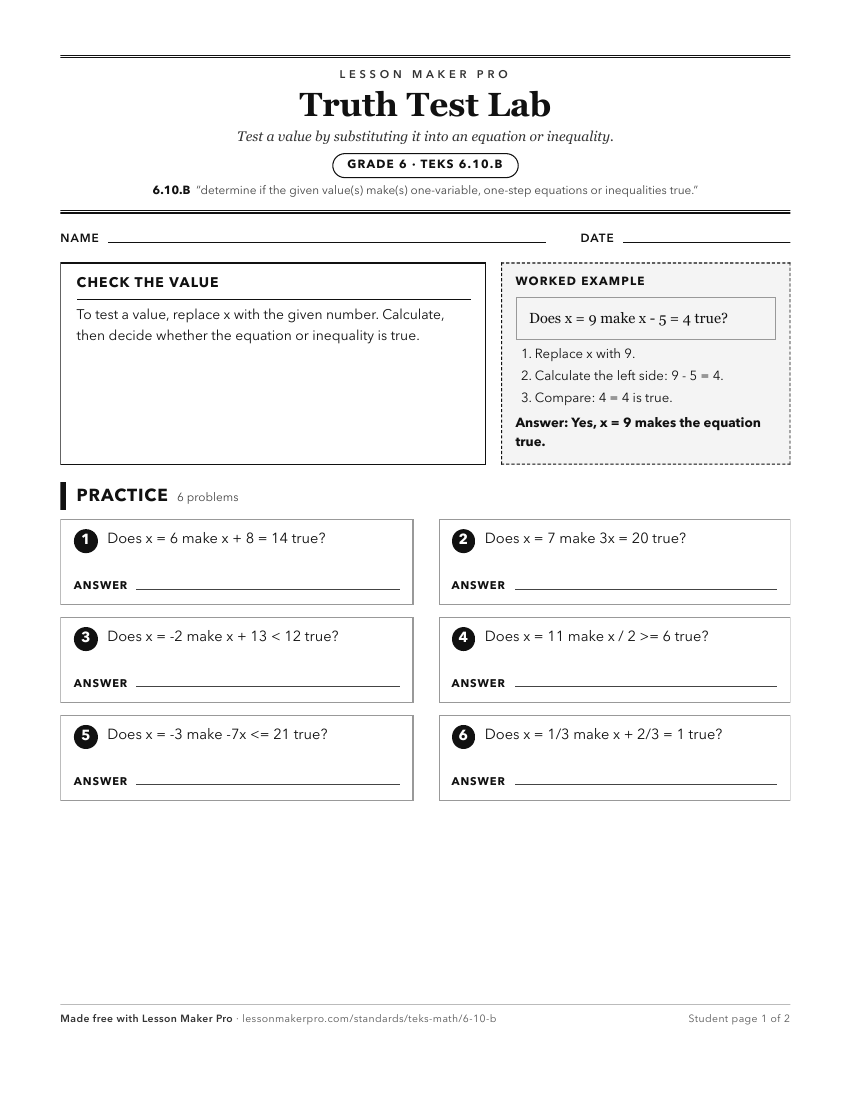
A ready-to-print activity worksheet aligned to 6.10.B, with an answer key for the teacher on its own page. No account needed.
PDF, US Letter, prints cleanly in black and white.
Download the worksheetKeep exploring
Related Standards
- 7.11.A
model and solve one-variable, two-step equations and inequalities
- 7.11.B
determine if the given value(s) make(s) one-variable, two-step equations and inequalities true
- 6.9.A
write one-variable, one-step equations and inequalities to represent constraints or conditions within problems
- 7.10.C
write a corresponding real-world problem given a one-variable, two-step equation or inequality
Turn this exact standard into a lesson
Grade, subject, topic, and the complete standard are prefilled. Create one free, no account needed.
Also for this standard:Make a WorksheetMake a QuizMake a Sub Lesson