TEKS ELAR 8.9.G
The Standard
explain the purpose of rhetorical devices such as analogy and juxtaposition and of logical fallacies such as bandwagon appeals and circular reasoning.
Texas Essential Knowledge and Skills for English Language Arts and Reading
Teacher's field guide
What This Standard Means
What Students Need to Do
- Students examine claims and explain how comparisons or sharp contrasts shape meaning. They also spot popularity claims and self-proving claims, then explain how each may influence a reader.
What Mastery Looks Like
- Given an advertisement, speech, or editorial, students identify the technique, cite the exact wording, and explain its intended effect. They also explain why faulty reasoning does not support a claim.
Common Misconceptions
- Students may call any comparison an analogy or treat juxtaposition as a contradiction. They may accept popularity as evidence and miss that circular reasoning simply repeats the claim.
How to Assess It
- Exit ticket: “Everyone uses BrightNote, so it must be the best app. Unlike its noisy rival, BrightNote opens quietly.” Name the fallacy and explain the contrast’s purpose.
Lesson moves
Ways to Teach It
Have groups sort printed claim cards into analogy, juxtaposition, bandwagon, or circular reasoning, then attach a sticky note explaining each writer’s purpose.
Ask students to write which technique would best persuade classmates to support a later start time, then explain their choice.
Play four corners with labeled techniques, read short examples aloud, and require students to move to a label and defend their answer.
Project two current advertisements, then have students mark popularity claims, repeated claims, comparisons, and contrasts before judging each ad’s reasoning.
Free download
Printable 8.9.G Worksheet
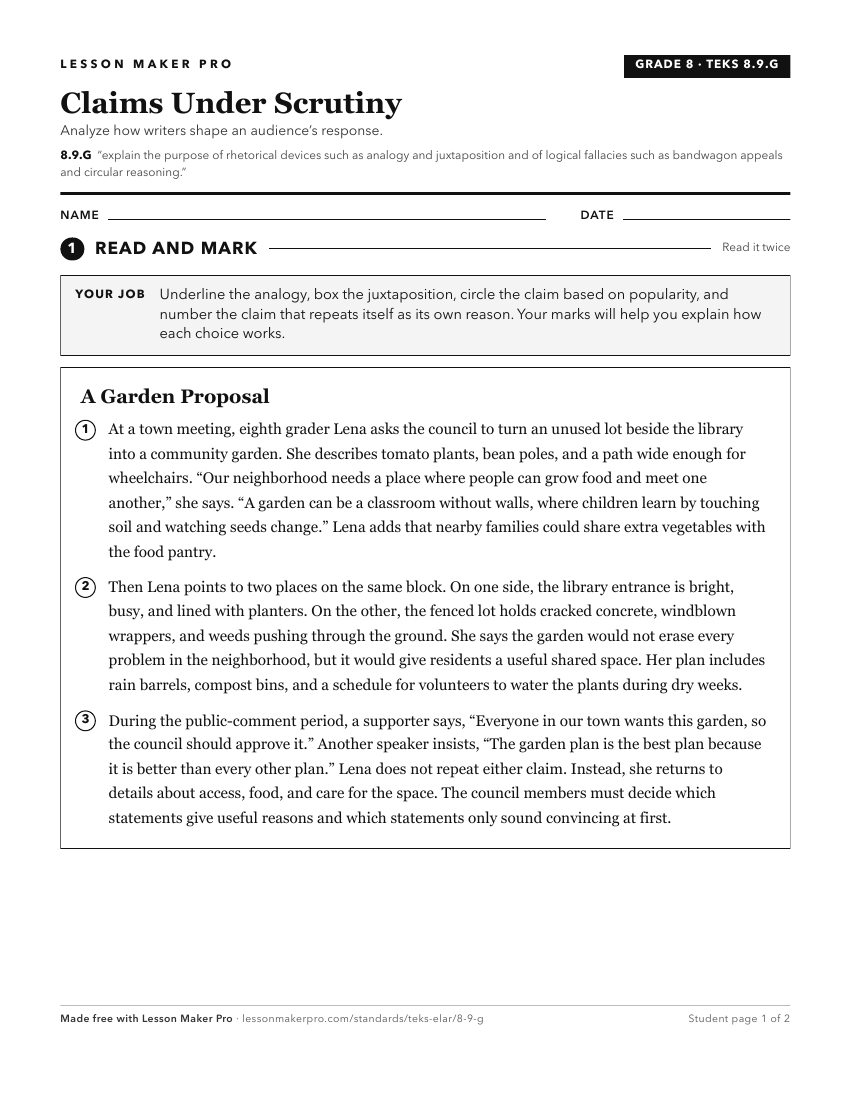
A ready-to-print activity worksheet aligned to 8.9.G, with an answer key for the teacher on its own page. No account needed.
PDF, US Letter, prints cleanly in black and white.
Download the worksheetKeep exploring
Related Standards
- 5.10.G
explain the purpose of hyperbole, stereotyping, and anecdote.
- 7.9.G
explain the purpose of rhetorical devices such as direct address and rhetorical questions and logical fallacies such as loaded language and sweeping generalizat...
- 8.12.H.ii
faulty reasoning such as bandwagon appeals, repetition, and loaded language;
- 6.9.G
explain the differences between rhetorical devices and logical fallacies.
Turn this exact standard into a lesson
Grade, subject, topic, and the complete standard are prefilled. Create one free, no account needed.
Also for this standard:Make a WorksheetMake a QuizMake a Sub Lesson