TEKS ELAR 7.9.G
The Standard
explain the purpose of rhetorical devices such as direct address and rhetorical questions and logical fallacies such as loaded language and sweeping generalizations
Texas Essential Knowledge and Skills for English Language Arts and Reading · Author's purpose and craft: listening, speaking, reading, writing, and thinking using multiple texts
Teacher's field guide
What This Standard Means
What Students Need to Do
- Students spot persuasive techniques and faulty reasoning in speeches, articles, advertisements, and arguments. They explain what each choice is meant to make the audience think, feel, or do.
What Mastery Looks Like
- Students correctly label a technique, quote the words that show it, and explain how it guides the audience. They can also rewrite misleading language as a fair, specific claim.
Common Misconceptions
- Students may label every question as rhetorical, even when the writer expects an answer. They may treat any strong wording as loaded language or accept one example as proof of a broad claim. They may name a technique without explaining its intended effect.
How to Assess It
- Use this exit ticket: “You know our school deserves better. Who could defend this ridiculous rule? Everyone hates it.” Identify each persuasive technique and explain its purpose.
Lesson moves
Ways to Teach It
Give pairs sentence strips from ads and speeches; students sort them by device, then attach a sticky note explaining each intended audience effect.
Ask, “When does persuasive wording become misleading?” Students cite one example, name the technique, and explain how wording steers the audience.
Play four-corners: read a statement, students move to the matching device label, then defend their choice using a word or phrase.
Students collect one advertisement or social post, highlight persuasive wording, identify any overgeneralization, and rewrite the message as a neutral claim.
Free download
Printable 7.9.G Worksheet
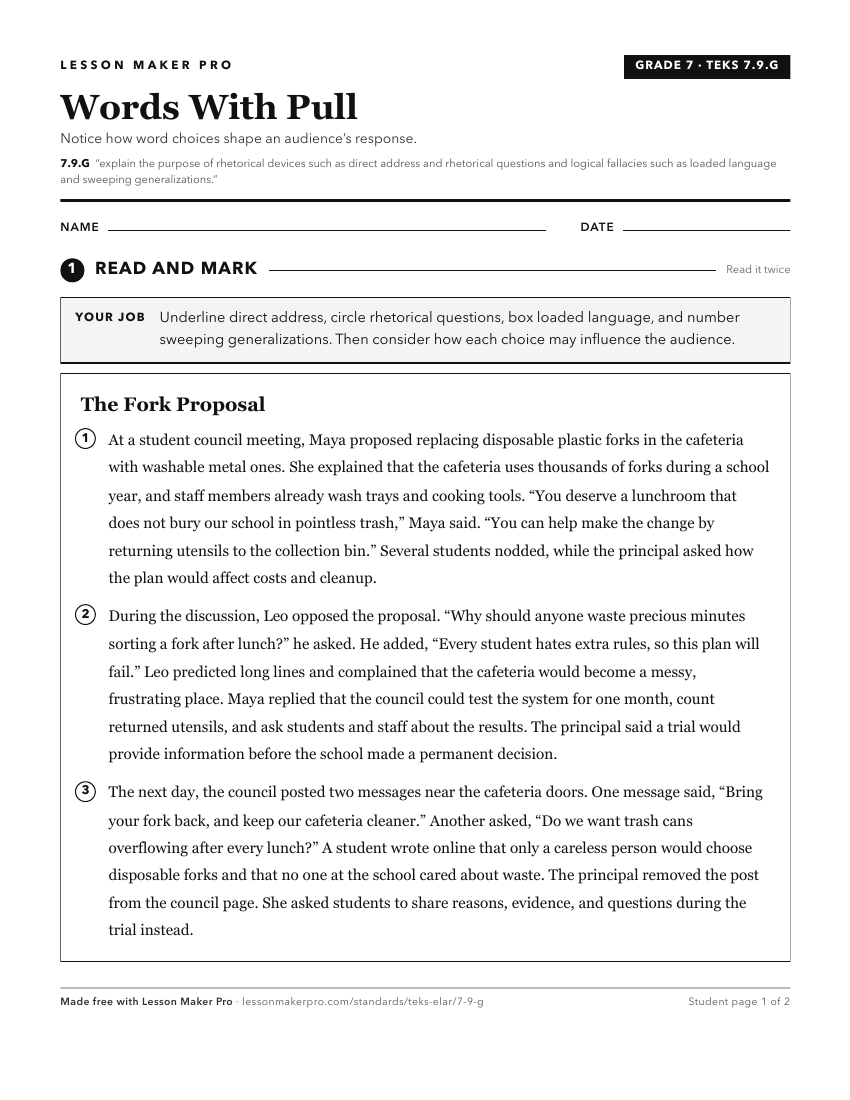
A ready-to-print activity worksheet aligned to 7.9.G, with an answer key for the teacher on its own page. No account needed.
PDF, US Letter, prints cleanly in black and white.
Download the worksheetKeep exploring
Related Standards
- 5.10.G
explain the purpose of hyperbole, stereotyping, and anecdote.
- 5.10.D
describe how the author's use of imagery, literal and figurative language such as simile and metaphor, and sound devices achieves specific purposes;
- 8.9.G
explain the purpose of rhetorical devices such as analogy and juxtaposition and of logical fallacies such as bandwagon appeals and circular reasoning.
- 6.9.G
explain the differences between rhetorical devices and logical fallacies.
Turn this exact standard into a lesson
Grade, subject, topic, and the complete standard are prefilled. Create one free, no account needed.
Also for this standard:Make a WorksheetMake a QuizMake a Sub Lesson