TEKS ELAR 5.10.G
The Standard
explain the purpose of hyperbole, stereotyping, and anecdote.
Texas Essential Knowledge and Skills for English Language Arts and Reading
Teacher's field guide
What This Standard Means
What Students Need to Do
- Students identify hyperbole, stereotypes, and anecdotes in texts. They explain why an author uses each one and how it affects the reader's response.
What Mastery Looks Like
- Students correctly identify each technique in a text. They explain how it shapes meaning, such as adding humor, supporting a point, or creating an unfair generalization.
Common Misconceptions
- Students may treat hyperbole as a lie instead of deliberate exaggeration. They may assume anecdotes prove a claim, or miss that stereotypes oversimplify groups and can cause harm.
How to Assess It
- Give students a short paragraph containing one of the three techniques. Ask them to name it and explain its purpose in one sentence using evidence.
Lesson moves
Ways to Teach It
Give groups three labeled cards and sample sentences, then have them match each sentence to a technique and explain the writer's purpose.
Ask students to write one hyperbole and one anecdote about homework, then discuss how each affects the audience differently.
Play Purpose Match by pairing technique cards with purpose cards, such as humor, emphasis, personal support, or oversimplified judgment.
Examine an advertisement or social media post and mark any exaggeration, personal story, or stereotype used to influence the audience.
Free download
Printable 5.10.G Worksheet
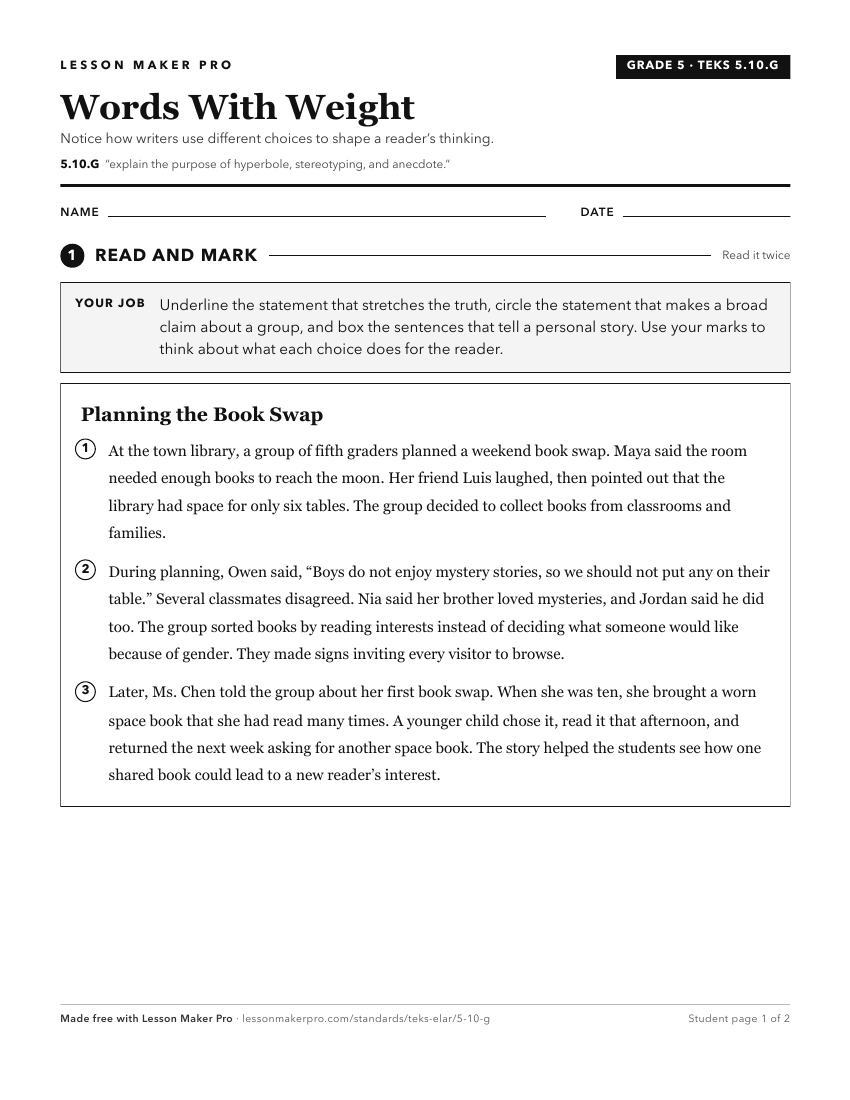
A ready-to-print activity worksheet aligned to 5.10.G, with an answer key for the teacher on its own page. No account needed.
PDF, US Letter, prints cleanly in black and white.
Download the worksheetKeep exploring
Related Standards
- 3.10.G
identify and explain the use of hyperbole.
- 6.12.H.ii
faulty reasoning such as hyperbole, emotional appeals, and stereotype;
- 8.9.G
explain the purpose of rhetorical devices such as analogy and juxtaposition and of logical fallacies such as bandwagon appeals and circular reasoning.
- 4.10.G
identify and explain the use of anecdote.
Turn this exact standard into a lesson
Grade, subject, topic, and the complete standard are prefilled. Create one free, no account needed.
Also for this standard:Make a WorksheetMake a QuizMake a Sub Lesson