TEKS ELAR 3.10.G
The Standard
identify and explain the use of hyperbole.
Texas Essential Knowledge and Skills for English Language Arts and Reading
Teacher's field guide
What This Standard Means
What Students Need to Do
- Students identify words or phrases that exaggerate beyond what is literally true. They explain the real meaning and why the writer chose the exaggeration.
What Mastery Looks Like
- Students can point out an exaggerated phrase in a sentence or short passage. They can explain the literal meaning and how the exaggeration adds humor, emphasis, or strong feeling.
Common Misconceptions
- Students may treat any strong description as hyperbole. They may also take an exaggeration literally or confuse it with a simile because both can make comparisons.
How to Assess It
- Give students the sentence, “My backpack weighs a ton.” Ask them to underline the hyperbole and explain what it really means.
Lesson moves
Ways to Teach It
Give pairs statement cards to sort into literal and exaggerated groups, then have them explain two choices.
Ask students to write about a terrible morning using one hyperbole, then explain the effect to a partner.
Play Hyperbole Detective by reading sentences aloud while students hold up H for hyperbole and L for literal language.
Study exaggerated phrases in advertisements, such as “the world’s best pizza,” and discuss what the advertiser really wants customers to believe.
Free download
Printable 3.10.G Worksheet
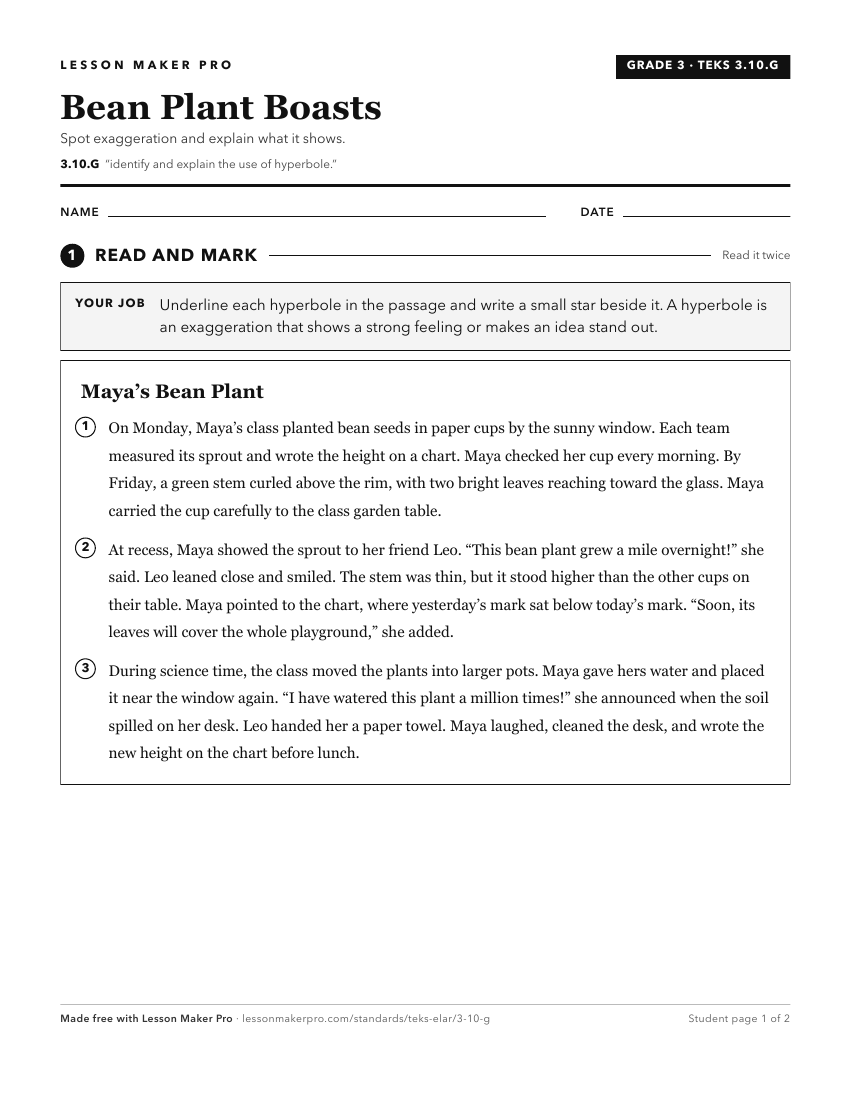
A ready-to-print activity worksheet aligned to 3.10.G, with an answer key for the teacher on its own page. No account needed.
PDF, US Letter, prints cleanly in black and white.
Download the worksheetKeep exploring
Related Standards
- 5.10.G
explain the purpose of hyperbole, stereotyping, and anecdote.
- 2.10.D
discuss the use of descriptive, literal, and figurative language;
- 6.9.D
describe how the author's use of figurative language such as metaphor and personification achieves specific purposes;
- 8.9.D
describe how the author's use of figurative language such as extended metaphor achieves specific purposes;
Turn this exact standard into a lesson
Grade, subject, topic, and the complete standard are prefilled. Create one free, no account needed.
Also for this standard:Make a WorksheetMake a QuizMake a Sub Lesson