TEKS ELAR 6.9.G
The Standard
explain the differences between rhetorical devices and logical fallacies.
Texas Essential Knowledge and Skills for English Language Arts and Reading
Teacher's field guide
What This Standard Means
What Students Need to Do
- Students examine persuasive statements and identify how the language influences an audience. They decide whether the reasoning is sound or flawed and support their judgment with details.
What Mastery Looks Like
- Students accurately identify techniques such as repetition and rhetorical questions, as well as fallacies such as bandwagon and false dilemma. They explain that an argument can include both.
Common Misconceptions
- Students may think every persuasive technique is dishonest or illogical. They may also label any weak argument as a fallacy without naming the faulty reasoning.
How to Assess It
- Use two examples: “Protect the park, protect the trees, protect our future” and “Everyone supports the rule, so it must be right.” Students label each and explain their reasoning.
Lesson moves
Ways to Teach It
Give pairs argument cards to sort into rhetorical device, logical fallacy, both, or neither, then require a written reason for each choice.
Have students write whether a persuasive sentence can be effective without sound logic, using one example to defend their position.
Play a four-corners game using labels device, fallacy, both, and neither, with students moving after each projected example.
Analyze a school advertisement or public service poster, marking persuasive wording in blue and faulty reasoning in red.
Free download
Printable 6.9.G Worksheet
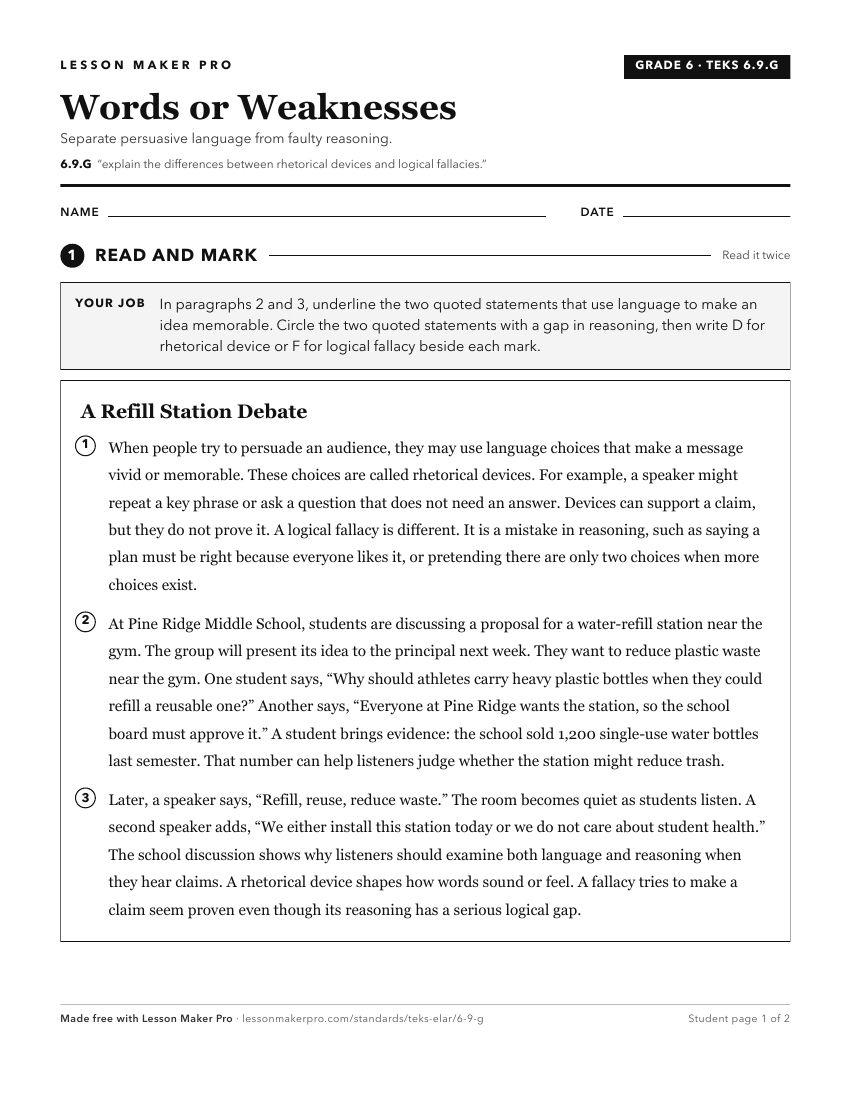
A ready-to-print activity worksheet aligned to 6.9.G, with an answer key for the teacher on its own page. No account needed.
PDF, US Letter, prints cleanly in black and white.
Download the worksheetKeep exploring
Related Standards
- 7.9.G
explain the purpose of rhetorical devices such as direct address and rhetorical questions and logical fallacies such as loaded language and sweeping generalizat...
- 8.9.E
identify and analyze the use of literary devices, including multiple points of view and irony;
- 5.9.B
explain the use of sound devices and figurative language and distinguish between the poet and the speaker in poems across a variety of poetic forms;
- 8.9.G
explain the purpose of rhetorical devices such as analogy and juxtaposition and of logical fallacies such as bandwagon appeals and circular reasoning.
Turn this exact standard into a lesson
Grade, subject, topic, and the complete standard are prefilled. Create one free, no account needed.
Also for this standard:Make a WorksheetMake a QuizMake a Sub Lesson