TEKS ELAR 8.12.H.ii
The Standard
faulty reasoning such as bandwagon appeals, repetition, and loaded language
Texas Essential Knowledge and Skills for English Language Arts and Reading · The student engages in both short-term and sustained recursive inquiry processes for a variety of purposes.
Teacher's field guide
What This Standard Means
What Students Need to Do
- Students examine sources for claims that rely on popularity, repeated statements, or emotionally charged wording instead of evidence. They explain how these tactics can mislead an audience.
What Mastery Looks Like
- Students accurately label each tactic in an article, advertisement, or speech. They explain how the tactic influences readers and separate persuasive wording from sound evidence.
Common Misconceptions
- Students may treat popularity as proof or assume a repeated claim becomes more reliable. They may also label any strong word as misleading without considering context or evidence.
How to Assess It
- Exit ticket: “Everyone knows this ridiculous rule must go. It is unfair, unfair, unfair.” Identify three persuasion tactics and explain why they are not evidence.
Lesson moves
Ways to Teach It
Give pairs printed ads and three highlighters to mark popularity claims, repeated phrases, and emotionally charged words, then identify missing evidence.
Discuss this prompt: When does persuasive wording become misleading, and what evidence would make the claim more trustworthy?
Students sort claim cards into evidence, popularity appeal, repeated assertion, or emotional wording, then defend one disputed choice.
Students examine three teacher-selected influencer posts and rewrite one unsupported claim using facts from a reliable source.
Free download
Printable 8.12.H.ii Worksheet
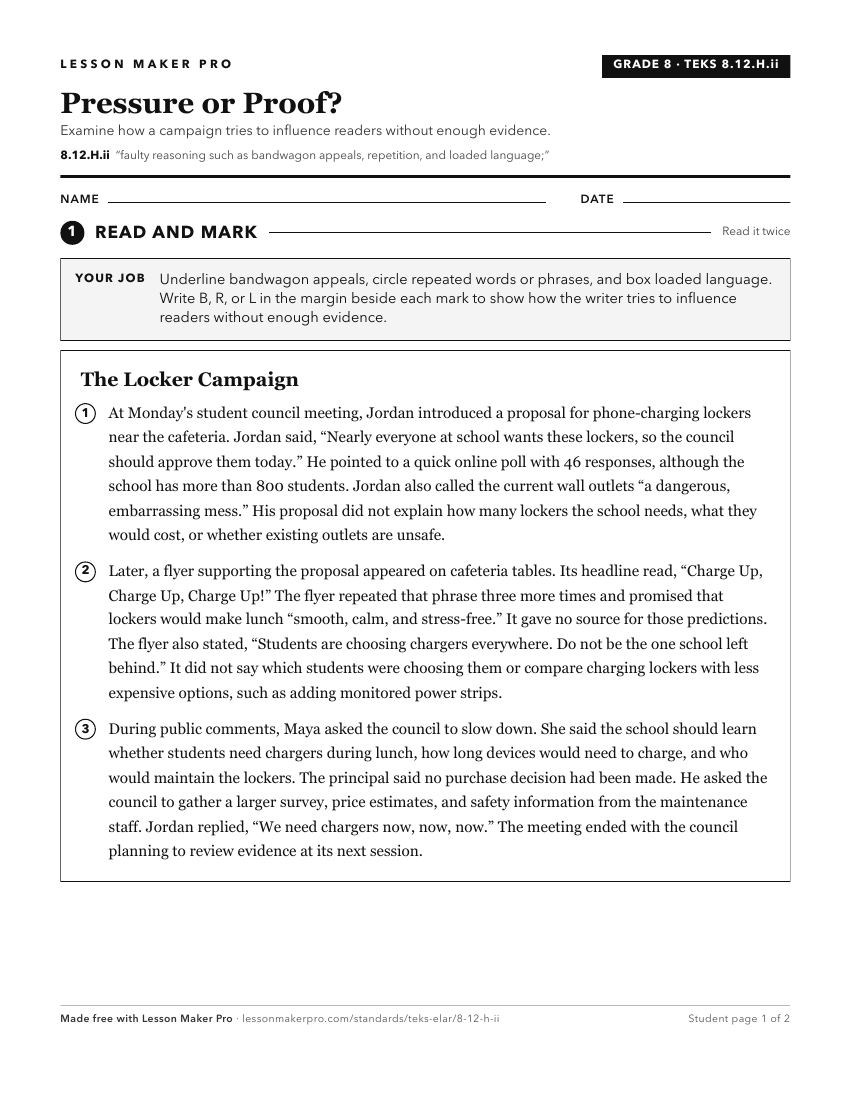
A ready-to-print activity worksheet aligned to 8.12.H.ii, with an answer key for the teacher on its own page. No account needed.
PDF, US Letter, prints cleanly in black and white.
Download the worksheetKeep exploring
Related Standards
- 6.12.H.ii
faulty reasoning such as hyperbole, emotional appeals, and stereotype;
- 7.9.G
explain the purpose of rhetorical devices such as direct address and rhetorical questions and logical fallacies such as loaded language and sweeping generalizat...
- 8.9.G
explain the purpose of rhetorical devices such as analogy and juxtaposition and of logical fallacies such as bandwagon appeals and circular reasoning.
- 7.12.H
examine sources for: reliability, credibility, and bias, and faulty reasoning such as hyperbole, emotional appeals, and stereotype
Turn this exact standard into a lesson
Grade, subject, topic, and the complete standard are prefilled. Create one free, no account needed.
Also for this standard:Make a WorksheetMake a QuizMake a Sub Lesson