TEKS ELAR 7.8
Knowledge and Skills Statement (Standard Cluster)
Genres. The student recognizes and analyzes genre-specific characteristics, structures, and purposes within and across increasingly complex traditional, contemporary, classical, and diverse texts
Texas Essential Knowledge and Skills for English Language Arts and Reading
Cluster contents
Student Expectations in This Statement
7.8 is a knowledge and skills statement. These are the student expectations under it.
- 7.8.A
demonstrate knowledge of literary genres such as realistic fiction, adventure stories, historical fiction, mysteries, humor, myths, fantasy, and science fiction
- 7.8.B
analyze the effect of rhyme scheme, meter, and graphical elements such as punctuation and capitalization in poems across a variety of poetic forms
- 7.8.C
analyze how playwrights develop characters through dialogue and staging
- 7.8.D
analyze characteristics and structural elements of informational text, including: the controlling idea or thesis with supporting evidence, features such as refe...
- 7.8.E
analyze characteristics and structures of argumentative text by: identifying the claim, explaining how the author uses various types of evidence and considerati...
- 7.8.F
analyze characteristics of multimodal and digital texts
Teacher's field guide
What This Cluster Means
What Students Need to Do
- Students identify a text’s genre from its features, not just its topic. They explain how poetic form, dramatic choices, informational organization, and argument structure shape meaning. They also examine how images, audio, links, and layout work with words in digital texts.
What Mastery Looks Like
- Given unfamiliar texts, students identify the genre and cite two defining features. They trace how evidence supports a thesis or claim and identify the intended audience. They explain the effect of a poetry technique, stage direction, or digital feature using text evidence.
Common Misconceptions
- Students often name a genre from its setting alone, such as calling every story set in the past historical fiction. They confuse topic with thesis and opinion with claim. They may identify rhyme, stage directions, images, or headings without explaining their effect.
How to Assess It
- Give students a one-page digital argument. Ask them to state its claim, name one evidence type, identify the audience, and explain how one visual or layout feature helps readers.
Lesson moves
Ways to Teach It
Give groups twelve excerpt cards; students sort them by genre, label two clues on each, then defend one difficult placement.
Compare a poem and play excerpt: Which author choice most shapes the reader’s response, and what exact words prove it?
Run a genre clue relay: teams match feature cards to excerpts, then earn a point only after explaining each match.
Analyze a news site page for thesis, evidence, audience, headings, links, images, and how those features guide readers.
Free download
Printable 7.8 Worksheet
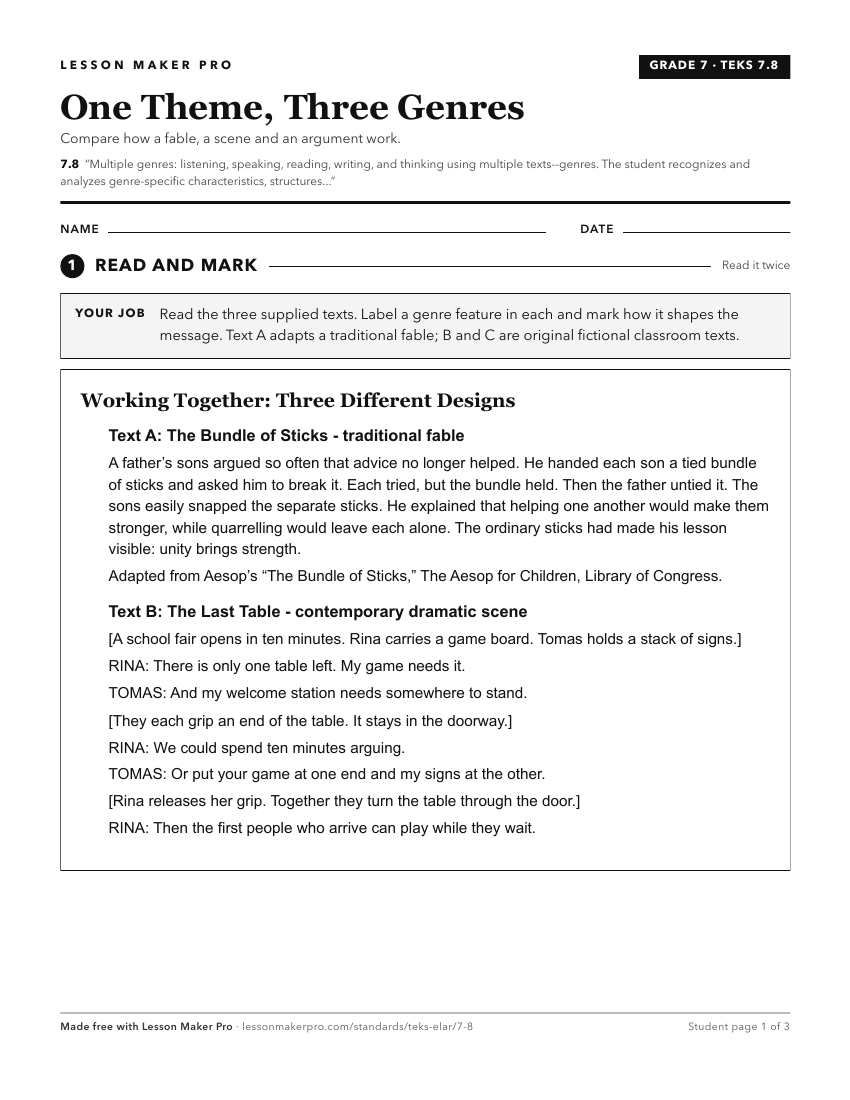
A ready-to-print activity worksheet aligned to 7.8, with an answer key for the teacher on its own page. No account needed.
PDF, US Letter, prints cleanly in black and white.
Download the worksheetKeep exploring
Related Standards
- 2.9
The student recognizes and analyzes genre-specific characteristics, structures, and purposes within and across increasingly complex traditional, contemporary, c...
- 8.8
The student recognizes and analyzes genre-specific characteristics, structures, and purposes within and across increasingly complex traditional, contemporary, c...
- 5.9
The student recognizes and analyzes genre-specific characteristics, structures, and purposes within and across increasingly complex traditional, contemporary, c...
- 6.8
The student recognizes and analyzes genre-specific characteristics, structures, and purposes within and across increasingly complex traditional, contemporary, c...
Turn this cluster into a lesson
Grade, subject, topic, and the complete cluster are prefilled. Create one free, no account needed.
Also for this cluster:Make a WorksheetMake a QuizMake a Sub Lesson